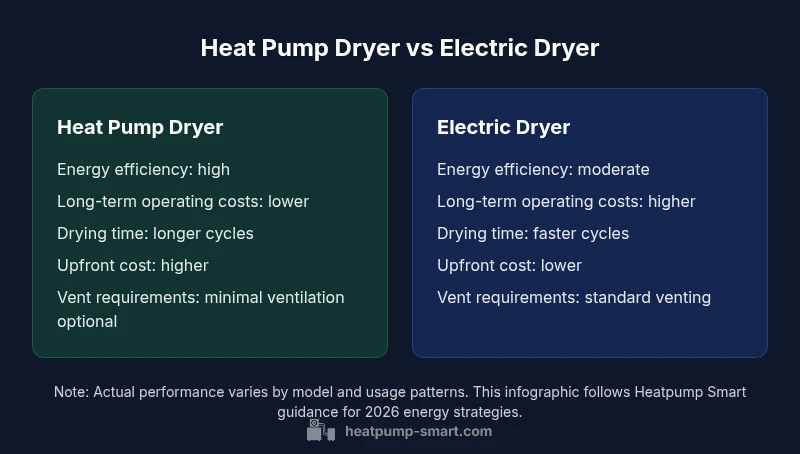
Heat Pump Dryer vs Electric Dryer: A 2026 Comparison
Compare heat pump dryers and electric dryers to understand energy efficiency, long-term savings, and performance. Learn which option suits homeowners, builders, and property managers in 2026.


According to Heatpump Smart, choosing between a heat pump dryer and an electric dryer comes down to upfront cost versus long-term energy savings. Heat pump dryers use a closed-cycle heat transfer, delivering higher efficiency and lower operating costs, but often require more space and a higher initial price. For households prioritizing ongoing savings, the heat pump option is typically the smarter long-term bet.
Energy efficiency foundations for heat pump dryers vs electric dryers
Across residential laundry options, the key performance delta between heat pump dryers and electric dryers is energy efficiency. Heat pump dryers rescue energy by recapturing heat rather than venting it as older electric models do. Heatpump Smart emphasizes that this closed-loop approach can dramatically reduce energy use over the life of a unit, especially in climates with moderate to cool outdoor temperatures where ambient heat can be recovered. In practice, the difference isn’t just about kilowatt hours; it’s also about load size, cycle choices, and the dryness level you expect.
Heat pump dryers operate on a vapor-compression cycle that transfers heat from inside the drum to re-condense water vapor. This means the compressor, condenser, and fan work together to extract moisture at lower temperatures, minimizing fabric wear and energy waste. Electric dryers typically rely on resistive heating elements that generate heat quickly but lose more energy as heat escapes through vents. The Heatpump Smart team notes that the practical implications depend on insulation, drum size, and user habits. While upfront prices are higher, long-term electricity bills tend to be lower for heat pumps, particularly when you run several loads a week.
Efficiency mechanics: how heat pumps work versus traditional electric coils
The core efficiency advantage of heat pump technology lies in heat recovery. Instead of generating heat anew for every cycle, heat pumps extract ambient heat, transfer it to the drum, and then reclaim latent energy as moisture leaves through condensation. This cycle reduces ambient heat loss and lowers energy usage per load. Electric dryers, by contrast, convert electricity into heat with resistive coils that expend energy as heat that is often lost to the room or vented outside. In practice, this means heat pump models deliver better energy efficiency ratings under typical residential usage, even when cycles take a bit longer.
Operating costs and long-term savings explained
Estimating operating costs requires a closer look at usage patterns, local electricity prices, and unit efficiency, but general trends are clear. Heat pump dryers tend to consume less electricity per cycle than electric dryers, which translates to lower costs over many loads per week. The potential savings grow with load frequency and load size, making heat pumps attractive to households with high laundry demand or tight energy budgets. The higher upfront cost may be offset within a few years for many users, especially when paired with energy-conscious habits like full-load operation and lower heat settings. Heatpump Smart notes that regional price variations will influence the break-even point, so homeowners should run a local comparison before upgrading.
Drying performance, cycles, and user experience
Drying performance can differ between technologies. Electric dryers often deliver rapid, powerful drying for single large loads, which some users value when time is critical. Heat pump models may take longer per cycle due to their lower heat and gentle drying approach, but they tend to protect fabrics better and reduce over-drying, which also saves energy. For families with mixed laundry needs, selecting a model with a broad cycle library and adjustable dryness levels is important. In practice, users should balance cycle duration with energy savings to optimize outcomes. Heatpump Smart recommends testing a few loads to calibrate expectations about dry times and fabric care.
Installation space, venting, and footprint considerations
Heat pump dryers are often larger or similarly sized to electric units, but the absence of regular venting can free up wall space and simplify installation. Many heat pump models are designed to fit in standard laundry rooms and may offer rear or side vent options for improved air handling. Electric dryers typically require appropriate venting to exhaust hot air, which can constrain placement and require ductwork. For renovations or new builds, check space dimensions, plumbing, electrical service, and any required clearances around the unit. Heatpump Smart highlights that a compact footprint and energy-efficient operation can make heat pump models a smart choice for smaller spaces or energy-conscious homes.
Upfront costs, financing, and value proposition
Upfront costs for heat pump dryers are generally higher than for electric models, reflecting the advanced technology and materials used. Financing options, tax incentives, or energy-efficiency rebates can help offset the initial price premium. Beyond sticker price, the value proposition rests on long-term energy savings, fabric care, and reduced venting requirements. Builders and property managers should include a total cost of ownership analysis in early procurement decisions, considering expected laundry load, maintenance needs, and expected utility rate changes over the equipment’s life. Heatpump Smart emphasizes evaluating reliability and service options to protect long-term value.
Reliability, maintenance, and longevity considerations
Heat pump dryers typically have fewer moving parts than electric dryers that rely heavily on heating elements and motors; however, the refrigerant loop introduces annual maintenance requirements to preserve efficiency. Regular cleaning of lint filters, condenser coils, and air pathways helps sustain performance and reduce energy use. Electric dryers require less frequent maintenance but may incur higher repair costs if heating elements or drum seals fail. Both types benefit from high-quality filters and a robust warranty. Heatpump Smart advises owners to schedule routine checks, particularly in homes with extreme humidity or high dust levels.
Climate suitability and usage patterns: where each shines
Climate matters when choosing between heat pump and electric dryers. In humid or cooler climates, heat recovery in heat pump models yields more pronounced energy savings, while vented electric dryers may lose heat more readily in less favorable conditions. For households with frequent, large loads or allergy considerations, heat pump dryers often offer gentler drying and less lint compared with traditional electric dryers. Conversely, in locations with very high electricity costs or limited access to service networks, electric dryers may be favored for their lower upfront cost and simpler maintenance. Heatpump Smart notes that regional energy profiles should guide the final decision.
Decision framework and practical recommendations for homeowners
To decide between heat pump and electric dryers, start with a load assessment: estimate weekly laundry volumes, typical cycle choices, and preferred dryness level. Compute a rough total cost of ownership over the appliance’s expected life, including energy usage, maintenance, and potential rebates. If long-term energy savings and fabric care are priorities, a heat pump dryer is usually the better choice. If upfront budget constraints are tight or drying time is the main concern, an electric dryer may still be appropriate. A staged upgrade, replacing an older unit first, can also help distribute costs while capturing energy savings over time.
Comparison
| Feature | Heat pump dryer | Electric dryer |
|---|---|---|
| Energy efficiency | Very high efficiency due to heat recovery | Moderate efficiency; vented/coil-based heating |
| Operating costs (long-term) | Lower due to reduced energy use | Higher due to greater energy consumption per cycle |
| Drying time | Longer cycles on average | Faster cycles for many loads |
| Upfront cost | Higher purchase price | Lower purchase price |
| Vent/installation | Can operate with flexible venting or ventless options | Typically requires venting to outside |
| Maintenance | Condenser coils and filters require periodic cleaning | Simpler maintenance; heating elements are durable |
| Environmental impact | Lower emissions per load due to energy efficiency | Higher emissions per load due to higher energy use |
| Fabric care | Gentler drying temperatures reduce wear | Faster drying can increase wear if over-dried |
Advantages
- High energy efficiency reduces utility bills over time
- Lower carbon footprint per load
- Gentle drying helps preserve fabrics
- Less requirement for venting in some models
Disadvantages
- Higher upfront purchase price
- Longer cycle times for typical loads
- Limited selection in some markets
- Potential maintenance for refrigerant loop
Heat pump dryer generally offers better long-term value for most homes.
Choose heat pump if you want lower operating costs and better fabric care. If upfront cost matters more or you require the fastest dry times, an electric dryer may be more suitable.
Your Questions Answered
What is the main difference between a heat pump dryer and an electric dryer?
The core difference is energy approach: heat pump dryers reuse heat to dry clothes, delivering higher efficiency and lower long-term costs, while electric dryers rely on resistive heating with venting that can waste more energy. Drying performance and cycle times vary by model and load.
Heat pump dryers reuse heat and save energy, while electric dryers heat with coils and vent warm air outside. The choice affects energy bills and cycle times depending on loads.
Do heat pump dryers take longer to dry clothes than electric dryers?
Yes, heat pump dryers often require longer cycles to reach the same dryness level because they operate at lower temperatures. This trade-off is balanced by significantly lower energy use per cycle and fabrics that look newer longer.
Heat pump dryers may take longer per cycle, but they use less energy and can be gentler on fabrics.
Are heat pump dryers more expensive upfront than electric dryers?
Generally yes. Heat pump models cost more at purchase due to the refrigeration components and advanced controls. The higher price can be offset by energy savings and rebates over the appliance’s life.
Upfront costs are higher for heat pumps, but energy savings can offset this over time.
Can heat pump dryers work in cold climates?
Yes, heat pump dryers perform well in a variety of climates, including cooler conditions, because they recover heat efficiently and do not depend on ambient heat as much as some electric models.
They work well in cold climates and often save more energy there.
Is upgrading to a heat pump dryer worth it if I already own an electric dryer?
If you run multiple loads weekly and want lower energy costs and gentler drying, upgrading is usually worthwhile. If your budget is tight and you need rapid cycles, an electric dryer may still be reasonable.
Upgrading is typically worth it for energy savings, unless upfront cost is your main constraint.
Top Takeaways
- Assess total cost of ownership, not just sticker price
- Prioritize heat pump if energy savings and fabric care matter
- Consider climate, load patterns, and space constraints
- Plan for maintenance and service accessibility
- Explore rebates or incentives to offset upfront costs