Fujitsu heat pump vs Daikin: A Practical Comparison
An analytical comparison of Fujitsu and Daikin heat pumps, covering climate performance, efficiency, installation, and maintenance to help homeowners choose the best all-season solution.


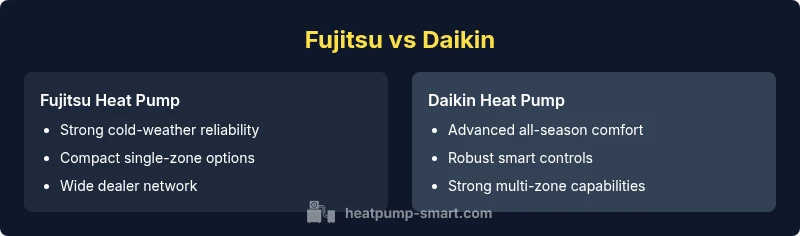
Fujitsu heat pump vs Daikin: both brands deliver high-efficiency air-source systems, but the best choice depends on climate, budget, and project size. Fujitsu often shines in colder climates with reliable cold-weather performance, while Daikin emphasizes all-season comfort and sophisticated controls. For most homeowners, the decision hinges on installation fit, local support, and which model matches your home’s energy goals.
Fujitsu vs Daikin: Market Context and What Matters
In the competitive space of heat pumps, Fujitsu and Daikin sit near the top of the list for homeowners, builders, and property managers. The fujitsu heat pump vs daikin decision isn’t about a single feature but a collection of factors: climate suitability, efficiency across seasons, installation complexity, and the strength of local dealer networks. According to Heatpump Smart, the practical way to compare is to match model families to real-world use — not just brand reputation. For most homes, the best choice balances cold-weather reliability, intuitive controls, and service availability in your region. The goal here is to provide a grounded, objective framework you can apply to your own site assessment and permitting process.
As you read, keep in mind that the two brands often compete across multiple niches—single-zone and multi-zone configurations, compact indoor units, and full-house systems. This article focuses on the core decision factors that tend to drive long-term satisfaction rather than marketing claims. By emphasizing climate data, efficiency considerations, and installation realities, you’ll be better prepared to navigate the fujitsu heat pump vs daikin debate.
Comparison
| Feature | Fujitsu heat pump | Daikin heat pump |
|---|---|---|
| Climate performance and cold-weather reliability | Strong cold-weather performance with dependable operation at low outdoor temperatures | Excellent all-season performance with advanced defrost and stability features |
| Energy efficiency emphasis | Traditionally strong cold-climate efficiency with robust inverter control | Broad efficiency emphasis with advanced controls for varied climates |
| Smart features and app controls | Solid app integration with zoning options on select models | Highly developed smart controls and smoother integration with third-party ecosystems |
| Installation considerations | Flexible configurations; dealer networks with emphasis on cold-climate installs | Broad dealer network with strong multi-zone and retrofit capabilities |
| Warranty and service network | Warranty terms vary by model; service centers widely available in many regions | Warranty terms vary by model; strong regional service networks |
| Best for | Cold-climate homes, retrofits, and compact spaces | All-season comfort, tech-forward homes, and larger installations |
Advantages
- Wide product range and global service presence
- Competitive options for cold climates with reliable performance
- Strong smart control ecosystems and zoning capabilities
- Potential for high ROI with energy savings when properly installed
- Good dealer support and regional availability
Disadvantages
- Installation cost and complexity can vary by model and home layout
- Upfront costs can be high for premium models
- Warranty terms vary by model and region
- Performance depends on correct sizing and professional commissioning
Neither brand is universally superior; choose Fujitsu or Daikin based on climate, installation fit, and service availability.
The best choice depends on your climate demands and installation context. If you live in a colder region, Fujitsu may offer more reliable cold-weather performance; for all-season comfort and advanced controls, Daikin often provides a compelling option. Always verify local dealer support and get a proper load/commissioning assessment before deciding.
Your Questions Answered
What is the main difference between Fujitsu and Daikin heat pumps?
The key differences lie in climate performance and control features. Fujitsu often emphasizes reliable cold-weather operation and compact configurations, while Daikin highlights all-season comfort with advanced controls and wider system integration. Both offer strong energy efficiency when sized and installed correctly.
The choice usually comes down to climate needs and how you want to control the system.
Which brand performs better in cold climates?
Both brands perform well, but Fujitsu has a reputation for strong cold-weather reliability in many models. A proper installation with a heat load calculation is essential to maximize performance in cold seasons.
Fujitsu tends to excel in cold conditions when properly sized.
Are Fujitsu and Daikin compatible with smart home systems?
Yes, many models from both brands offer app control and integration with common smart-home ecosystems. Features vary by model, so check compatibility with your preferred platform and whether you want voice assistant support.
Most models play nicely with modern smart homes, but verify each model’s compatibility.
What factors affect installation cost for Fujitsu vs Daikin?
Costs depend on system size, number of indoor units, zoning requirements, ducting (if applicable), and labor. Regional permitting and tax credits can also influence total expense. Get multiple quotes for an apples-to-apples comparison.
Size and installation complexity drive the cost more than the brand.
How do warranty terms typically compare for these brands?
Warranty terms vary by model and region. Both brands offer substantial coverage on major components, but always confirm the exact terms with the installer and manufacturer for your chosen model.
Warranty length and coverage depend on the specific model and region.
Is it better to buy a single-zone vs multi-zone system from Fujitsu or Daikin?
Multi-zone configurations offer better zoning and comfort for larger homes, while single-zone systems can be cost-effective for smaller spaces. Both brands provide viable options; selection should align with home layout and heating/cooling needs.
Multi-zone setups give you more precise temperature control.
Top Takeaways
- Prioritize climate and seasonal patterns when evaluating fujitsu heat pump vs daikin
- Compare model families rather than brand names to match home needs
- Assess dealer support and local service networks before purchase
- Evaluate smart features and integration with existing systems
- Factor installation costs and potential rebates into the ROI