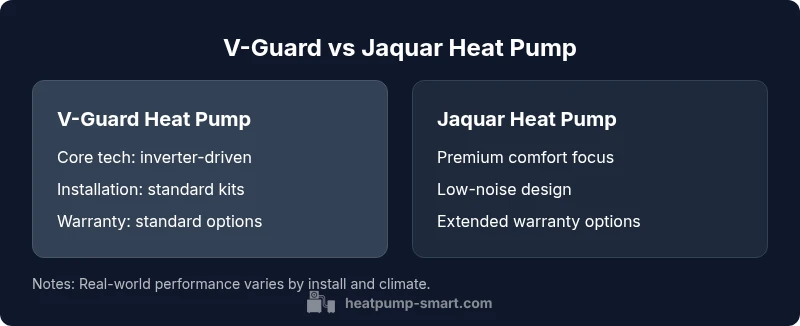
V Guard vs Jaquar Heat Pump: An Analytical Comparison
Compare V-Guard and Jaquar heat pumps across efficiency, installation, warranty, and value to help homeowners, builders, and property managers decide which brand fits their project.


According to Heatpump Smart, the v guard vs jaquar heat pump comparison reveals that both brands deliver reliable air-source systems with decent energy performance, but they cater to different priorities. V-Guard often emphasizes robust electrical safety and value-oriented components, while Jaquar tends to prioritize comfort, quieter operation, and stronger warranty options. Your decision should hinge on installation context, budget, climate, and long-term service expectations.
Brand Landscape and Positioning
The heat pump market in many regions features two widely recognized brands that homeowners encounter when evaluating v guard vs jaquar heat pump: V-Guard and Jaquar. V-Guard has built a broad reputation around dependable electrical components, robust build, and a network that emphasizes value and accessibility. Jaquar, on the other hand, leans toward a premium comfort experience, refined acoustics, and a warranty program that appeals to customers seeking performance and peace of mind. For property managers and builders, understanding how these brands position their products helps in selecting units that align with project budgets and maintenance plans. Heatpump Smart notes that the choice between these brands should start from practical constraints—space, climate, and service coverage—before weighing feature sets.
In practice, both brands offer air-source heat pumps capable of space heating and cooling, but there can be differences in model families, control interfaces, and installation compatibility. The v guard vs jaquar heat pump question often boils down to which brand ecosystem aligns with a property's electrical layout and the desired level of on-site support. As projects scale, the reliability of the local service network and the ability to source parts quickly can become deciding factors—not just the headline efficiency numbers. The Heatpump Smart team emphasizes planning around lifecycle costs and serviceability to ensure long-term performance.
Overall, the two brands serve overlapping audiences but prioritize different aspects of value creation. This context helps decode where each unit might excel in real-world applications, from compact apartments to larger, retrofitted homes. When homeowners chart a path, the brand landscape becomes a guide for aligning product selection with installation realities and long-term maintenance expectations.
Core Technologies and How They Impact Performance
A core distinction in the v guard vs jaquar heat pump discussion often centers on technology strategy rather than flashy feature lists. Both brands rely on inverter-driven compressors to modulate output and improve part-load efficiency, but their engineering emphasis can diverge. V-Guard typically prioritizes robust electrical interfaces, durable components, and straightforward control logic, which translates into dependable performance in variable temperatures and less complex installations. Jaquar, meanwhile, often emphasizes refined indoor comfort, quieter operation, and more advanced control algorithms that optimize user experience and energy management. The practical impact is that v guard models may be easier to service and mount within standard home electrical layouts, while Jaquar units may deliver smoother operation at low loads and provide richer feature sets through apps and integration.
Another factor is heat exchanger design and refrigerant management. While both brands aim to balance reliability with efficiency, Jaquar's products may utilize more sophisticated control schemas to optimize defrost cycles, compressor cycling, and zoning logic in premium configurations. The v guard lineup can offer strong baseline efficiency with robust safety protections that appeal to homeowners prioritizing durability and straightforward performance. In climate zones with extended heating seasons, the ability to maintain comfortable indoor temperatures with predictable cycling becomes a meaningful differentiator for either brand. The key takeaway is to compare specific model families within each brand rather than the brand as a single monolith.
From a systems-thinking perspective, integration with existing thermostats, smart home hubs, and building management systems plays a crucial role in how these technologies translate to real-world comfort. Both brands provide connection options, but the depth of integration and ongoing software support can differ. For builders and property managers, selecting models with clear upgrade paths and widely available replacement parts reduces risk over time. The result is a nuanced picture: core hardware feasibility matters alongside software and control ecosystems to deliver stable, comfortable climate control.
Efficiency and Real-World Performance
When evaluating the v guard vs jaquar heat pump in terms of efficiency and real-world performance, designers and homeowners should distinguish between label metrics and sustained comfort. Inverter-driven systems inherently react to changing loads, which helps maintain comfortable temperatures without abrupt on/off cycling. However, the efficiency that a household experiences in everyday use depends on several context factors: the insulation quality of the building envelope, the climate profile, the size of the living space, and how the system is operated across seasons.
Heatpump Smart analysis shows that no single brand outperforms the other in every condition; instead, performance will hinge on proper sizing, installation, and setup. V-Guard’s value-oriented approach often yields excellent performance in typical residential environments with standard insulation and moderate occupancy. Jaquar’s emphasis on premium comfort and fine-tuned control may offer smoother performance in homes where occupants demand quiet operation and precise temperature stability. In practical terms, the difference may appear as marginal comfort perception rather than stark energy-number gaps, especially when both systems are correctly installed and calibrated.
Homeowners should consider commissioning a formal load calculation and a performance check after the first heating season. This helps validate that the chosen unit meets expectations for efficiency and reliability. In addition, ensure that any added thermostats or zoning strategies are compatible with the unit’s control architecture. The broader message is that the best efficiency outcome comes from alignment among installation quality, climate, and user behavior—more so than brand alone.
Installation, Sizing, and System Compatibility
A thorough comparison of v guard vs jaquar heat pump must address how each brand manages sizing and installation complexity. Sizing a heat pump correctly is crucial to ensure adequate heating in winter and cooling in summer, while avoiding short cycling that wastes energy and wears components. V-Guard’s product line is often praised for straightforward installation, widely available replacement parts, and compatibility with common electrical panels found in mid-range homes. This breadth can translate to faster installs and easier service calls, particularly in markets with a large number of existing V-Guard components in homes.
Jaquar’s line often emphasizes a more premium installation path, with a focus on quiet operation and refined indoor-head unit aesthetics. In practice, this can mean that some Jaquar configurations may benefit from specialized installers who understand premium ducting, acoustic requirements, and advanced control integration. For property managers, this might translate into longer lead times for high-end configurations but improved long-term comfort and perceived quality. Regardless of brand, confirm the following before a purchase:
- Proper load calculation by a qualified technician.
- Confirmed compatibility with existing ducts or space constraints.
- Available service coverage and trained technicians in your area.
- Clear understanding of warranty terms and on-site support. The central point is that installation quality and correct sizing trump brand name when it comes to achieving the promised energy savings and comfort levels.
Reliability, Warranty, and After-Sales Support
Warranty depth and service reliability are often deciding factors in the v guard vs jaquar heat pump decision, particularly for property managers and builders who prioritize long-term maintenance planning. V-Guard usually provides standard warranties with a broad service network, which can be a strong selling point for multi-unit projects where minimizing downtime is important. This approach helps ensure that parts and technicians are accessible across a wide geography, reducing total ownership costs. Jaquar tends to offer more premium warranty options in many markets, with emphasis on longer coverage periods and enhanced support for customers seeking peace of mind and predictable maintenance costs.
From a maintenance perspective, both brands rely on authorized service centers and trained technicians, but the level of proactive service can differ. A rigorous warranty program can translate into faster response times and a more predictable budget for repairs. When assessing options, prioritize: (a) the scope of the warranty (parts, labor, compressor), (b) the transferability of coverage to new owners in resale scenarios, and (c) the availability of local service technicians. Overall, warranty and after-sales support should be weighed as part of the total cost of ownership, not only the upfront price. Heatpump Smart underscores that a robust service ecosystem often yields greater long-term value than a slightly cheaper initial installation.
In summary, reliability and support considerations are frequently the differentiators between v guard vs jaquar heat pump choices for large-scale projects. The right selection depends on how critical service speed, parts availability, and warranty depth are to your specific context.
Noise, Comfort, and User Experience
Noise levels and perceived comfort are central to the v guard vs jaquar heat pump decision for many home environments. Inverter-driven units naturally offer improvements over older fixed-speed designs, but the degree of acoustic performance depends on cabinet design, fan speed control, and the layout of the outdoor condensing unit. V-Guard models in several markets tend to emphasize robust construction and practical noise management strategies as part of an all-around value proposition. This approach can make these units a dependable, lower-maintenance choice for apartments or homes where outdoor equipment must be unobtrusive.
Jaquar typically prioritizes refined indoor comfort, aiming for lower noise during critical operation periods and smoother ramping between modes. The net effect is a quieter indoor experience, particularly when the system runs in modes that require frequent cycling. For occupants who prefer a near-silent environment—such as open-plan living areas or bedrooms—Jaquar configurations may provide a perceptible advantage. However, real-world performance also hinges on the installation geometry, acoustic treatments, and the quality of ductwork or air distribution.
User experience extends beyond raw acoustics. App interfaces, remote sensors, and smart features that monitor energy use or modulate operation based on occupancy can significantly affect daily satisfaction. Both brands offer varying levels of smart integration, but the depth and ease of use may differ. When evaluating options, test the system with the intended control devices and verify the availability of updates and support for smart features over time.
The practical takeaway is to consider both the audible footprint and the comprehensive user experience, including how easy it is to set schedules and monitor performance over the long term.
Price and Value Proposition in Everyday Scenarios
Price and value are rarely one size fits all in the v guard vs jaquar heat pump conversation. Upfront cost is often a major driver for homeowners and builders, but total cost of ownership over the system’s lifetime matters more for most projects. V-Guard units are typically positioned as cost-conscious options that deliver reliable performance suitable for many mid-market homes. The broader distribution network can translate into lower service costs and shorter downtime, which is a practical advantage for rental properties or multi-family housing.
Jaquar configurations frequently command a premium, buoyed by design considerations, stronger premium warranties, and a perception of enhanced living comfort. For households that value quiet operation, premium aesthetics, and longer, more comprehensive coverage, Jaquar’s value proposition may justify a higher initial investment.
When assessing price/value, couple the price with projected energy savings, expected maintenance needs, and the availability of qualified service technicians in your area. A thoughtful comparison should also include potential rebates, financing options, and the cost of accessories or smart controllers that may be required to unlock full system capabilities. The bottom line is that the best value hinges on how well the unit aligns with project constraints, usage patterns, and long-term serviceability rather than on sticker price alone.
Real-World Scenarios: Which Brand Shines When
Different homes and climates demand different strengths from heating and cooling systems. V-Guard often excels in projects where budget discipline, quick turnarounds, and reliable component quality are priorities. This makes V-Guard a sensible choice for retrofit projects, multi-unit dwellings, or homes where the electrical infrastructure is already tailored for robust, straightforward equipment. Jaquar tends to stand out in premium homes, where occupants prioritize comfort, acoustics, and advanced control capabilities. In such settings, Jaquar’s refined design and longer warranty options can translate into higher occupant satisfaction and a more predictable maintenance experience.
For new builds in moderate climates, either brand could be a strong fit if sizing and installation are executed well. In extreme climates with sustained heating or cooling demands, the premium control features and potential for deeper energy optimization may tip the scales toward Jaquar. The practical decision becomes: map the project’s performance expectations to the brand’s strengths, and ensure the chosen unit integrates with the building’s control ecosystem. Heatpump Smart’s guidance remains: start with load calculations, verify compatibility, and confirm service coverage before deciding which brand to install in bulk.
Ultimately, the best outcomes come from aligning product attributes with real-world constraints—installation realities, occupancy patterns, and the maintenance framework that will support the system for years to come. The v guard vs jaquar heat pump decision should be grounded in these project-specific factors rather than generic brand prestige alone.
Comparison
| Feature | V-Guard Heat Pump | Jaquar Heat Pump |
|---|---|---|
| Core technology approach | Inverter-driven platform focused on reliability and value | Premium comfort orientation with advanced controls and acoustics |
| Ease of installation | Standard kits and broad service network | Premium installations with specialized support |
| Noise levels | Moderate to low depending on model | Typically lower noise due to premium design |
| Warranty and support | Standard warranty with broad network | Extended/wider warranty options in many markets |
| Smart features | App monitoring, basic automation | Advanced integration, energy management, voice control |
| Price/value | More affordable upfront with solid value | Higher upfront cost with premium features |
| Reliability and service network | Wide distributor coverage | Strong regional coverage with premium service |
Advantages
- Competitive upfront pricing with broad availability
- Strong service networks and local support
- Proven reliability for mid-range homes
- Good balance of energy savings and installation flexibility
Disadvantages
- Long-term efficiency may lag premium models
- May lack some advanced smart features in base models
- Fewer premium design options in some markets
- Resale value can vary by region
Jaquar is the pick for premium comfort and advanced controls; V-Guard offers strong value and reliable performance for budget-conscious projects.
Jaquar typically delivers superior comfort and feature depth, making it the preferred option for luxury installations. V-Guard provides dependable performance at a friendlier price with broad service coverage. Heatpump Smart’s verdict is to prioritize project goals—premium comfort favors Jaquar, budget and coverage favor V-Guard—and to align selection with installation realities and long-term serviceability.
Your Questions Answered
How do V-Guard and Jaquar heat pumps compare in efficiency?
Both brands use inverter-driven compressors to improve part-load efficiency. Real-world performance depends on proper sizing, climate, and installation quality. Heatpump Smart analysis suggests efficiency gaps are often small when systems are correctly installed, but Jaquar may edge ahead in premium setups with advanced controls.
Both use inverter tech, and real-world efficiency depends on installation and climate. Jaquar often offers more advanced controls for efficiency in premium setups.
Which brand offers better warranty coverage?
Jaquar tends to offer longer or more comprehensive warranty options in many markets, while V-Guard provides standard warranties with broad service coverage. The best choice depends on the specific model and local terms—read the warranty documentation carefully.
Jaquar often has longer warranties, but check the exact terms for the model you’re considering.
Are there installation challenges to consider for existing homes?
Yes. Existing ductwork, electrical capacity, and space constraints influence ease of installation. V-Guard models are often easier to install in homes with standard electrical layouts, while Jaquar configurations may require more planning for premium features and acoustics.
Old homes may need careful planning; V-Guard is usually quicker to install, Jaquar may need more setup for premium features.
Can both brands be integrated into a smart home system?
Both brands offer smart controls, but the depth of integration varies by model and regional support. Jaquar typically provides deeper app-based energy management and potential voice assistant compatibility; verify compatibility with your chosen hub.
Both offer smart controls, but Jaquar often has richer app integrations. Check compatibility with your smart hub.
Which is better for a small apartment?
For small apartments, V-Guard often delivers reliable performance with easier installation and lower upfront cost. If quiet operation and advanced controls are a priority, Jaquar’s premium models may be worth the extra investment.
In small apartments, V-Guard is usually a solid value, but Jaquar can be better if you want premium features and quiet operation.
Top Takeaways
- Match project budget with service availability
- Prioritize proper sizing and installation quality
- Prefer Jaquar for premium comfort; choose V-Guard for value and reliability
- Evaluate warranty depth and service network before committing
- Integrate with existing smart systems where possible