Who Makes ACIQ Heat Pumps? Manufacturer Insights
Explore who makes ACIQ heat pumps, how manufacturing is arranged, and how to verify maker credibility. Heatpump Smart analyzes the landscape for homeowners and builders.


ACIQ heat pumps are not produced by a single public maker. The line is typically manufactured under contract by multiple OEM partners across regions, with assembly and component sourcing varying by model and market. In practice, the exact maker can differ between models and countries, so checking model-specific documentation before purchasing is essential.
The Manufacturer Landscape for ACIQ Heat Pumps
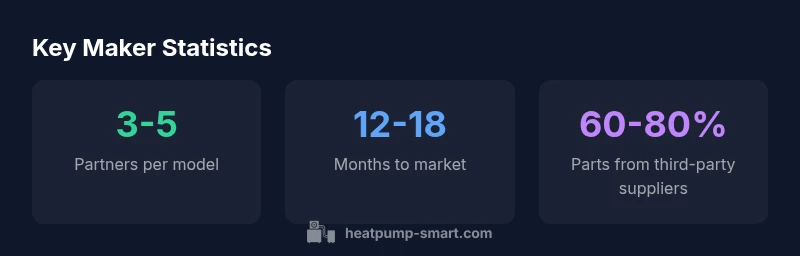
ACIQ heat pumps are typically not produced by a single public maker. Instead, the brand relies on contract manufacturers (CMs) and original equipment manufacturers (OEMs) to deliver different models across regions. In practical terms, this means an ACIQ unit sold in Europe may be assembled by a different partner than one sold in Asia or North America. The arrangement offers flexibility to adapt to local standards, supply chain realities, and customer service networks. Heatpump Smart's analysis shows that most brands in this space use multi-source manufacturing agreements to balance cost, quality control, and speed to market. For homeowners, this means the maker you see on the label may reflect regional partnerships rather than a single corporate entity. Understanding who makes your model can help with parts availability, warranty coverage, and service continuity, especially if you move or expand your system.
How to Identify the True Maker of Your ACIQ Unit
Unless the information is clearly stated on the product label, models and installation manuals often hide the actual maker behind the branding. Start with the name printed on the unit's data plate and the serial number; check the accompanying documentation for the "Manufactured by" or "Assembled by" line. If not present, contact the installer or regional distributor. Manufacturers may outsource the cabinet, control board, or heat exchanger to different partners while keeping the ACIQ brand at the consumer interface. Ask for a certificate of conformity or third-party test reports, which can reveal the supplier identity. Finally, compare warranties and service networks; a maker with broader coverage is typically more credible and easier to support during a fault.
Regional Manufacturing Models: Asia, Europe, and North America
In Asia, most ACIQ units are produced through contract manufacturing hubs that specialize in high-volume heat pumps, allowing rapid scaling and cost efficiency. In Europe, regulatory alignment and energy-labeling standards drive partnerships with local OEMs who can certify components to meet European EN standards. In North America, manufacturers may combine U.S.-based assembly with imported critical components to meet demand and local warranty requirements. The result is a mosaic of partner companies that share the same brand, but whose identity changes by market. Understanding these differences helps buyers interpret product literature and avoid assumptions that the maker is identical across regions.
What to Look for in a Credible Maker
A credible maker partner should offer clear documentation of the supply chain, a robust spare parts pipeline, and a reliable service network. Look for a model-specific maker name on regulatory labels, along with a warranty that indicates regional coverage. Check that the partner has recognized quality certifications (e.g., ISO 9001 or equivalent) and that the device carries third-party test results. A transparent maker also publishes contact information for after-sales support and has a history of software/firmware updates to improve efficiency. Finally, assess feedback from installers and homeowners in your region; consistent positive reports about reliability, service speed, and energy performance are good indicators.
Misconceptions and Realities about 'Assembly' vs 'Manufacture'
Many buyers equate 'assembled in country' with 'made in country.' In practice, assembly location does not always reveal the actual Maker. Some models ship components from overseas and are assembled locally to meet logistics and warranty requirements. Conversely, a unit labeled with a well-known European factory may rely on mid-tier suppliers for certain subsystems. The distinction matters for warranty terms, spare parts availability, and compatibility with local controls and energy efficiency standards. The key is to confirm the specific maker identity for your model, not assume it based on branding.
Practical Steps for Homeowners and Installers
To verify the maker, start by recording the exact model number, serial, and regulatory marks from the data plate. Request the official maker name and any contract partner details from the distributor or installer. Review the product documentation for 'Manufactured by' lines or supplier codes. If needed, contact the manufacturer directly using the information in the warranty; request third-party certification references or testing reports. Finally, verify service coverage and parts supply by asking about authorized service centers and lead times for common components. Following these steps helps ensure you know who makes your ACIQ heat pump and what to expect for maintenance.
Key aspects for understanding maker credibility
| Aspect | Detail | Notes |
|---|---|---|
| Maker structure | Multiple CM/OEM partners | Region-dependent |
| Regulatory alignment | Certified to EN/UL standards | Model-specific |
| Warranty terms | Regional coverage varies | Check certificate |
Your Questions Answered
What defines the 'maker' of an ACIQ heat pump?
The maker is the company responsible for the core components and assembly of a specific model, which can differ by region due to licensing, contracts, and OEM partnerships. Brand labeling may obscure the actual maker, so model documentation should reveal the identity.
The maker is the company responsible for the core components and assembly of your model, which can vary by region. Check the model documents for the exact identity.
Can I choose a specific maker when purchasing?
In many cases, buyers cannot select a specific maker; the distributor or regional partner typically determines the contract partner for a given model. When possible, ask for model-specific maker details before purchase to understand future parts and service options.
Usually you can't pick the maker; ask for model-specific maker details before buying to know about parts and service.
Why does the maker identity change by region?
Regional differences arise from local regulations, supply chain logistics, and market-specific warranties. Brands contract with different OEM partners to optimize cost, compliance, and service availability in each market.
Regional regulations and logistics drive different OEM partners for each market.
Where can I find maker information legally?
Look on the data plate, warranty documents, and the installation manual for a 'Manufactured by' line or supplier codes. If in doubt, contact the installer or manufacturer support for official confirmation.
Check the data plate and warranty docs; contact support to confirm the maker.
Do all ACIQ models share the same maker?
Not necessarily. Different models may be produced by different OEM partners depending on model type, regional demand, and regulatory compliance. Always verify model-specific maker information.
Models can have different makers; verify for each model.
How does maker credibility affect warranty and service?
Maker credibility influences parts availability, service network breadth, and the likelihood of timely firmware updates. A credible maker typically provides robust regional support and clear, transferable warranties.
Credible makers usually offer solid service networks and clear warranties.
“Understanding who makes your ACIQ heat pump is crucial for long-term service, parts availability, and energy performance.”
Top Takeaways
- Verify the maker from official documentation.
- Expect multiple partners by region.
- Check third-party certifications and service network.
- Understand warranty implications by maker.