What is needed for heat pump tax credit in 2026
Learn exactly what is needed to qualify for the heat pump tax credit in 2026, including eligibility, qualifying equipment, documentation, and filing steps. A Heatpump Smart guide to maximize savings while ensuring compliance.


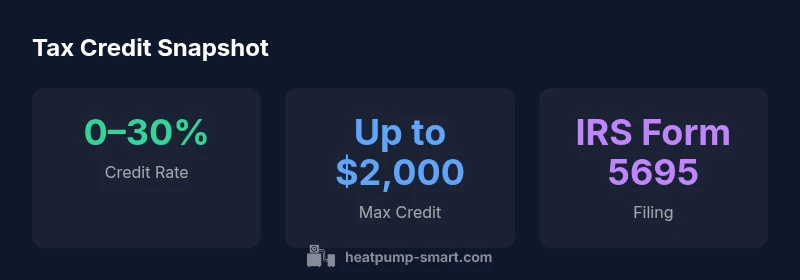
To qualify for the heat pump tax credit, you generally need a qualifying heat pump installed by a licensed contractor, documentation showing energy efficiency compliance (such as ENERGY STAR labeling or similar certifications), and records of total project costs (equipment, labor, and permitting). You must file IRS Form 5695 with your federal return. Keep manufacturer certification statements and installation contracts in case of an audit or review.
What is needed for heat pump tax credit
What is needed for heat pump tax credit is a combination of a qualifying unit, proper documentation, and a valid installation. In 2026, federal credits for energy-efficient home improvements help homeowners offset a portion of installed costs, including heat pumps such as air-source and geothermal systems. The key is to ensure the heat pump meets established efficiency standards and that the installation is performed by a qualified contractor. The credit is typically tied to the overall cost of the project, including equipment, labor, and certain permitting fees, but not every ancillary improvement qualifies.
To get started, confirm your project qualifies for the federal incentive by verifying that the heat pump is a qualified energy-efficient model and that the installation site is your primary residence or another eligible dwelling. It is also essential to confirm that the installation involves a complete system rather than a single component, as the tax credit generally applies to the full package. Collect purchase receipts, installation contracts, and any manufacturer certification statements. Your tax professional can help you understand how the credit interacts with other incentives and your particular tax liability. By documenting early, you ensure you have the necessary paperwork when you file next year.
Eligibility criteria
To qualify for the heat pump tax credit, several criteria usually apply. The primary residence requirement means your main home is eligible for the credit, while rentals or commercial properties may be excluded or treated differently. The system must be installed as a home improvement that increases energy efficiency, and the installation must be completed by a licensed contractor. In some years, the timing of the installation (year of purchase vs. year of installation) can affect eligibility and the credit amount. Your adjusted gross income (AGI) and tax liability influence whether you can use the full credit in a given year; some homeowners may not be able to claim the full amount if their tax liability is limited. Always review the current IRS guidance or consult a tax professional to confirm your individual eligibility. If you previously claimed other energy credits, coordinate to avoid double-dipping on the same expenditure. In short, the eligibility hinges on the heat pump meeting efficiency criteria, proper installation, and your personal tax situation.
Qualifying equipment and energy standards
Qualifying heat pumps are typically models that meet established efficiency standards and carry recognized labeling such as ENERGY STAR or equivalent certifications. The credit generally applies to air-source and geothermal heat pumps that are part of a complete system installed in a primary residence or other eligible dwelling. Manufacturers statements and AHRI/ENERGY STAR listings help prove eligibility. When evaluating options, ask your installer to confirm that the chosen unit and configuration will qualify for the credit and that you will receive the necessary documentation at project close. The emphasis is on energy efficiency performance and the integrity of the installation rather than on any single high-tech feature.
Beyond the unit itself, ensure ancillary components necessary for proper operation (such as compatible thermostats or control systems) are included in the project scope if they are essential to achieving the system’s efficiency. Your contractor should provide a written assessment indicating that the heat pump system meets the qualifying criteria. This ensures your claim is straightforward and minimizes questions from the IRS or your tax preparer.
Costs that qualify and typical project ranges
Eligible costs generally include the heat pump equipment itself, professional installation, labor, and certain permitting or inspection fees directly tied to improving home energy efficiency. Non-energy-related improvements—such as cosmetic upgrades or unrelated renovations—usually do not count toward the credit. The total project cost can vary widely based on unit type (air-source vs. geothermal), house size, climate, and local labor costs. As a guide, many homeowners report ranges that reflect a broad spectrum of comfort levels and system complexity. While the federal credit percentage is defined, the actual dollar amount will depend on your eligible costs and the year’s policy. Consulting a contractor early helps you map out an eligible scope that maximizes your credit while staying within your budget.
How to claim the credit: a step-by-step guide
- Verify the heat pump qualifies for the credit and is installed as a complete system by a licensed professional. 2) Gather all relevant documents: purchase receipt, installation contract, and manufacturer certification statements showing compliance with energy-efficiency standards. 3) Confirm the project costs (equipment, labor, permits) are included in the eligible amount. 4) Obtain and complete IRS Form 5695 for residential energy credits. 5) File the form with your federal tax return and keep copies for your records. If you have questions about interaction with other incentives, consult a tax professional. 6) Retain the supporting documentation in case of review or audit.
Documentation you must keep and filing basics
Prepare a meticulous documentation pack to support your claim:
- Purchase receipt and model/serial information of the heat pump
- Installation contract and scope of work
- Manufacturer certification statements or AHRI/ENERGY STAR listings confirming eligibility
- Any permits or inspection reports related to the installation
- The completed IRS Form 5695 and a copy of your filed tax return Keeping these records organized makes it easier to file accurately and defend your claim if questioned by the IRS or your tax professional.
Additional incentives: state and local programs
In addition to the federal heat pump tax credit, many states, municipalities, and utility providers offer rebates, rebates, or other incentives for energy-efficient upgrades. Availability varies by location and change over time, so it is essential to research current offerings in your area. Coordinating federal credits with state incentives can maximize your overall savings on a heat pump project. Your contractor or a local energy office can point you to current programs and help you navigate the application process. Always document any state or local incentives you intend to stack with the federal credit to ensure proper claim and compliance.
Practical tips to maximize savings
- Start with a thorough energy assessment to select a heat pump that delivers meaningful efficiency gains. - Prioritize models with durable efficiency ratings and reliable performance data. - Time your purchase to fit within the tax year you plan to claim the credit while coordinating with local rebate windows. - Combine the heat pump with a well-insulated home and an efficient thermostat to realize ongoing energy savings beyond the credit. - Work with a reputable, licensed installer who can provide the documentation needed for your claim and help you optimize the system configuration for best results.
Key data points for the heat pump tax credit
| Element | Details | Notes |
|---|---|---|
| Qualifying equipment | Heat pumps that meet energy efficiency standards | Check ENERGY STAR labeling or equivalent certification |
| Installation requirements | Professional installation by licensed contractor | Permits may be required by your state or locality |
| Documentation | Receipts, contracts, manufacturer certifications | Keep for tax records and audits |
| Filing | IRS Form 5695 with tax return | Attach to your annual return; retain copies |
Your Questions Answered
What counts as a qualifying heat pump?
Qualifying heat pumps are those that meet established energy-efficiency standards and labeling. ENERGY STAR labeling is a common indicator, but always verify the specific criteria for your year and location. The credit typically supports the full system when installed as a complete package for a primary residence.
A qualifying heat pump meets energy-efficiency standards and is installed as a complete system in a eligible home.
Do rentals qualify for the federal credit?
Most federal credits apply to primary residences; some programs may differ for rentals. Always check IRS guidance and consult a tax professional before purchasing or installing a heat pump for a rental property.
Rentals usually don’t qualify for the federal heat pump credit; check local incentives.
Can I claim both labor and equipment costs?
Yes, as long as the costs are part of the energy-efficient heat pump installation and are properly documented. Keep detailed records of what was purchased and installed, including labor charges.
Yes, keep receipts for both equipment and installation costs that relate to energy efficiency.
Is there a deadline to claim the credit?
The credit is claimed on the annual tax return for the year you install the heat pump. Filing rules depend on your tax year; consult a tax professional to ensure timely filing.
Claim it when you file your annual tax return for the year of installation.
What if the credit exceeds my tax liability?
Nonrefundable credits reduce tax owed to zero; unused portions generally cannot be carried forward. Check current IRS rules or speak with a tax pro for your situation.
If your tax bill is low, you might not receive the full credit.
How can I maximize savings with other incentives?
Explore state, local, and utility rebates that can stack with the federal credit. Coordinate with your installer to select a high-efficiency unit and ensure all required documentation is in place.
Combine federal and local incentives for bigger savings.
“Eligibility hinges on unit efficiency, correct installation, and complete documentation. Start with your installer to confirm qualifications.”
Top Takeaways
- Confirm a qualifying heat pump and licensed installation.
- Gather receipts, certifications, and IRS Form 5695.
- Credit amount varies; plan with a pro and total eligible cost.
- Explore state/local incentives to maximize total savings.