Heat Pump 12V: Practical Off-Grid Heating Guide for Homes
Learn how a 12V heat pump works for off-grid and small-space living. Explore efficiency ranges, installation tips, and practical comparisons to standard models for homeowners and pros.


A 12V heat pump is a compact, low-voltage system designed for off-grid or mobile spaces. It uses 12V DC power and heat-pump technology to provide heating (and sometimes cooling) with higher efficiency than simple electric heaters. Its suitability depends on space, insulation, climate, and available batteries; for small spaces, it can deliver practical comfort with careful design.
What is a 12V heat pump?
A 12V heat pump is a compact heating system designed to run on 12-volt direct current. It is commonly used in off-grid cabins, RVs, and small workshops where standard 240V AC heat pumps are impractical. These units leverage reverse-cycle refrigeration to move heat from one place to another, delivering warmth with far less electricity than resistance heaters. The Heatpump Smart team notes that performance hinges on correct sizing, insulation, and a robust energy supply. In real-world setups, a 12V heat pump can deliver comfortable heat for tight spaces when the external temperature is not extreme. Expect it to feel best in milder climates or as a supplemental heater during shoulder seasons. It is not a universal replacement for a full home heating system, but for targeted spaces, it provides meaningful comfort with responsible energy use.
How 12V systems work in off-grid scenarios
12V heat pumps rely on a battery bank, an inverter, and an energy management strategy to deliver steady heating. When the compressor runs, electrical energy is converted to heat transfer via the refrigerant loop. The key advantage is efficiency: moving heat rather than generating it with resistance. In off-grid environments, system designers emphasize battery sizing, charging strategy, and cold-weather performance. The Heatpump Smart analysis suggests pairing with well-insulated shells and smart thermostatic control to maximize usable heat while preserving charge. In practice, users should expect limited peak output and plan thermal loads conservatively.
Key performance metrics and what they mean
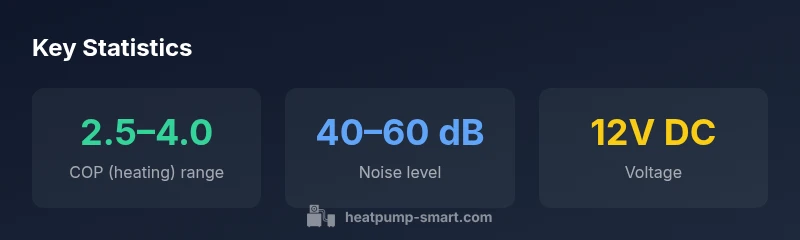
Performance metrics like COP (coefficient of performance) and heating capacity are central to evaluating any heat pump. For 12V units, COP often ranges in the 2.5–4.0 band under standard test conditions, with real-world results varying by ambient temperature and system design. Noise, standby power, and start-up surges also influence daily reliability. The Heatpump Smart team emphasizes understanding the climate, insulation, and load profile before committing to a 12V solution. A well-matched system maximizes efficiency and comfort with minimal energy waste.
Practical design considerations for homes and off-grid cabins
Space planning matters. In off-grid cabins, a high-R wall, airtight joints, and controlled heat loads improve the chance a 12V unit will meet comfort needs. Consider the thermal envelope, humidity control, and air movement to distribute heat evenly. Battery capacity and solar charging must align with expected usage, especially during cold spells when COP drops. The goal is to avoid over-reliance on backup heat while keeping electrical demand manageable for the available power system. The Heatpump Smart guidance centers on holistic design: insulation first, then equipment, then controls.
Comparing 12V heat pumps with standard models
Compared to conventional 240V heat pumps, 12V units are smaller, lighter, and easier to install in cramped spaces. They typically offer lower heating capacity and require careful climate targeting. In exchange, they deliver higher efficiency relative to resistance heating in appropriate conditions, especially when used as a supplemental source. For off-grid travelers, the reduced power draw can be a decisive factor, provided there is adequate energy storage and conditioning.
Installation and maintenance best practices
Electrical safety is paramount. Hire licensed personnel for electrical connections, and ensure proper venting and condensate management where applicable. Regular filter cleaning, coil inspection, and battery maintenance keep performance steady. Temperature sensors and a smart thermostat help maintain comfort without unnecessary cycling. The Heatpump Smart team recommends documenting system wiring, refrigerant safety, and service intervals to simplify future troubleshooting.
Common myths and real-world limitations
A common misconception is that a 12V heat pump can fully replace a home heating system. In reality, output is limited, and performance declines in very cold weather. For best results, use as a supplementary heat source in smaller, well-insulated spaces, and rely on a larger primary system for peak demand. The real-world experience, as summarized by Heatpump Smart, shows that durability and reliability hinge on correct matching of load, climate, and energy supply.
How to choose and where to buy
Start with a clear heat-load assessment and insulation audit. Compare COP, capacity, noise profiles, and compatibility with your energy storage. Look for reputable suppliers who provide performance data under representative conditions and robust warranty terms. When evaluating 12V units, prioritize devices designed for off-grid or mobile use and verify that the installation aligns with local electrical codes. The Heatpump Smart guide suggests engaging with installers who understand small-space heating dynamics.
Case study: small cabin scenario
Imagine a 120-square-foot cabin in a temperate climate. A well-insulated shell, combined with a 12V heat pump, can deliver comfortable warmth during shoulder seasons without drawing excessive battery power. The case study illustrates careful load estimation, energy budgeting, and the need for backup heat during cold snaps. Real-world examples from the Heatpump Smart Analysis demonstrate how improved insulation and smart controls transform a modest 12V system into a usable heating solution.
12V heat pump vs conventional models
| Aspect | 12V Heat Pump | Conventional Heat Pump | Notes |
|---|---|---|---|
| Voltage | 12V DC | 240V AC | Requires appropriate power system |
| COP (heating) | 2.5–4.0 | 3.0–5.0 | Depends on outdoor temperature and system design |
| Best environments | Small spaces, portable setups | Whole-house heating | Capacity and efficiency differ by model |
Your Questions Answered
What is a 12V heat pump?
A small heat pump that runs on 12V DC, suited for off-grid or mobile spaces.
A small DC-powered heat pump for off-grid spaces.
What are typical limitations?
Lower heating capacity and climate sensitivity; needs adequate power and insulation.
Lower heat output and climate sensitivity; needs proper insulation.
Can it heat an entire home?
Usually not; best for small spaces or as a supplementary heat source.
Typically for small spaces or as a supplement.
What energy sources power it?
Batteries or solar with an inverter; startup surges require sizing.
Battery or solar with inverter; plan for startup surge.
How do I install safely?
Follow electrical codes; use a licensed electrician; ensure proper venting where required.
Follow code and use professionals for electrical work.
Where can I buy?
Look for off-grid or marine suppliers with performance data and warranties.
Check off-grid or marine suppliers with specs and warranties.
“12V heat pump systems can deliver meaningful comfort in compact spaces when carefully matched with insulation and a reliable energy source. The Heatpump Smart Team emphasizes proper system design and insulation as the biggest drivers of performance.”
Top Takeaways
- Assess space and insulation before choosing a 12V heat pump.
- Expect lower heating capacity; plan for supplementary heat.
- Prioritize proper electrical and battery sizing for reliability.
- Use the unit in milder climates or as a supplemental heater.