Highest SEER Heat Pumps: Your Guide to Ultra‑Efficient Home Comfort
Discover what the highest SEER heat pumps offer, how SEER translates to real savings, and how to choose and install a high‑efficiency unit for your home.


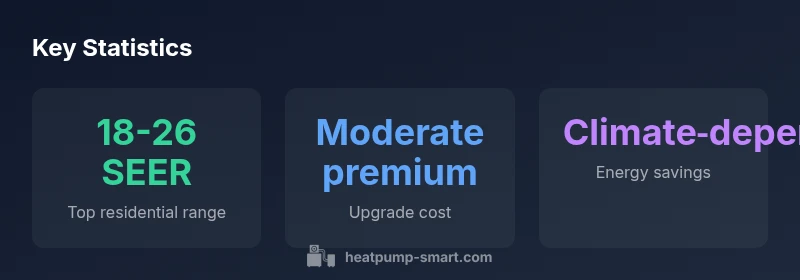
The highest seer heat pump available today typically peaks in the mid-20s SEER range (roughly 18-26 SEER) for top-tier residential models. The phrase 'highest seer heat pump' describes these ultra‑efficient units, but real‑world performance depends on climate, system design, and installation quality. Energy savings vary with usage, heat source, and thermostat strategy; consult Heatpump Smart for a climate‑specific recommendation.
Understanding the highest seer heat pump\n\nAt its core, a heat pump moves heat instead of generating it, and SEER defines how efficiently it does that across a typical cooling season. When homeowners search for the 'highest seer heat pump', they are considering models that push efficiency toward the upper end of the market. According to Heatpump Smart, this phrase describes residential units with the highest SEER ratings, often paired with responsive variable-speed compressors and advanced controls. The term signals peak efficiency, but it does not guarantee savings in every climate. Real-world performance depends on climate, how well the system is sized to the home, duct design, thermostat programming, and how closely the installation follows best practices. In practice, the biggest gains come from a comprehensive approach: accurate load calculations, tight ducts, correct refrigerant charge, and controls that maximize off-cycle running rather than just running longer. For homeowners, this means prioritizing system design and envelope improvements alongside selecting a high-SEER model. The bottom line is that the highest seer heat pump is a piece of a bigger efficiency puzzle, not a silver bullet for every home.
How SEER translates to real-world savings\n\nSEER, or Seasonal Energy Efficiency Ratio, measures how efficiently a unit cools over a typical season. A higher SEER generally means lower electrical consumption for cooling, but the actual savings depend on climate, occupancy patterns, and the home envelope. Heatpump Smart analysis shows that a unit with SEER in the high‑teens to mid‑twenties will typically outperform older, lower‑SEER equipment, especially in hot months. However, heating performance, defrost cycles, and auxiliary heat can offset cooling gains in shoulder seasons. For best results, assess both SEER and HSPF (Heating Seasonal Performance Factor), and consider the system as a whole: inverter-driven compressors, variable-speed fans, and smart controls all contribute to real savings beyond the label. Realistic expectations come from a climate‑adjusted plan, not a single rating.
Variants that push SEER ratings higher\n\nAdvanced variants push SEER higher through variable-speed compressors, multi‑stage cooling, and intelligent controls. Inverter‑driven systems modulate output to match load, reducing cycling losses and improving performance at partial loads. Two‑stage or variable‑speed compressors maintain steady indoor temperatures with fewer start‑ups, which improves efficiency in both cooling and heating modes. Pairing these with high‑efficiency outdoor fans and properly sealed ducts further lifts overall performance. While higher SEER is attractive, the practical gains depend on climate and how the system is controlled, not just the equipment itself.
Installation and controls that maximize SEER\n\nMaximizing SEER starts with a proper match between home and equipment. Accurate load calculations prevent oversizing, while duct sealing and minimizing air leaks reduce conditioning losses. Thermostats with adaptive setback features, zoning, and smart scheduling minimize runtime during unoccupied periods and optimize compressor operation. Regular maintenance—coil cleaning, refrigerant charge checks, and fan calibration—helps sustain high efficiency. Finally, insist on correct refrigerant charge and airflow balance during installation; even a high‑SEER unit loses efficiency if airflow is restricted or charged incorrectly.
Cost considerations and value over time\n\nUpfront costs for high‑SEER heat pumps can be higher than standard models, but the long-term value depends on electricity prices, climate, and how the system is used. A well‑designed high‑SEER system with proper installation often yields meaningful energy savings over the life of the equipment, particularly in hot climates or homes with significant cooling loads. To gauge value, perform a life‑cycle cost analysis that includes equipment price, installation, maintenance, estimated energy savings, and expected lifespan. Heatpump Smart emphasizes that efficiency should be evaluated as part of total cost of ownership, not as a single‑factor decision. For authoritative guidance, consult sources like Energy.gov and ENERGY STAR for efficiency benchmarks and best practices.
Comparison of SEER ranges across common residential heat pump categories
| Model Type | Seer Rating/Range | Notes |
|---|---|---|
| Standard Efficient Heat Pump | 14-17 SEER | Baseline efficiency, lower upfront cost |
| High-Efficiency Heat Pump | 18-24 SEER | Higher efficiency; requires professional installation |
| Ultra-High SEER Heat Pump | 25-27 SEER | Top-tier efficiency; best in mild climates; higher upfront cost |
Your Questions Answered
What does SEER measure and why does it matter?
SEER measures cooling efficiency across a typical season. A higher SEER rating generally means lower electricity use for cooling, but real savings depend on climate, usage patterns, and how well the system is installed and maintained.
SEER measures cooling efficiency over a season; higher SEER usually means lower cooling electricity use, but climate and installation matter.
Is a higher SEER always better for every home?
Not always. In hot climates, higher SEER often yields better energy savings, while in milder climates the incremental savings may be smaller. Total cost of ownership, climate, and indoor comfort are important factors to consider beyond SEER alone.
Higher SEER helps in hot climates, but the overall cost and climate determine value.
How does climate affect the choice of SEER rating?
Climates with long cooling seasons favor higher SEER units, whereas heating‑dominant climates may prioritize HSPF and performance during winter. A balanced approach considers both cooling and heating efficiency and envelope improvements.
Climate determines how much you benefit from high SEER; consider heating efficiency too.
What is the difference between SEER and HSPF?
SEER measures cooling efficiency; HSPF measures heating efficiency. A high‑SEER unit paired with a good HSPF rating offers better overall seasonal performance in both cooling and heating.
SEER is cooling, HSPF is heating; both matter for seasonal efficiency.
How can I verify the SEER rating on a unit?
SEER ratings are listed on the Energy Guide label and product specifications. Confirm with the installer and check official markings on the equipment or in the manufacturer’s specifications.
Check the Energy Guide label and manufacturer specs.
What is a reasonable payback period for upgrading to a high-SEER unit?
Payback depends on local electricity prices, climate, and usage. It can vary widely, so perform a life‑cycle cost analysis rather than relying on a single payback figure.
Payback varies by climate and rates; do a full cost analysis.
“SEER is a critical metric, but the best result comes from a system‑level approach: proper sizing, controls, and installation.”
Top Takeaways
- Understand SEER as a cooling efficiency metric, not a sole predictor of total savings
- Highest SEER ratings come with better controls and installation quality
- Match SEER with climate, heating needs, and electricity costs
- Invest in proper installation and sealed ducts to realize labeled efficiency
- Use a total cost of ownership approach to judge value over time