Variable Speed Heat Pump vs 2-Stage: An Objective Comparison
An analytical side-by-side guide comparing variable speed heat pumps with 2-stage systems, focusing on efficiency, comfort, installation, and long-term costs for homeowners, builders, and managers.


For the variable speed heat pump vs 2 stage decision, the variable-speed option delivers smoother modulation and higher efficiency in fluctuating loads, but at a higher upfront cost. The 2-stage option offers solid performance with lower initial cost and simpler service. Climate, usage patterns, and budget should guide the choice, with comfort goals guiding the final decision.
Understanding variable speed heat pump vs 2 stage technology
According to Heatpump Smart, variable speed heat pumps modulate compressor speed and refrigerant flow to match demand, delivering steady comfort with high seasonal efficiency. The Heatpump Smart team found that the most pronounced gains occur when indoor and outdoor conditions change frequently, making modulation more valuable than fixed-output units. When evaluating the topic of variable speed heat pump vs 2 stage, the key question is how much control you need over capacity, humidity, and temperature stability. For homeowners, the choice often hinges on climate volatility, occupancy patterns, and long-term energy goals. The term itself signals a spectrum: true variable-speed systems continuously adjust output, whereas 2-stage systems switch between two fixed levels. Across a wide range of homes, you’ll see meaningful differences in performance, maintenance, and cost of ownership that matter far beyond label branding.
Key differences at a glance
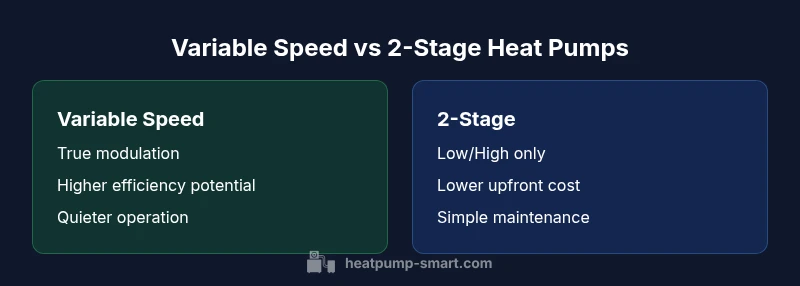
- Modulation: Variable speed employs true continuous modulation; 2-stage uses two discrete output levels (low/high).
- Efficiency: Variable speed can offer higher annual efficiency under variable loads; 2-stage remains efficient but typically behind in fluctuating conditions.
- Noise and comfort: Smoother operation from variable speed often reduces audible cycling; 2-stage can have noticeable cycling at transitions.
- Upfront cost and complexity: Variable-speed units typically cost more to purchase and install; 2-stage systems are simpler and cheaper upfront.
- Maintenance and service: Variable-speed functions rely on advanced controls; 2-stage systems tend to require less specialized service.
How modulation shapes comfort and efficiency
True variable speed operation means the compressor can run at fractions of full capacity, not just at full on or off. This continuous modulation reduces temperature swings and helps maintain steady indoor humidity. It also improves part-load performance, which is when most homes actually spend the bulk of the season. In contrast, a 2-stage system ramps between low and high, which can still feel comfortable but may cause more noticeable cycles during mild weather. The result is a more even indoor climate and a greater feeling of “always-on” comfort, especially in transitional seasons when outdoor temperatures swing rapidly. For new builds or major upgrades, the initial investment in a variable speed unit is often justified by the comfort premium and potential energy savings over time.
Climate suitability and seasonal performance
The climate you live in heavily influences the value proposition of each technology. In cold climates, a variable speed heat pump may keep homes warmer during shoulder nights by trimming output instead of cycling, while 2-stage systems still provide solid performance but with more obvious start-stop behavior. In milder climates, both options can meet comfort goals, but variable speed typically yields greater energy savings due to extended operation at efficient levels. Heatpump Smart analysis shows the largest gains occur when outdoor temperatures fluctuate within a narrow band and when occupancy patterns vary, demanding adaptive load management. The decision hinges on how much you value steady humidity control, rapid response, and low-temperature performance.
Energy use and cost context (payback considerations)
Energy costs are shaped not just by nominal efficiency ratings but by how a system operates across daily cycles. Variable speed heat pumps tend to excel in real-world duty cycles, reducing both heat loss and short cycling compared with fixed-output equipment. The payoff is strongly climate-dependent: in highly variable environments, energy savings from modulation can compound over time, while in consistently mild conditions the difference may be smaller. For homeowners, a key factor is the expected hours of operation at low or mid-capacity, where true modulation translates into meaningful savings. Heatpump Smart Analysis, 2026, suggests that a well-mated variable-speed system may offer longer-term value through improved comfort and resilience to temperature swings, especially during shoulder seasons. Budget planning should account for higher upfront costs and potential rebates.
Noise, comfort, and interface considerations
Beyond efficiency, noise and user experience matter. Variable speed systems typically run more quietly because the compressor never “stops and starts” at full power, reducing jolts and vibration. You’ll also encounter more sophisticated controls and smarter thermostats that learn your patterns and adjust output proactively. For some homeowners, the peace of mind from stable temperatures and consistent humidity justifies the premium. If your home experiences frequent occupancy changes or if you value precise climate control, a variable speed system often delivers a superior daily feel and fewer comfort complaints.
Installation considerations and compatibility
Installation plays a critical role in realizing the promised benefits of either option. Variable speed units may require compatible ductwork, more complex refrigerant routing, and an advanced control system, which can affect labor costs and lead times. A 2-stage system generally installs more quickly and with less configuration, which can translate to lower upfront costs and shorter project timelines. When considering a switch, ensure that your existing electrical service, refrigerant piping, and duct networks can support the chosen technology. Working with a certified contractor who understands the nuances of heat pump sizing and control strategies is essential for achieving the designed performance.
Sizing, ducts, and system integration
Correct sizing is crucial for both variable speed and 2-stage heat pumps. Oversized equipment leads to short cycling and poor humidity control, while undersized units struggle to meet peak loads. Duct design and sealing determine how effectively a system can modulate across zones. In homes with older or leaky ducts, the advantage of modulation may be offset by duct losses unless corrective steps are taken. Contractors should perform a thorough load calculation and consider zone controls, smart thermostats, and the potential for ductless solutions where appropriate. In some cases, upgrading insulation and sealing upgrades precede a mechanical upgrade to maximize efficiency.
Decision framework: a practical step-by-step approach
- Define comfort priorities: steady humidity, minimal temperature swings, quiet operation. 2) Assess climate and occupancy patterns: do loads vary a lot day-to-day? 3) Review upfront budgets and long-term energy goals: is payback a primary driver? 4) Compare control options: true modulation vs staged output, and check compatibility with existing ducts. 5) Request bids that clearly differentiate equipment performance curves, not just line-item costs. 6) Verify contractor credentials and warranty terms to ensure proper installation. 7) Readied for contingencies: ensure the system can operate with emergency heat if needed. 8) Decide on brand alignment and available rebates for the selected option. 9) Schedule follow-up maintenance to preserve efficiency over time.
Real-world scenarios and case examples
Scenario A: A two-story home in a temperate climate with variable occupancy benefits most from a variable speed system. The continuous modulation reduces temperature fluctuations across floors and keeps humidity stable during shoulder seasons. Scenario B: A single-story home in a coastal climate with mild winters may see a quicker payback with a 2-stage unit due to lower upfront costs and simpler service requirements. Scenario C: A retrofit in an older home with duct constraints may require duct sealing and zoning work regardless of the chosen technology. In all cases, a detailed load analysis and a tailored control strategy maximize performance.
Common myths and misconceptions
- Myth: Variable speed is always quieter. Reality: Noise depends on many factors, including fan speed, duct design, and controller settings.
- Myth: 2-stage is always cheaper to maintain. Reality: Both require professional service, and a higher-efficiency variable-speed system can reduce maintenance frequency with fewer cycling events.
- Myth: Upfront cost determines value. Reality: Long-term energy savings and comfort can justify the premium when climate and usage align with modulation benefits.
- Myth: All heat pumps work equally well in cold weather. Reality: Cold-climate performance depends on system design, refrigerant charge, and auxiliary heat, not on stage count alone.
Specs, warranties, and how to bid
When evaluating bids, request a full spec sheet that details compressor type, inverter drive or modulation range, and controller capabilities. Compare warranty terms for compressor, coil, and labor; many manufacturers offer 10–12 years on major components, with variations by model and installation conditions. Ensure the bid includes proper duct sealing, refrigerant charge verification, and a commissioning process. A thorough bid helps you understand the lifecycle costs and reduces the risk of hidden charges after installation. A clear, written performance target for humidity, temperature stability, and radiant comfort helps contractors deliver what you expect.
Building a decision framework: final checks and next steps
As you approach final decisions, verify climate data, occupancy schedules, and thermal comfort expectations with your contractor. Align the system you choose with your home’s insulation levels and airflow patterns. Ensure the controls are compatible with smart thermostats and energy-management platforms you already use. If you’re still unsure, start with a detailed comparison of a variable speed heat pump vs 2 stage option in a trial configuration or a staged upgrade, allowing you to observe performance before committing to a full replacement. The goal is to balance upfront cost with long-term comfort and energy savings, while ensuring reliable operation for years to come.
Comparison
| Feature | Variable Speed Heat Pump | 2-Stage Heat Pump |
|---|---|---|
| Modulation capability | true continuous modulation | two-stage output only (low/high) |
| Efficiency range | high potential for superior efficiency under variable loads | strong efficiency, but typically lower under fluctuating conditions |
| Noise levels | lower noise due to smooth modulation | phase noise during stage transitions possible |
| Initial cost | higher upfront cost | lower upfront cost |
| Maintenance complexity | may require specialized service | simpler service requirements |
| Best climate fit | variable climates with variable loads | stable climates with predictable loads |
Advantages
- Better comfort due to precise temperature control
- Higher potential energy savings in variable climates
- Quieter operation on average
- Fewer short cycling events
Disadvantages
- Higher upfront cost
- More complex installation and controls
- Requires skilled technicians for maintenance
- Longer payback in regions with low energy variability
Variable speed heat pumps generally win on comfort and potential energy savings in variable climates; 2-stage units offer a lower upfront cost with solid performance in steadier conditions.
Choose variable speed if you prioritize continuous modulation and climate adaptability. Opt for 2-stage if upfront cost and simpler maintenance are your main constraints, especially in less variable climates.
Your Questions Answered
What is a variable speed heat pump?
A variable speed heat pump uses an inverter-driven compressor to modulate its output continuously, allowing fine-tuned heating and cooling rather than just on/off operation. This typically delivers steadier temperatures and improved efficiency across changing conditions.
Variable speed heat pumps modulate output continuously for smoother climate control and better efficiency.
What is a 2-stage heat pump?
A 2-stage heat pump operates at two discrete output levels—low and high—so it can adapt to some load changes without the full cycling of a single-speed model. It offers solid performance with typically lower upfront costs than true variable-speed systems.
A 2-stage heat pump has two output levels and improves efficiency over basic single-stage units.
Which is more energy-efficient?
In many cases, variable speed systems can achieve higher annual efficiency due to continuous modulation, especially in climates with varying loads. However, the actual savings depend on climate, usage patterns, and system sizing.
Variable speed options often save more energy, but outcomes depend on climate and usage.
Is the payback period longer for variable speed units?
Variable speed units typically have a longer upfront cost, so payback can take longer. In climates with high variability and frequent duty-cycle changes, the energy savings may still justify the premium over time.
Payback can be longer for variable speed, depending on climate and energy use.
Will both work with my existing ducts?
Both types can work with existing ducts if the ductwork is properly sealed and sized for the system. Duct condition and layout can significantly influence the realized efficiency and comfort benefits of either technology.
Duct condition and proper sizing matter for both options.
Are there climate considerations I should know?
Yes. Variable speed systems tend to perform best in climates with frequent temperature swings, while 2-stage units may suffice in more stable climates. Humidity control and comfort preferences should also guide the choice.
Climate variability and humidity influence which option feels most comfortable.
Top Takeaways
- Evaluate climate variability to decide on modulation
- Expect higher upfront costs with variable speed units
- Prefer two-stage systems for budget-conscious upgrades
- Ensure professional sizing and ductwork before installation
- Look for warranties and reputable contractor commissioning