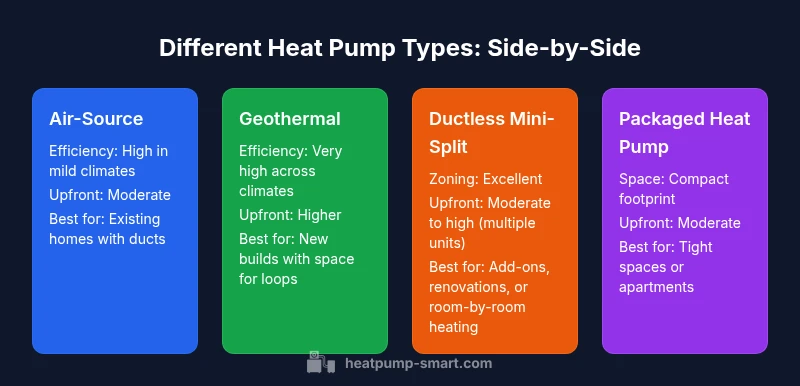
Different Heat Pump Types: A Comprehensive Comparison
Compare air-source, geothermal, and ductless heat pump types to fit your climate and home. This Heatpump Smart guide covers efficiency, costs, and installation considerations to help homeowners, builders, and managers choose wisely.


Among the different heat pump types, air-source heat pumps strike the best balance of upfront cost, performance, and ease of installation for most homes. Geothermal systems offer very high efficiency but require substantial upfront investment and space. Ductless mini-splits excel for zoning and renovations, while packaged heat pumps suit tight spaces with straightforward installation. Choose based on climate, space, and budget.
Why understanding different heat pump types matters for homeowners
Choosing the right heat pump type affects comfort, energy use, and long-term costs. The phrase different heat pump types covers several technology families, each with its own strengths and constraints. For homeowners, builders, and property managers, understanding these categories helps tailor solutions to climate, home design, and budget. According to Heatpump Smart, the most important early questions are: What climate do you live in? How is your home insulated? Do you need single-zone or multi-zone control? And what is your willingness to invest upfront versus over time? By mapping climate, thermal loads, and space, you can narrow the options before contacting contractors. The rest of this guide walks through the main types, how they compare on key metrics, and practical recommendations for real-world installations. The goal is to empower you to pick the right system for long-term comfort and energy efficiency.
How heat pumps actually work: core components and metrics
Heat pumps move heat rather than generate it. At a high level, they rely on a refrigerant cycle driven by a compressor, paired with an outdoor condenser and indoor air-handling unit. The same equipment can provide heating and cooling by reversing the cycle. When evaluating different heat pump types, focus on performance metrics such as SEER (seasonal energy efficiency ratio), HSPF (heating performance factor), and COP (coefficient of performance). These indicators are influenced by climate, system sizing, ductwork, and how well the system is installed. A professional will verify refrigerant charge and airflow. Heatpump Smart analysis notes that installation quality often has as much impact on real-world efficiency as the model itself. In practice, you’ll see higher efficiency with properly sized equipment and well-sealed building envelopes. A well-chosen heat pump should align with your home's insulation, windows, and thermal mass to maximize performance year-round.
Air-source heat pumps: benefits, limits, and best-use scenarios
Air-source heat pumps (ASHPs) draw heat from outdoor air and move it inside. They are versatile, with versions designed for ducted homes or for independent zones via ductless mini-splits. Benefits include: generally moderate upfront costs, relatively quick installation, and strong performance in temperate climates. They can integrate with existing ductwork or serve individual rooms with wall-mounted units. Limitations include performance loss in freezing temperatures and higher demand in extremely cold climates unless paired with auxiliary heat. For single-family homes in moderate climates or renovations, ASHPs often balance cost and comfort well. In multi-story homes, using ASHPs with zoning can create efficient, comfortable zones without large ductwork. For best results, pair ASHPs with good insulation, airtight envelope, and smart controls to maximize seasonal efficiency. Real-world results improve when the system is correctly sized for each zone and the seasonal energy use aligns with the climate profile of the region.
Geothermal (ground-source) heat pumps: benefits, limits, best-use scenarios
Geothermal heat pumps exploit the relatively stable underground temperatures to achieve excellent efficiency. The ground loop or well field typically delivers steady output, resulting in strong year-round performance. Benefits include very high efficiency, reliable heating in cold weather, and often long equipment life. Limitations include high upfront costs for loop installation, potential land-use or permitting considerations, and longer project timelines. Best-use scenarios include new builds with available outdoor space for digging or trenching, homes in regions with long heating seasons, or properties seeking the lowest operating costs over the system's life. For retrofit projects, geothermal can be more complex, but it may still be viable where there is space for loops and the budget allows. When evaluating options, consider long-term energy savings versus upfront investment and local permitting requirements. The decision often hinges on property size, soil or rock conditions, and local permitting processes. Heatpump Smart's perspective emphasizes evaluating the total cost of ownership over 15–20 years rather than just the first year.
Ductless mini-splits: zoning potential and retrofit considerations
Ductless mini-splits provide flexible, zone-based heating and cooling without the need for ductwork. Each indoor air-handling unit can be controlled independently, delivering personalized comforts in different rooms or spaces. Benefits include precise zoning, high efficiency, and simpler retrofits in existing homes where ductwork is impractical. Limits include higher upfront costs when multiple indoor units are required, and the need for professional outdoor-to-indoor line-set routing. They are especially effective in additions, converted spaces, and older houses where extending ducts would be expensive or disruptive. When sizing, consider each zone's heating and cooling load separately, and plan for future expansions if the home layout changes. A thoughtful mini-split design can deliver comfort with minimal energy waste, especially when paired with good insulation and smart thermostats.
Packaged heat pumps: compact solutions for tight spaces
Packaged heat pumps combine the condenser and air handler in a single outdoor or compact unit connected to ductwork or space-saving indoor units. This configuration is often easier to install in small homes or retrofit projects where space is at a premium. Benefits include a simplified installation flow and fewer indoor units to mount, which can translate to lower aesthetic impact and faster commissioning. Limits include potentially lower efficiency in extremely cold climates compared to split systems, and the fact that a single outdoor unit serves all spaces, reducing zoning flexibility. They can be a practical option for basements or small footprints where traditional split systems are hard to fit. When considering a packaged unit, verify compatibility with your duct layout, insulation quality, and the ability to integrate with modern controls for energy savings.
Efficiency and climate: matching the type to your climate
Climate plays a decisive role in selecting a heat pump type. Moderate climates often yield excellent performance with air-source or ductless options, providing comfort with manageable upfront costs. Extremely cold climates historically favored geothermal systems or high-efficiency cold-climate ASHPs, though advances in refrigerants and defrost strategies are narrowing the gap. In hot and humid regions, proper refrigerant charge, outdoor unit clearance, and properly sealed envelopes impact reliability just as much as the type itself. Heatpump Smart notes that the best choice balances climate realities with home design, available space for outdoor equipment, and the owner's tolerance for upfront investment versus long-term operating costs. A robust energy audit and a design phase with a licensed HVAC contractor typically yields the most reliable long-term performance.
Sizing, installation, and contractor considerations
Accurate sizing is critical for any heat pump type. Oversized units lead to short cycling and poor humidity control; undersized systems struggle to keep up during peak demand. A professional should perform a manual J load calculation, assess insulation, windows, air sealing, and indoor air distribution, and then propose a system that aligns with your climate goals. Installation complexity varies by type: geothermal requires trenching or drilling a loop field; ductless mini-splits need careful placement of interior heads and line sets; air-source split systems must align with existing ductwork; packaged units demand careful site planning for both outdoor and indoor components. Ask contractors for references, verify licensing and insurance, and request a written commissioning protocol that validates performance targets before handover. Emphasize warranty terms on major components and refrigerant handling requirements to ensure long-term reliability.
Cost considerations and lifecycle value
Total cost of ownership for a heat pump should consider upfront purchase and installation, energy savings, maintenance, and potential rebates or incentives. While geothermal and high-end ductless systems may require higher upfront investments, their operating costs can be substantially lower over time, especially in climates with long heating seasons. Air-source heat pumps offer a favorable balance for many homeowners, delivering good energy performance with moderate upfront costs and simpler service. In addition to direct costs, evaluate space requirements, noise levels, and aesthetics, as well as potential future expansion or remodeling plans. Heatpump Smart highlights the importance of estimating energy savings over the system life and comparing them with the installed cost to determine true value.
Common pitfalls and how to avoid them
Several pitfalls can undermine performance and satisfaction: undersizing or oversizing, installing in poorly insulated homes, neglecting maintenance, and selecting a model without considering real climate conditions. Another common issue is neglecting zoning needs in multi-room homes, which reduces comfort and increases energy waste. To avoid these issues, work with a knowledgeable contractor who uses a systematic sizing approach, performs a detailed site inspection, and provides a clear maintenance plan. Ensure the project includes proper air sealing, ductwork repair or reinforcement where needed, and a robust thermostat strategy that supports efficient operation across different seasons. By planning for future repairs and system upgrades, you reduce the risk of early equipment failure and high operating costs.
Future trends: refrigerants, hybrids, and smart controls
The heat pump landscape is evolving with new refrigerants that aim to reduce environmental impact and improve efficiency. Hybrid systems that combine heat pumps with backup furnaces are common in regions with harsh winters, offering resilience alongside efficiency. Smart controls, occupancy-based heating, and weather forecasts integrated into thermostats help optimize performance and energy use. Heatpump Smart expects continued improvements in cold-climate performance, system integration, and user-friendly design to support homeowners, builders, and property managers seeking reliable, energy-efficient comfort.
Case studies and decision guide: choosing the right type for your home
To make a confident choice, translate the above into a practical decision framework. Start with a climate assessment, then map your home's insulation quality and envelope integrity. For renovations or additions, ductless mini-splits can provide flexible zoning without heavy ductwork. For new builds with ample outdoor space, geothermal may offer long-term savings, provided you can justify the upfront cost. If you need a straightforward, space-efficient solution in a tight footprint or apartment setting, an air-source or packaged heat pump could be the best fit. Finally, consult multiple reputable contractors, compare equipment efficiency ratings, and review warranty terms before deciding. Heatpump Smart’s practical approach emphasizes total cost of ownership, climate compatibility, and long-term reliability.
Feature Comparison
| Feature | Air-Source | Geothermal (Ground-Source) | Ductless Mini-Split | Packaged Heat Pumps |
|---|---|---|---|---|
| Efficiency | High efficiency in mild climates; performance decreases in extreme cold | Typically very high efficiency across climates; less outdoor temperature impact | High efficiency with zoning; model-dependent | High efficiency possible; often lower than split systems in large homes |
| Climate Suitability | Versatile for temperate zones; needs defrost management in cold snaps | Excellent in extreme cold; ideal for long heating seasons | Best for additions or rooms without ductwork; adaptable to various climates | Suitable for tight spaces; best with moderate climates |
| Upfront Cost | Moderate upfront; typically lower than geothermal | High upfront due to loop installation and site work | Moderate to high; depends on number of indoor heads | Lower upfront than geothermal; compact footprint |
| Installation Complexity | Moderate; ductwork may be reused or simplified for minisplits | High; requires ground loops, drilling, or trenching | Moderate; wall-mounted units with minimal ductwork | Lower; single outdoor unit with possible simple ductwork |
| Space Requirements | Outdoor condenser; indoor air handler options | Outdoor loop field and indoor distribution; substantial space | Minimal ductwork; several indoor units or a single unit per zone | Compact footprint; best for small homes or apartments |
| Maintenance Needs | Regular filter changes; routine checks | Fewer moving parts; periodic loop integrity checks | Regular filters and occasional coil maintenance | Similar to central AC; filter and coil care |
Advantages
- Wide range of options for different climates and home designs
- High efficiency potential with proper sizing and installation
- Zoned comfort possible with ductless mini-splits
- Easier retrofits for some homes compared to geothermal
Disadvantages
- Higher upfront costs for geothermal and some multi-unit minisplits
- Performance varies with climate and model quality
- Geothermal requires space for loops and longer project timelines
- Packaged units may have lower efficiency in very cold conditions
Air-source heat pumps generally offer the best balance of cost, performance, and ease of installation, while geothermal excels in maximum efficiency with upfront investments.
For temperate climates and retrofit projects, air-source heat pumps are typically most practical. If you have space for loops and want the highest efficiency, geothermal may be worth the premium. Ductless mini-splits shine for zoned comfort, and packaged units are convenient in tight spaces. The right choice depends on climate, home design, and budget.
Your Questions Answered
What are the main types of heat pumps?
The main types include air-source, geothermal (ground-source), ductless mini-splits, and packaged heat pumps. Each offers different efficiency profiles, installation requirements, and climate suitability.
The main heat pump types are air-source, geothermal, ductless mini-splits, and packaged units, each with distinct benefits and installation needs.
Which heat pump type is best for cold climates?
Geothermal heat pumps and some high-efficiency air-source models perform well in cold conditions, but geothermal typically maintains higher efficiency in freezing weather. A dedicated cold-climate unit may be required.
Geothermal systems perform very well in cold weather; some air-source units with cold-climate design also work well.
Are ductless mini-splits suitable for whole-home replacement?
Ductless mini-splits are excellent for renovations or additions and for multi-zone heating, but replacing a full ducted system can be complex and costly. A professional assessment is essential.
Mini-splits work great for adding zones or retrofits, but replacing an entire ducted system needs careful planning.
What maintenance does a heat pump require?
Regular filter changes, coil and fan cleaning, and periodic professional inspections are recommended. Refrigerant levels should be checked by a technician if you notice performance drops.
Keep filters clean, schedule annual checkups, and have a tech check refrigerant if performance vanishes.
What is the difference between an air-source and geothermal heat pump in terms of cost?
Air-source units tend to have lower upfront costs and simpler installation, while geothermal systems require higher upfront investment but can offer lower operating costs over time.
Air-source is cheaper to install; geothermal costs more up front but saves more over time.
Can heat pumps provide both heating and cooling?
Yes. Most modern heat pumps deliver both heating and cooling by reversing the refrigerant cycle, providing year-round comfort.
Heat pumps can heat in winter and cool in summer with one system.
Do heat pumps use refrigerants that require special handling?
Most modern units use EPA-approved refrigerants; some models use alternatives. Handling and disposal must be done by licensed technicians.
Most use approved refrigerants; only licensed pros should handle them.
What affects the choice between air-source and geothermal for a retrofit?
For retrofits, consider space for a loop field, existing ductwork, and the home's insulation. Air-source tends to be less invasive, while geothermal demands more planning and budget.
Retrofits favor air-source for least disruption, geothermal needs careful planning and space.
Top Takeaways
- Identify climate and home design before choosing a type
- Consider zoning needs for effective ductless systems
- Weigh upfront costs against long-term energy savings
- Assess installation complexity and space availability
- Check refrigerant type, warranty, and serviceability