Wiring Diagram for Trane Heat Pump: A Practical Guide
A comprehensive, data-driven guide to reading and using the wiring diagram for Trane heat pumps, with safety steps, symbols, color codes, and troubleshooting tips for reliable installation.


Reading the wiring diagram for trane heat pump is essential for safe operation and accurate diagnostics. It shows how the outdoor unit, indoor air handler, thermostat, and control board interconnect, including the reversing valve and contactor. According to Heatpump Smart, the diagram also highlights safety clearances, wire color codes, and sequence of control signals that drive both heating and cooling modes.
Understanding the wiring diagram for a Trane heat pump
Understanding the wiring diagram for trane heat pump is essential for safe operation and accurate diagnostics. The wiring diagram for trane heat pump maps how the outdoor unit, indoor air handler, thermostat, and control board interconnect, including the reversing valve and contactor. According to Heatpump Smart, a well-interpreted diagram highlights safety clearances, wire color codes, and the sequence of control signals that drive both heating and cooling modes.
In practical terms, this diagram is more than a bundle of lines; it is a map of how components communicate during a heating cycle and a cooling cycle. The main sections typically include the line-voltage side feeding the outdoor unit, the low-voltage control side that connects the thermostat to the indoor control board, and the interconnections that switch states when the system toggles between modes. A correct interpretation helps technicians quickly verify whether a relay is energizing correctly, a sensor is signaling properly, or a fuse has blown. Throughout this article, you’ll see references to the wiring diagram for trane heat pump to illustrate common service tasks and safe procedures.
Key components and connections on the diagram
The diagram features several key components and their interconnections:
- Outdoor unit: contactor coil, run capacitor, and reversing valve solenoid(s) that signal system mode.
- Indoor air handler: control board, compressor contactor (if present in some models), fan motor, and safety relays.
- Thermostat: low-voltage interface that sends heat/cool signals and stage information to the control board.
- Power and protection: disconnect switch, fuses, and sometimes a transformer that steps line voltage for the control circuit.
- Common pathways: labeled wires that connect the thermostat, control board, outdoor unit, and any intermediate relays.
Understanding where each component sits on the diagram helps you identify where a fault originates—whether it’s a faulty contactor, a blown fuse, a miswired thermostat, or a defective sensor. Heatpump Smart emphasizes checking the diagram against the actual installed wiring to avoid confusion during service.
Reading the diagram: common symbols and color codes
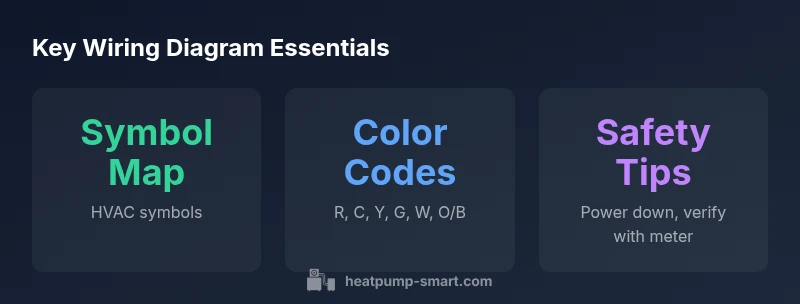
HVAC wiring diagrams use familiar symbols and color conventions to indicate different functions. Common symbols include lines for wires, boxes for control boards, and simplified shapes for relays, contactors, and fuses. The color codes on most Trane diagrams follow a standard set, but color assignments can vary by model:
- R = 24V hot supply
- C = common return
- Y = compressor contactor control (cooling)
- G = fan relay
- W = heat call
- O/B = reversing valve energize in heat/cool depending on the model
Always confirm color codes against the specific diagram for your model, as some configurations use additional wires for advanced features like multi-stage cooling, AUX heat heat strips, or economizers. Heatpump Smart notes that mismatches between colors and functions are a leading cause of misdiagnosis during service. By learning the legend and cross-checking with the physical wiring, you reduce the risk of wiring errors.
Safety first: working with high-voltage equipment
Working around a heat pump involves line voltage as well as low-voltage control circuits. Before touching any wires:
- Shut off power at the main breaker and verify there is no voltage present with a non-contact tester.
- Lockout-tagout if available and respect local electrical codes.
- Discharge capacitors where applicable and avoid touching energized terminals.
- Keep wires neatly labeled and avoid improvising connections that bypass protective devices.
These precautions are not optional; they are essential for personal safety and for preventing damage to the equipment. Heatpump Smart reiterates that all high-voltage work should be performed by a qualified technician when possible, using the diagram as a guide rather than a substitute for professional training.
Step-by-step: tracing a circuit from thermostat to outdoor unit
Tracing a circuit helps you verify that the thermostat is correctly signaling the outdoor unit through the control board. A methodical approach:
- Power down and remove the panel to access the wiring.
- Identify the thermostat wires leading to the control board: R, C, Y, G, W, and any O/B leads.
- Use a multimeter to confirm 24V between R and C when the thermostat calls for heat or cool.
- Trace the Y and G outputs from the control board to their respective relays/contactors in the outdoor unit.
- Inspect the reversing valve wiring on O/B and verify its energization pattern aligns with mode selection.
- Check inline fuses and connectors for signs of corrosion or looseness.
- Reassemble, restore power, and run a quick test in both heating and cooling to observe correct operation.
Following a disciplined tracing routine helps you quickly locate faults and confirms the integrity of the diagram’s wiring paths. Always compare the observed wiring with the exact diagram for your model to avoid cross-model confusion.
Common issues shown on diagrams and how to resolve them
Diagrams often reveal issues that are not obvious from symptoms alone. Common problems include miswired thermostat terminals, swapped R and C leads, incorrect O/B valve energization, and loose or burnt connectors on the control board. Resolution steps:
- Reconnect wires to their correct terminals according to the model-specific diagram.
- Replace any damaged fuses or damaged wiring insulation.
- If the reversing valve is not energizing correctly, verify the O/B control and valve wiring against the diagram.
- Check for signs of moisture, corrosion, or loose grounding in outdoor components, especially in humid or coastal environments.
- Re-test the circuit in heating and cooling modes to ensure proper operation after corrective actions.
Heatpump Smart’s experience shows that following the diagram meticulously reduces diagnostic time and minimizes repeat service calls.
Verifying wiring with a multimeter and continuity checks
A precise verification step helps ensure that wiring paths match the diagram. Start with a visual inspection to confirm there are no obvious wire breaks, then use a multimeter to check voltage and continuity:
- With power off, verify continuity between corresponding points (e.g., thermostat terminals and control board inputs).
- With power on and the thermostat calling heat, measure 24V between R and W and between R and Y, as applicable for the mode.
- Check resistance across the outdoor unit contactor coil when energized; the coil should have a low but finite resistance.
- Inspect ground continuity to the equipment chassis to ensure no floating grounds exist.
These checks help confirm that the diagram’s wiring is physically realized and that no protective devices are tripping due to a fault. Heatpump Smart recommends documenting findings and updating labels to reflect actual connections for future maintenance.
Installation tips: planning and labeling for future service
Planning ahead saves time during future service calls. Best practices:
- Create a wiring map on the equipment access panel, labeling each wire with its function and color code.
- Keep a copy of the model-specific wiring diagram on file with the unit and ensure technicians can access it easily.
- Use color-coded zip ties and wire tags to keep related wires together and avoid tangling.
- Where possible, separate high-voltage and low-voltage harnesses to minimize interference.
- Document any field modifications with clear notes and attach a revised diagram to the unit’s service log.
Proper labeling and documentation reduce guesswork and improve long-term reliability, especially for multi-configuration systems in homes with upgrades or aerating controls. Heatpump Smart emphasizes that a well-documented diagram is as valuable as the diagram itself.
Where to obtain official diagrams and best practices
Always start with official sources for model-specific diagrams. The install manual that accompanies your Trane heat pump contains the precise wiring diagram, recommended wire sizes, and safety notes. If you cannot locate the manual, contact Trane support or a licensed HVAC technician to request the diagram that matches your exact model and configuration. Heatpump Smart also recommends maintaining a library of approved schematics for your most common installations and updates. For complex systems that use add-on accessories (advanced controls, variable-speed fans, or smart thermostats), verify compatibility and wiring requirements against the manufacturer’s latest guidance.
Wiring diagrams for Trane heat pumps: quick reference
| Diagram Type | Voltage | Notes |
|---|---|---|
| Outdoor unit wiring diagram | 208-230V | Shows contactor, run capacitor, and reversing valve control |
| Indoor unit wiring diagram | 24V control | Thermostat connections and board wiring |
Your Questions Answered
Where can I find the official wiring diagram for a Trane heat pump?
Start with the equipment’s installation manual or contact Trane support for the exact wiring diagram that matches your model. A licensed technician can also provide model-specific schematics.
Check the manual or contact Trane support for your exact diagram.
Is it safe to work on wiring diagrams while the system is powered?
No. Always shut off power at the breaker and verify with a tester before touching any wiring. If unsure, hire a licensed technician.
Never work on live circuits.
Can I use a generic diagram for all Trane models?
No. Wiring can differ by model and configuration, so always use the diagram that matches your exact unit and control options.
Don’t rely on a generic diagram.
What tools are needed to trace a wiring diagram?
A multimeter, voltage tester, wire strippers, and the service manual for your model are typically required.
Grab a multimeter and the manual.
What do the common wire colors mean (R, C, Y, G, W)?
R is the 24V hot, C is common, Y engages the compressor (cool), G controls the fan, and W is the heat call. O/B controls the reversing valve depending on mode.
R is power, C is common, Y cools, G runs the fan, W heats.
“Reading a wiring diagram accurately reduces installation errors and speeds troubleshooting, especially on heat pumps with reversing valves and multi-stage controls.”
Top Takeaways
- Read the model-specific wiring diagram before any service
- Label wires and keep a clean layout for future maintenance
- Verify safety devices (fuses/disconnects) are correct
- Use a multimeter to verify control voltages against the diagram
- Routinely update service logs with any field modifications