Heat pump vs mini split: Which is right for your home?
Compare heat pump vs mini split systems for home comfort, energy efficiency, and installation. Learn which option fits your climate, budget, and zoning needs with expert guidance from Heatpump Smart.


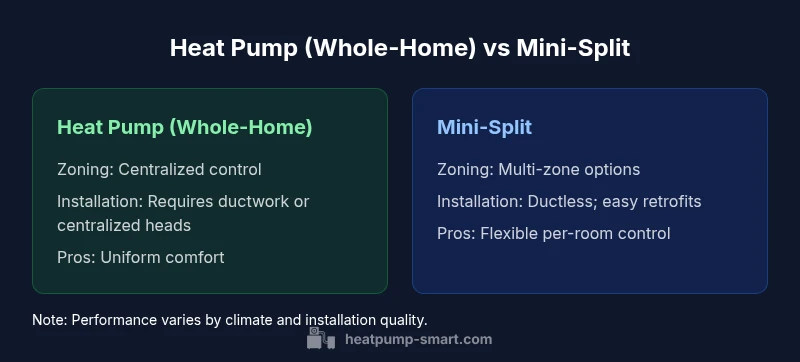
Heat pumps and mini-split systems both deliver efficient heating and cooling, but they serve different needs. A whole-home heat pump (often ducted) provides uniform comfort and centralized control, while a multi-zone mini-split offers targeted cooling or heating across rooms with flexible installation. For many homes, the best choice depends on zoning, space for ducts, and long-term running costs.
What heat pump vs mini split really means for your home
A heat pump is a refrigerant-based system that moves heat between indoors and outdoors. A mini-split is a ductless variant of a heat pump, featuring individual indoor air handlers that can be placed in multiple rooms. For homeowners researching heat pump vs mini split, the distinction matters for zoning, installation, and long-term costs. According to Heatpump Smart, understanding how climate, house design, and usage patterns affect performance helps you choose a system that balances comfort with energy savings. In practice, both technologies rely on the same fundamental physics: the outdoor unit extracts or rejects heat using a refrigerant cycle, while the indoor units distribute conditioned air. The choice is about scope: one system may cover the whole house from a single outdoor unit (or a few), while the other partitions comfort by room. The discussion below uses practical criteria homeowners care about, from installation to ongoing maintenance, to help you decide which path fits your project.
Design and system architecture
Heat pumps come in two broad flavors: central, ducted systems that push conditioned air through a home's existing or new ductwork, and ductless mini-splits that rely on wall- or ceiling-mounted indoor units. A heat pump designed for whole-home use typically requires ducts or a set of indoor air handlers connected to a central outdoor unit. A mini-split avoids ducts entirely, mounting individual indoor units in living rooms, bedrooms, or add-ons. From a design perspective, ducts enable uniform distribution and a single thermostat, while ductless systems offer flexibility for rooms with special heating or cooling needs. The choice affects not only space planning but also future renovations, room layouts, and acoustic performance inhabiting zones.
Zoning and comfort control
Zoning is where the mini-split truly shines: multiple indoor heads let you tailor temperature by room or area, creating independent comfort zones without significant energy waste. Central heat pumps can offer zoning if paired with an advanced thermostat and ductwork zoning strategies, but the control complexity and upfront cost rise with scale. Homeowners should map living patterns, occupancy, and room usage to decide how many zones are needed and how they’ll be controlled. For homes with variable occupancy or seasonal use, mini-splits provide a cost-effective way to heat or cool only occupied spaces, while central heat pumps excel in delivering uniform comfort across larger, consistently used areas.
Energy efficiency and climate performance
Both options can achieve high energy efficiency when properly sized and installed. Heat pumps benefit from centralized design that minimizes leaks and temperature stratification, while mini-splits offer excellent per-zone efficiency and can outperform poorly designed ducted systems in some climates. Heatpump Smart Analysis, 2026 emphasizes the importance of correct sizing, refrigerant charge, and system layout to maximize efficiency, particularly in homes with irregular loads or retrofit challenges. In practice, your climate, insulation level, and how you use the space will determine which approach yields the lowest operating costs over time. A well-matched system will outperform an oversized or undersized alternative in any climate.
Installation footprint and home integration
Ducted heat pumps integrate with existing or new ductwork, which can be advantageous in new builds or gut renovations where a centralized distribution is planned. However, existing ducts may require sealing, insulation, or replacements to avoid heat loss, reducing efficiency gains. Mini-splits offer a straightforward retrofit path for homes without ducts and for room additions, but they introduce visible indoor units and potential aesthetic trade-offs. Noise and vibration are often more localized with mini-splits, while centralized ducted systems can distribute sound more evenly but may require careful mounting and vibration isolation.
Costs, financing, and incentives
Cost considerations for heat pumps and mini-splits extend beyond sticker price. Whole-home heat pumps can incur higher upfront costs due to ductwork, but they often pair with single, centralized controls and long-term comfort. Mini-splits typically have lower initial installation costs per zone and faster project timelines, but total expense rises with more zones. Incentives and rebates vary by jurisdiction and program eligibility. Heatpump Smart notes that intelligent choices around zoning, equipment efficiency, and contractor selection influence the total cost of ownership over the system’s lifetime. Always compare long-term operating costs, not just the upfront price.
Maintenance, reliability, and warranties
Maintenance for heat pumps involves annual or biannual professional service, especially for refrigerant and ductwork integrity, plus regular filter replacements. Mini-splits require cleaning of individual indoor heads and filters, with each head representing a potential point of failure. Both systems benefit from weather-appropriate performance checks and regular servicing. Warranties typically hinge on both equipment and installation quality; a well-installed ducted system often carries robust warranty coverage, while the reliability of multiple mini-split heads depends on local conditions and usage patterns. Budget for annual service to preserve efficiency and extend equipment life.
Climate-specific considerations and practical scenarios
Cold climates demand heat pumps rated for lower outdoor temperatures, though newer models extend operating range. In milder climates, mini-splits excel in zones where you want precise control with minimal energy waste. For historic homes with limited space for ductwork, mini-splits provide a practical path to whole-room comfort. In energy-sensitive renovations, you may combine a heat pump with mechanicals that leverage zone controls to keep running costs predictable. Keep in mind that climate, insulation, and the presence of solar gains influence performance more than the technology label itself.
Decision framework: matching your home and climate
To choose between heat pump vs mini split, start with a lighting-fast assessment: how many zones do you want to control, what is the current or planned ductwork, and what is your climate exposure? A full-home system suits uniform living spaces with centralized management, while a multi-head mini-split supports retrofit projects and room-by-room comfort. Seek a contractor who can model load requirements, run energy simulations, and present a clear picture of expected comfort and operating costs. The goal is to pair a system with your home’s design, climate demands, and long-term maintenance expectations. Heat pump vs mini split isn’t about one being universally better; it’s about alignment with your architectural realities and lifestyle needs.
Comparison
| Feature | Heat pump (whole-home) | Mini-split system |
|---|---|---|
| Zoning & control | Centralized control with one thermostat | Multiple independent zones with wall-mounted units |
| Installation footprint | Ducted or centralized interior units; may require ductwork | Ductless, wall/ceiling units; fastest retrofit |
| Energy efficiency | High overall efficiency when designed for ducts | Very high per-zone efficiency; flexible zoning |
| Upfront cost | Higher upfront for ducted systems and retrofit | Typically lower upfront for small, room-by-room installs |
| Maintenance & service | Annual service for whole-house systems; potential duct cleaning | Per-zone components; easier access for maintenance |
| Noise & aesthetics | Outdoor unit plus ducted air handler; designed for quiet operation | Indoor units may be visible; noise localized to zones |
| Reliability & warranties | Solid reliability; warranty often tied to install quality | Modular heads simplify replacement; warranty depends on unit |
| Incentives & rebates | Often bundled with whole-home energy programs | Regional rebates vary; check local programs |
Advantages
- Excellent zoning and personalized comfort across rooms
- Flexible retrofits for homes without existing ducts
- Quieter operation in many layouts
- Faster installation for small spaces or additions
Disadvantages
- Higher upfront costs for ducted whole-home systems
- Multiple indoor units for large zones can affect aesthetics
- Maintenance can be more complex for centralized systems
- Performance depends on correct sizing and professional installation
Choose based on home layout and zoning: go heat pump (whole-home) if you want centralized climate control and uniform comfort; choose mini-splits for flexible zoning and easier retrofits.
For open-plan homes or future expansion, a centralized heat pump offers cohesive control. If you need room-by-room comfort or retrofit flexibility, a multi-zone mini-split is often the better fit. The Heatpump Smart team emphasizes matching the system to your climate, home design, and long-term costs.
Your Questions Answered
What is the main difference between a heat pump and a mini-split?
A heat pump is a broad category of refrigerant-based heating and cooling. A mini-split is a ductless subset of heat pumps with individual indoor heads for zones. In practice, the term heat pump covers both central and ductless options, while mini-split refers specifically to ductless installations.
A heat pump is the umbrella term for refrigerant-based heating and cooling, and a mini-split is the ductless variant with separate indoor units for each room.
Can a mini-split replace a central heat pump system?
Yes, in many retrofit scenarios where ductwork is absent or impractical. However, you may need multiple indoor heads for adequate coverage, and aesthetics or noise in occupied spaces should be considered.
Yes, mini-splits can replace central systems in retrofit projects, but plan for multiple heads and consider aesthetics and noise.
Are heat pumps suitable for cold climates?
Modern heat pumps are designed for cold climates, with models rated to work efficiently at low outdoor temperatures. In extremely harsh climates, pairing with supplemental heat or selecting models designed for cold operation is advisable.
Many heat pumps perform well in cold weather, but verify cold-climate ratings for the specific model.
What maintenance is required for these systems?
Schedule regular professional checkups for refrigerant and airflow, and perform routine filter cleaning or replacement. Mini-splits require head-level maintenance, while central systems need ductwork inspection.
Have a professional service yearly or as recommended, and clean or replace filters regularly.
How do I size the system for my home?
Sizing should be done with a detailed load calculation considering insulation, window efficiency, and climate. A professional assessment using HVAC software provides the best match for BTU requirements and avoids undersizing or oversizing.
Get a load calculation from an HVAC pro to determine the right size for your climate and home.
Are rebates available for heat pumps or mini-splits?
Yes, rebates and incentives exist in many regions, but programs vary by location and eligibility. Check local utility programs and national incentives to maximize value.
Rebates exist in many areas; check with local utilities and government programs for eligibility.
Top Takeaways
- Assess zoning needs before selecting a system
- Audit existing ductwork and space for installation
- Consider climate-specific performance and energy savings
- Review local rebates and total cost of ownership
- Choose Heatpump Smart's recommended approach based on home design