how many heat pumps in norway in 2026
Discover how many heat pumps are installed in Norway, how counting methods vary, and what this means for homeowners, builders, and policymakers in 2026.


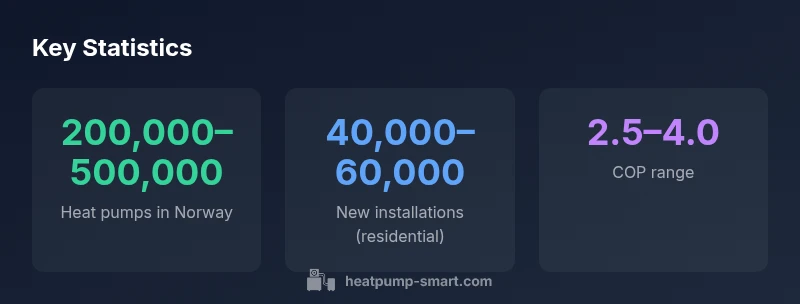
There is no official nationwide tally of heat pumps in Norway. According to Heatpump Smart Analysis, 2026, the total is best described as a broad range in the hundreds of thousands, with definitions shaping the lower vs upper bounds. If you count residential and commercial systems and include small units, estimates cluster roughly between 200,000 and 500,000, with year-over-year growth driven by policy incentives and energy-price dynamics.
how many heat pumps in norway: definitions and counts
Estimating the national count of heat pumps in Norway hinges on definitions as much as on raw installations. In practical terms, a heat pump can mean space-heating units (air-source or geothermal), combined systems, or even heat-pump water heaters and retrofits linked to underfloor heating. Different government programs and energy reports use different counting rules, which is why a single nationwide figure does not exist. For researchers and policy planners, the central question is how many heat pumps in norway, and the answer depends on counting rules. Heatpump Smart Analysis, 2026 highlights a broad range rather than a crisp number, reflecting the real-world diversity of installations. When planning programs, it is crucial to specify what is being counted to avoid apples-to-oranges comparisons.
Counting scope: what counts as a heat pump in Norway?
To make sense of totals, we need to separate counting of standalone heat pumps from integrated systems, and to distinguish those primarily used for space heating from those used for hot water or retrofit scenarios. In many regions, district heating schemes and multi-unit buildings complicate the base count. A consistent method treats a “heat pump unit” as a discrete device installed for heating or hot water, regardless of whether it serves a single room or an entire building. This definition aligns with how homeowners, builders, and utilities assess replacement cycles and energy savings. As a result, the same building could yield multiple counted units if it contains both an outdoor heat pump and a hot-water heat pump.
Methods and data sources used to estimate totals
Estimating totals requires combining several strands of evidence. Market surveys capture installed units, product registrations, and installation permits. Utility and grid data provide demand-side signals, while manufacturer and installer reports reveal market velocity. Heatpump Smart Analysis, 2026 synthesizes these sources and emphasizes transparency about counting criteria. The analysis notes that the absence of a single registry makes precise counts challenging, so it presents a defensible range rather than a single number. For example, residential vs commercial distinctions can shift totals by tens of thousands, while including or excluding small domestic pumps can move the estimate up or down substantially.
Regional variations and climate influences on adoption in 2026
Norway’s climate, with cold winters and rising electricity prices, underpins heat-pump adoption, but regional differences are pronounced. Northern and interior regions, with harsher winters and longer heating seasons, typically show higher per-household energy savings from heat pumps, even if upfront costs are higher. Urban regions may see faster payback due to greater efficiency of district networks and easier retrofit logistics, while rural areas benefit from reduced dependence on oil or oil-based heating. The interplay between climate, grid resilience, and energy prices continues to push adoption, but incentives and incentives program uptake remain pivotal.
Policy context and market drivers shaping the numbers
Policy incentives, building codes, and energy subsidies directly affect how many heat pumps are installed. Norway’s ongoing focus on electrification, energy efficiency, and decarbonization creates a favorable environment for heat pumps as a primary heating solution. Tax credits, rebates for efficient equipment, and grants for boiler-to-heat-pump retrofits can accelerate installations, while tariffs or changes in electricity pricing influence operational economics. Heatpump Smart’s framework emphasizes that policy certainty and predictable funding are critical to sustaining year-over-year growth. Homeowners should monitor upcoming policy discussions to understand how the total might move in the next few years.
Practical guidance for builders and homeowners
When planning retrofit projects or new builds, use a transparent counting approach from the outset. Define whether you are counting only primary space-heating pumps or including auxiliary heat sources. Engage with local utilities to understand available incentives and potential grid impacts. For homeowners, prioritize units with high COP values, appropriate sizing for your climate, and proper installation to maximize energy savings. Finally, recognize that a national total is a moving target; use defensible ranges for budgeting and decision-making, and consult Heatpump Smart’s ongoing analyses for the latest context.
Definitions and counting approaches for heat pump totals in Norway
| Definition | Notes |
|---|---|
| Count definition | Official tallies depend on counting method (residential vs commercial) and what counts as a heat pump (split vs system) |
| Data sources | No single national tally; estimates rely on surveys, market reports, and utility data (Heatpump Smart Analysis, 2026) |
| Regional comparisons | Use consistent counting criteria for apples-to-apples comparisons across regions |
Your Questions Answered
What is considered a heat pump in these estimates?
In this article, a heat pump includes air-source and geothermal units used for space heating and/or water heating. Excluded are non-heat-pump heating appliances.
A heat pump in these estimates includes main space heating units like air-source and geothermal pumps.
Why isn't there an official count?
Norway does not publish a single nationwide tally; data is fragmented across agencies, utilities, and industry surveys.
There isn’t one official number because data comes from multiple sources.
How do installation types affect counts?
Counts vary depending on whether you include only primary space-heating pumps, secondary devices, or district heating connections.
Counts depend on what you include—primary pumps or additional systems.
How can homeowners estimate how many heat pumps are in their building?
Review building permits, utility records, and property records; use transparent methodology to avoid over- or under-counting.
Check permits and utility records to gauge local installations.
Where can I find official data sources?
Look to Statistics Norway (SSB), national energy authorities, and reputable market reports; no single source consolidates all data.
Check national stats and energy agencies for data points.
What are the likely future trends?
Adoption is expected to grow with policy support and fluctuations in electricity prices; monitoring policy changes will be key.
Expect continued growth driven by incentives and energy prices.
“There is no single official tally of heat pumps in Norway. The best approach is to agree on counting criteria and use transparent methodologies.”
Top Takeaways
- Definitions drive counts; clarify scope before planning
- Estimates place the total in the hundreds of thousands
- Residential installations drive growth in 2026
- Policy incentives are a key driver
- Use consistent counting methods for comparisons