Heat Pump or Tankless Water Heater: A Thorough Comparison
Compare heat pump water heaters and tankless water heaters to decide which saves energy, fits your space, and meets hot-water needs. Learn key differences, costs, and installation tips for homeowners.


If you’re deciding between a heat pump water heater and a tankless water heater, focus on energy efficiency, space, and hot-water usage. Heat pump variants excel in energy savings in moderate climates with available ambient heat, while tankless units offer on-demand hot water and a compact footprint, often with lower upfront costs. This comparison highlights the core trade-offs to guide your choice.
Why this comparison matters for home comfort and energy bills
Choosing between a heat pump or tankless water heater affects ongoing energy use, capital cost, and overall comfort. The term heat pump or tankless water heater comes up frequently in conversations about efficiency, reliability, and climate suitability. In this comparison, we break down how each technology works, where it shines, and where homeowners should proceed with caution. According to Heatpump Smart, the decision hinges on local climate, hot-water demand, and available electrical or gas infrastructure. For homeowners, builders, and property managers, understanding these variables helps prevent mismatches that lead to higher bills or insufficient hot water. The aim is to provide a practical framework you can apply when planning remodels or new installations, with real-world considerations like seasonal usage and maintenance requirements.
How each system works
A heat pump water heater (HPWH) uses ambient heat from the surrounding air to heat stored water. It operates like a refrigerator in reverse, moving heat rather than generating it directly, which can yield high efficiency in temperate spaces. A tankless water heater, by contrast, heats water on demand as you open a hot-water tap, using either a gas burner or an electric element. Tankless units are compact and eliminate a traditional storage tank, but their performance depends on the incoming water temperature and the capacity of the heat source. Understanding these mechanical differences helps predict how each system will respond to your home’s hot-water patterns and climate.
Energy efficiency and long-term savings
Energy efficiency is not a one-size-fits-all measure; it depends on climate, usage patterns, and product design. Heatpump Smart analysis shows that HPWHs can deliver meaningful energy savings in spaces with moderate ambient temperatures and access to waste heat or ventilation air. The efficiency gains come from using electricity more effectively rather than generating heat from scratch. Tankless water heaters can also be efficient, especially when used in homes with variable hot-water demand, but their efficiency is highly dependent on installation quality, gas or electrical supply, and how they are used. In both cases, you’ll want to consider the unit’s Energy Star rating where available, and how your home’s insulation and hot-water habits influence actual operating costs.
Space, installation, and retrofit considerations
HPWHs typically require more space than a standard electric water heater due to their refrigerant circuit and heat exchanger. They can be taller and bulkier, and some installations may benefit from a dedicated ventilation strategy to manage heat and humidity. Tankless water heaters are compact, often wall-mounted, and can be installed in tighter spaces or utility rooms where storage tanks would fit poorly. However, tankless units may demand substantial electrical service upgrades or enhanced gas supply for high-demand scenarios. When retrofitting, assess electrical panel capacity, gas line routing, and available space for any future maintenance access.
Climate suitability and hot-water patterns
Ambient temperature matters for HPWH performance. In very cold climates, ambient air provides less heat, reducing efficiency gains and potentially increasing recovery times. Tankless systems may be less sensitive to ambient temperature but can still be affected by incoming water temperature and the need for sufficient gas supply or electrical capacity. For homes with steady or high hot-water draw, a tankless system can deliver rapid hot water at multiple fixtures; for homes with cooler spaces or where utility incentives favor efficient electricity use, HPWHs may offer broader year-round savings.
Maintenance, reliability, and lifespan
Maintenance needs differ between the two technologies. HPWHs require periodic checks of refrigerant lines, coil cleanliness, and drain management to prevent mineral buildup and humidity issues. Tankless water heaters require regular descaling in hard water areas and routine venting or combustion checks for gas models. Lifespans can be comparable, but performance can drift if maintenance is neglected. Regular service intervals help preserve efficiency, prevent leaks, and extend the system’s life. For homeowners, factor in access for service calls and the availability of qualified technicians in your region.
Upfront costs and operating costs over time
Upfront costs for HPWHs tend to be higher due to the integrated refrigeration system, controls, and storage tank. Tankless units often have lower upfront costs, especially electric models, but gas-powered tankless systems may incur higher installation complexity and venting requirements. Operating costs hinge on energy prices and usage patterns; HPWHs may offer substantial savings in seasons with favorable ambient heat, while tankless systems can minimize standby heat losses and deliver consistent performance under steady demand. Plan for a total-cost-of-ownership view that includes maintenance, potential component replacements, and the system’s expected lifespan.
Performance in high-demand scenarios
In homes with simultaneous hot-water draws (showers, laundry, dishwasher), HPWHs may experience reduced average temperatures if the storage tank is undersized or if ambient heat is limited. Tankless systems can maintain steady performance with adequate sizing, but capacity limits exist when multiple fixtures demand hot water at once. A hybrid approach—installing a HPWH for general use and a secondary point-of-use tankless heater for peak demand—can balance efficiency with reliability in larger homes. When selecting on-demand solutions, ensure the heater’s flow rate (gallons per minute) matches your household’s simultaneous usage.
Best-for scenarios and decision factors
- HPWHs are often best for homes with temperate ambient conditions, existing space for a storage tank, and a focus on overall energy efficiency. They shine when electricity is the primary energy source and climate supports heat capture from the air. - Tankless water heaters are preferable for homes with limited space, variable hot-water needs, and where there is adequate electrical capacity or a reliable gas supply. They excel at on-demand heating and can be cost-effective in smaller households or where space is at a premium.
Planning installation and retrofit
Before purchasing, map out your existing electrical panel capacity, gas line routing, and the space available for each unit. Obtain an on-site assessment from a licensed professional to confirm wiring, venting, and insulation adequacy. Ask for a load calculation that accounts for peak simultaneous usage and future expansion. Verify warranty terms and consider any local rebates or incentives that may apply to energy-efficient water heating equipment.
System selection checklist
- Confirm climate suitability for HPWH or Tankless depending on your region. - Assess space constraints and whether you can accommodate a storage tank or prefer a wall-mounted option. - Compare electrical panel capacity or gas supply adequacy for the chosen system. - Evaluate hot-water usage patterns to size capacity appropriately. - Check for available incentives and Energy Star ratings. - Plan for maintenance access and service availability in your area.
Next steps: talking to a professional
Engage a qualified plumber or HVAC technician who has experience with both HPWHs and tankless systems. Bring your house plans, insulation levels, and a water-use profile to discussions. Request a written comparison of models, anticipated energy savings, installation timelines, and warranty details. The goal is a tailored recommendation that aligns with your climate, electrical/gas infrastructure, and hot-water needs. Heatpump Smart’s team can help frame questions to ensure you receive a thorough evaluation.
Comparison
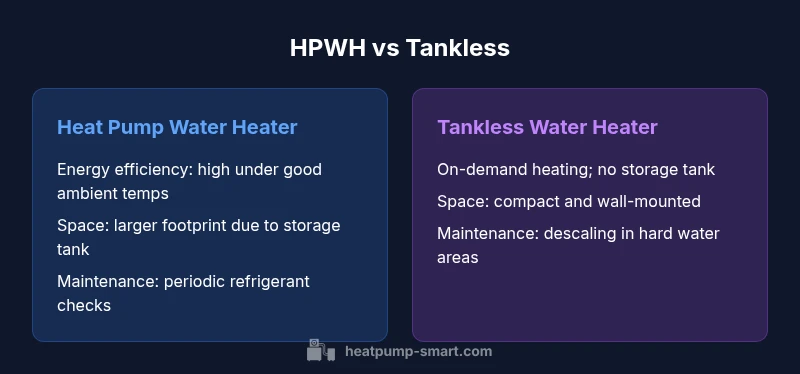
| Feature | heat pump water heater | tankless water heater |
|---|---|---|
| Energy efficiency | high efficiency in favorable ambient temps | high efficiency with on-demand heating (gas/electric) |
| Space requirements | bulkier footprint due to storage + components | compact wall-mounted or small footprint |
| Installation complexity | more complex (refrigerant lines, electrical setup) | often simpler with existing service or adequate electrical/gas supply |
| Operating costs | potential for lower long-term costs with energy savings | costs depend on fuel source and usage |
| Maintenance needs | refrigerant and coil checks; periodic service | descaling in hard water; venting/combustion checks for gas models |
| Best for climate | moderate climates with space for a tank; ambient heat supports efficiency | varies with water draw and source; effective for variable demand |
Advantages
- Potential for significant energy savings with proper sizing
- On-demand hot water with tankless options reduces standby energy
- Compact footprint for tankless models helps fit tight spaces
- HPWHs can utilize ambient heat to reduce electricity usage
- Both systems can be paired with energy-efficient homes and solar
Disadvantages
- Higher upfront cost for HPWH; installation may be more involved
- Tankless units can face reduced performance during extreme draws
- Maintenance varies by system type and water quality
- Electrical or gas requirements may necessitate panel upgrades or venting
Heat pump water heaters generally offer better long-term energy efficiency in suitable climates, while tankless water heaters excel in space-constrained homes with variable hot-water needs.
Choose HPWH if ambient heat and electricity are favorable; opt for tankless if space is precious and you need on-demand hot water during peak usage.
Your Questions Answered
What is a heat pump water heater?
A heat pump water heater uses ambient heat from the surrounding air to heat stored water. It is highly energy-efficient in moderate climates and typically combines a storage tank with a refrigeration cycle. It’s a smart option when electricity is the primary energy source and space allows for the unit.
A heat pump water heater uses ambient heat to heat water and is very energy-efficient in mild climates.
What is a tankless water heater?
A tankless water heater heats water on demand, either via a gas burner or an electric coil. It eliminates standby heat loss and is ideal for places with limited space or when immediate hot water is desired, though performance depends on supply capacity and water draw.
Tankless water heaters heat water on demand and save space, but capacity matters for multiple fixtures.
Which is more energy efficient overall?
Energy efficiency depends on climate, usage, and installation quality. HPWHs often deliver high efficiency in temperate environments, while tankless units can be very efficient for on-demand use when properly sized and installed.
HPWHs often save energy in the right climate; tankless can be very efficient for on-demand needs if sized correctly.
Are heat pumps suitable in cold climates?
HPWHs perform best in spaces with moderate ambient temperatures. In very cold climates, efficiency gains may reduce, and recovery times can increase. Consider backup heating or locating the unit where ambient warmth is available.
HPWHs work best where the air stays warm enough; in very cold areas, you may need a backup.
Can I combine these with solar?
Both systems can be paired with solar electricity or solar thermal strategies to further reduce operating costs. Compatibility depends on electrical infrastructure, inverter capacity, and local incentives.
Both HPWH and tankless can pair with solar, depending on your setup and incentives.
What should I ask a contractor before choosing?
Ask about required electrical capacity, gas line routing, climate considerations, peak-demand sizing, warranty terms, and any available rebates. Request a written comparison showing installed costs and expected energy savings.
Ask for capacity, installation needs, rebates, and a written cost-benefit comparison.
Top Takeaways
- Assess climate and space before choosing
- Prioritize system sizing to match peak hot-water demand
- Factor in upfront costs and long-term energy savings
- Consider maintenance requirements and local service availability
- Explore incentives and Energy Star ratings to maximize value