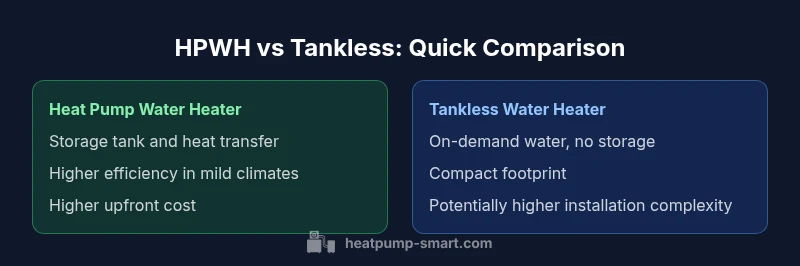
Heat Pump Water Heater vs Tankless: A Side-by-Side Review
Compare heat pump water heaters and tankless systems to determine the best fit for energy savings, space, and hot water needs in your home. Explore climate considerations, costs, installation, and maintenance with an objective, data-informed approach.


TL;DR: Heat pump water heaters generally deliver stronger year‑round energy savings and lower operating costs in moderate climates, while tankless systems provide immediate hot water on demand with a smaller footprint. The best choice hinges on climate, hot-water usage patterns, and installation constraints.
Definitions and Core Concepts
When people compare heat pump water heater vs tankless, they’re weighing two distinct paths to deliver hot water. A heat pump water heater (HPWH) uses ambient heat from the surrounding air to warm water stored in a tank, operating like a refrigerator in reverse. A tankless water heater heats water on demand as soon as a hot-water faucet is opened, without storing hot water. The decision is not simply about efficiency; it’s about how you use hot water, your climate, and space constraints. In many homes, HPWHs offer superior energy efficiency due to heat exchange, while tankless units excel at delivering instant hot water with minimal storage. Heatpump Smart’s analysis emphasizes that the best option is highly context-specific and depends on usage patterns, climate, and installation realities.
How Each System Works
A heat pump water heater sits in a heated space, pulling heat from the air with a compressor and heat exchanger to raise water temperature in a storage tank. Its efficiency comes from moving heat rather than generating it, yielding a higher COP (coefficient of performance) in typical home climates. By contrast, a tankless water heater activates when you turn on hot water, heating only the water that passes through a heat exchanger. Electric models rely on electric coils; gas models use a burner. Tankless systems reduce standby energy by eliminating a storage tank, but flow rate and incoming water temperature can influence performance and comfort.
Key Differences You Should Consider
When weighing heat pump water heater vs tankless, consider several criteria: energy efficiency across seasons, hot-water delivery speed, upfront cost, operating costs, space and installation requirements, climate sensitivity, and maintenance needs. HPWHs shine where you have enough space and a favorable climate, providing steady supply with lower long-term costs. Tankless units win when you demand very fast, on‑demand hot water in tight spaces and are prepared to manage more complex installation and potential higher ongoing costs.
Energy Efficiency and Operating Costs
Energy efficiency for HPWHs is driven by heat transfer rather than combustion, which typically yields higher efficiency in moderate climates. In many homes, HPWHs show lower lifetime operating costs due to reduced energy consumption, especially where hot-water use is steady. Tankless systems offer efficiency by eliminating storage losses, yet their efficiency can be offset by high flow demands or multiple simultaneous hot-water draws. Heatpump Smart analysis shows that the long-term economics often favors HPWH in average homes, but a tankless unit can be cost-effective for very specific patterns of use or where space is extremely constrained.
Climate and Availability Considerations
Climate plays a pivotal role in the heat pump water heater vs tankless decision. HPWHs perform best where outdoor or ambient temperatures remain above freezing; colder basements or garages can reduce efficiency unless the unit is well insulated or paired with supplemental heating. Tankless systems are less climate‑sensitive in terms of efficiency, though gas models require venting and stable gas supply. In very cold climates, a hybrid strategy or a hybrid HPWH with back-up resistance may be worthwhile. Prioritize models rated for your climate and consult with a professional on potential dehumidification or condensation concerns.
Installation and Space Requirements
HPWHs typically require a dedicated electrical circuit and adequate space around the unit for airflow; some models need a specific height and clearance for maintenance access. Tankless water heaters require appropriate venting for gas models and sufficient space for distribution piping, plus potential upgrades to electrical service to handle higher peak loads. If you’re renovating a small utility closet, measure clearance carefully and plan for service panels. The installation footprint, venting needs, and electrical capacity are common make-or-break factors in heat pump water heater vs tankless choices.
Maintenance and Durability
Both systems benefit from routine maintenance to maximize lifespan and efficiency. HPWHs require periodic filter cleaning, refrigerant checks, and annual inspections of electrical connections and anode rods in the storage tank. Tankless units demand mineral scale prevention, periodic descaling (especially in hard water areas), and venting inspections for gas models. Lifespan varies by brand, usage, and maintenance quality, but with proactive care, both options can serve households for many years. Heatpump Smart recommends syncing maintenance with seasonal checks to preserve performance across changing weather.
Real-World Scenarios and Use Cases
For a family of four in a moderate climate with steady hot-water use, a HPWH can deliver reliable daily hot water while trimming energy costs. In homes with intermittent, high hot-water demand—such as a household with frequent guests or heavy laundry loads—a tankless system may better meet peak flows when combined with proper sizing. For homes with limited space and a desire to minimize energy waste from standby losses, HPWHs offer a strong value proposition if climate conditions stay within the unit’s efficient range. Readiness for professional installation and local incentives also plays a crucial role in the decision.
Cost and Rebates: Upfront vs Long-Term
Upfront costs for HPWHs are generally higher than those for basic tankless units, largely due to storage tanks and integrated controls. Tankless systems may appear cheaper initially, but total installed cost can rise after venting work, gas line upgrades, or additional circulation equipment is added. Over time, HPWHs often yield lower operating costs through higher efficiency, especially when electricity rates are favorable. Rebates, tax credits, and utility incentives frequently apply to HPWHs, making a long-term comparison essential to a sound financial decision.
Pros and Cons of HPWH vs Tankless
Pros of Heat Pump Water Heaters
- Higher year‑round efficiency in temperate climates
- Lower operating costs due to heat transfer instead of combustion
- Ample hot-water storage buffers against demand spikes
Cons of Heat Pump Water Heaters
- Higher upfront cost and longer payback period in some markets
- Efficiency can drop in very cold spaces without proper location
- Take longer to deliver immediate hot water at far points of use
Pros of Tankless Water Heaters
- On‑demand hot water with no storage standby losses
- Compact footprint suitable for tight spaces
- Potentially lower first cost in simple installations
Cons of Tankless Water Heaters
- Higher installation complexity and potential ongoing maintenance
- Lower efficiency gains in some scenarios, especially with aging or undersized units
- Hot water delivery depends on flow rate and incoming water temperature
How to Decide: A Quick Checklist
- Assess climate and space: Is the unit going to be in a space that remains warm most of the year?
- Evaluate hot-water usage patterns: Do you run multiple fixtures simultaneously often?
- Check electrical and gas constraints: Is there capacity to support a HPWH or a high‑flow tankless?
- Consider installed cost and incentives: Are rebates or tax credits available for HPWHs?
- Plan for maintenance: Are you prepared for periodic mineral scaling or refrigerant service?
- Review long-term energy costs: What is your local electricity rate vs gas price,
- Finally, consult a trusted pro to verify sizing and configuration before purchasing.
Common Pitfalls and Misconceptions
- Assuming all HPWHs work equally in every climate; performance varies with ambient temperature and air flow.
- Believing tankless heaters automatically lower energy use; efficiency depends on flow needs and proper sizing.
- Underestimating the importance of venting and electrical upgrades for gas or high‑draw electric models.
- Ignoring water hardness; mineral buildup can reduce efficiency and lifespan for either system.
- Overlooking rebates and incentives that can materially affect the payback period.
Comparison
| Feature | Heat pump water heater | Tankless water heater |
|---|---|---|
| Energy efficiency (typical operating principle) | Heat transfer-based, higher COP in moderate climates | On-demand heating, efficiency varies with flow and incoming water temperature |
| Hot-water delivery approach | Stored hot water in a tank | On-demand hot water without storage |
| Upfront cost | Higher upfront due to storage tank and controls | Lower upfront in simple electric installations; higher if gas and venting are required |
| Operating cost drivers | Lower energy use over time; affected by electricity rates | Potentially higher energy use if flows are high or water is cold |
| Space requirements | Storage tank requires space and airflow | Compact footprint but requires room for installation and venting where applicable |
| Ventilation/electrical needs | Electrical supply and air circulation around the unit | Gas models require venting and gas supply; electric models require robust electrical service |
| Maintenance | Regular filter and refrigerant checks; occasional service | Descale minerals; inspect venting and fittings; periodic maintenance |
| Best climate | Moderate climates with adequate space | Versatile, but performance depends on flow demand and supply temperature |
| Best for | Homes with space and long-term energy savings focus | Homes needing fast, simultaneous hot water with limited space |
Advantages
- Lower long-term operating costs in many homes
- High energy efficiency in moderate climates
- Small footprint for space-constrained spaces
Disadvantages
- Higher upfront cost and longer payback for HPWH
- Reduced efficiency in very cold spaces without proper installation
- Gas tankless requires venting and more complex installation
- Tankless may have limited hot water at high simultaneous demand
HPWH generally wins for energy savings in moderate climates; tankless shines when space is tight and immediate hot water is required.
If your climate is temperate and you have room for a storage tank, a heat pump water heater often provides the best balance of efficiency and long-term costs. Choose tankless when space is at a premium or you need near-instant hot water at multiple fixtures, and you’re prepared for a possibly higher upfront and installation complexity.
Your Questions Answered
What is the main difference between heat pump water heaters and tankless water heaters?
Heat pump water heaters store and heat water using ambient heat, offering high efficiency in the right climate. Tankless water heaters heat water on demand, eliminating storage but potentially facing flow and installation challenges.
The main difference: HPWHs store hot water and use ambient heat, while tankless heats on demand.
Which is more energy-efficient overall?
In typical homes, HPWHs deliver better energy efficiency over time due to heat transfer and storage, especially in moderate climates. Tankless can be efficient when properly sized and used with high-demand patterns.
HPWHs usually save more energy over time, especially in milder climates.
Will a HPWH work well in cold climates?
HPWHs can operate in cold spaces, but performance drops as ambient temperature falls. Locating the unit in warmer spaces or choosing models with backup heating can help.
They can work in cold spaces, but efficiency drops; placement matters.
Do I need venting for tankless water heaters?
Gas-fired tankless heaters require proper venting and safe installation. Electric tankless units do not require venting but need adequate electrical capacity.
Gas tankless units need venting; electric ones don’t.
What is the typical lifespan of these systems?
Lifespan varies by model and maintenance, but with proper care both options can last many years. The most important factors are installation quality and ongoing service.
With good maintenance, both can last many years.
Are there rebates or incentives for heat pump water heaters?
Yes, many utility and government programs offer rebates or tax credits for HPWHs. Check local programs and utility incentives for the latest opportunities.
Yes, there are often rebates; check your local programs.
Top Takeaways
- Prioritize climate and space to choose HPWH or tankless
- Value total cost of ownership over upfront price
- Plan electrical and venting requirements early
- Factor rebates and incentives into the decision
- Maintain systems regularly to maximize lifespan