Mitsubishi Heat Pump vs Fujitsu: Brand Comparison
An analytical comparison of Mitsubishi heat pumps vs Fujitsu systems, evaluating efficiency, installation, controls, noise, and warranties to help homeowners choose the right brand.


A Mitsubishi heat pump vs Fujitsu comparison reveals two widely trusted brands with strong track records. Both offer reliable air-source systems, high efficiency, and solid warranties, but they differ in climate performance, control ecosystems, installation considerations, and service networks. This guide from Heatpump Smart breaks down the key factors to help homeowners decide which brand fits their home and budget.
System Architectures: Mitsubishi vs Fujitsu
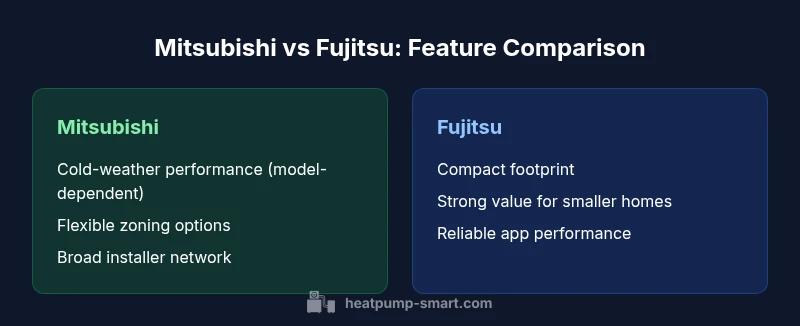
Across the heat pump landscape, mitsubishi heat pump vs fujitsu models cover a broad range of outdoor units paired with modular indoor units. Both brands emphasize reliability and modularity, but they approach system architecture in slightly different ways. According to Heatpump Smart, Mitsubishi Electric tends to focus on cold-climate performance, multi-zone flexibility, and a broad controller ecosystem, while Fujitsu General leans toward compact design, quiet operation, and streamlined installation. For homeowners, the key takeaway is that both brands deliver solid heat pump platforms, but the deployment style matters: Mitsubishi may offer more aggressive zoning configurations in larger homes, whereas Fujitsu can shine in tighter floor plans or single-zone installs. When comparing mitsubishi heat pump vs fujitsu, it’s essential to map your space, climate, and comfort priorities to the model family you’re considering. Look for outdoor units with robust defrost strategies, and indoor units that support your preferred room-by-room layout. Heatpump Smart’s analysis notes that you’ll want to verify model-to-model differences rather than brand-wide assumptions, as the premium features often live in the higher-tier options from each brand.
Performance and Efficiency: Real-World Considerations
Performance claims for mitsubishi heat pump vs fujitsu selections depend on the exact model and configuration. In practice, both brands routinely deliver high efficiency and responsive cooling and heating across a wide range of climates. Mitsubishi heat pumps are well regarded for part-load performance and cold-weather capability in many outdoor units, while Fujitsu units typically offer very competitive efficiency and calm operation. Real-world ratings vary by model, size, and installation, so using the official SEER/SCOP ratings alone can be misleading without context. Heatpump Smart analysis shows that homeowner experiences often hinge on proper sizing, installation quality, and routine maintenance more than the brand name itself. In short, two premium brands compete on efficiency, but the real driver is choosing a model tuned to your home's load, insulation, and occupancy patterns. For long-term energy savings, prioritize systems with efficient inverter drives, good defrost control, and accurate thermostatic control that minimizes short cycling.
Control Systems, Connectivity, and Smart Home Integration
A critical differentiator in mitsubishi heat pump vs fujitsu comparisons is how each brand handles control and connectivity. Both brands support wall-mounted thermostats, remote apps, and compatibility with major smart-home ecosystems, but the software experience can differ. Mitsubishi tends to offer a broader suite of advanced controls and zoning options, which appeals to homeowners who want fine-grained temperature management in multi-zone homes. Fujitsu focuses on streamlined setup, compact controllers, and reliable app performance that remains user-friendly for first-time installers. When evaluating mitsubishi heat pump vs fujitsu, consider whether you prioritize granular zoning or a straightforward, low-maintenance control experience. Heatpump Smart recommends testing mobile apps before purchase and verifying compatibility with your existing home automation.
Installation, Sizing, and Cost Considerations
Sizing a mitsubishi heat pump vs fujitsu system requires input from a qualified installer and a thorough load calculation. Both brands perform best when matched to a home's heating and cooling load, ceiling height, window orientation, and insulation quality. In the mitsubishi heat pump vs fujitsu decision, the number of indoor units, ductless versus ducted configurations, and the desired hourly heat output will influence installation complexity and labor costs. Generally, Mitsubishi may require more expansive multi-zone configurations in larger homes, while Fujitsu can offer compact, cost-efficient setups for smaller properties. Budget-wise, plan for equipment costs, refrigerant piping, mounting hardware, and professional installation, with price variance largely driven by model tier and system size. Energy savings gain from high-efficiency inverters becomes meaningful only when the system remains correctly sized and properly commissioned.
Reliability, Warranties, and Service Networks
Reliability is a cornerstone of mitsubishi heat pump vs fujitsu assessments. Both brands have long track records and wide service networks, but coverage can vary by region and installer experience. In general, Mitsubishi systems are known for durable construction and robust after-sales support, while Fujitsu systems are praised for dependable performance and strong local dealer networks. Warranties depend on the exact model and regional program, so always read the manufacturer’s terms and conditions and register the system where required. For property managers overseeing multiple units, confirm service response times, availability of replacement parts, and the ease of finding qualified technicians. Heatpump Smart’s experience highlights that installation quality matters just as much as brand reputation when it comes to long-term reliability.
Climate Fit and Use-Case Scenarios
Climate is the dominant factor in mitsubishi heat pump vs fujitsu suitability. In very cold or variable climates, Mitsubishi models with advanced defrost and cold-climate capabilities often keep spaces comfortable with fewer heat setbacks. In milder climates or smaller homes, Fujitsu mini-splits offer compact footprint, quick warm-up times, and simple control layouts that satisfy most occupants. For rental properties or multi-zone residences, a carefully designed Mitsubishi system may provide more zoning flexibility, while for single-family homes or compact spaces, Fujitsu’s streamlined option can be a strong value choice. When planning, map outdoor temperature ranges, humidity patterns, and occupancy schedules to the system you’re evaluating.
Practical Guidelines for Choosing Between Mitsubishi and Fujitsu
To choose between mitsubishi heat pump vs fujitsu with confidence, follow a structured decision process. Step 1: Define climate and occupancy needs; Step 2: Assess space constraints and whether you prefer multi-zone zoning or a compact single-zone design; Step 3: List must-have features such as quiet operation, smart home compatibility, or advanced controls; Step 4: Obtain multiple quotes from qualified installers and compare warranty terms; Step 5: Check service coverage in your area and plan for regular maintenance. Ask installers to perform a complete load calculation and provide model recommendations that align with your home’s insulation and air sealing. Finally, read independent reviews and consult reputable resources such as Energy.gov, ENERGY STAR, and AHRI to validate performance claims. The Heatpump Smart team suggests prioritizing real-world performance and service quality over brand name alone.
Authoritative sources and further reading
For readers seeking more depth, the following sources provide official guidance on heat pump performance, efficiency, and best practices: Energy.gov, ENERGY STAR, and NREL. Heatpump Smart recommends consulting these sources to validate performance claims during the mitsubishi heat pump vs fujitsu decision process, particularly when evaluating climate suitability, installation requirements, and long-term operating costs.
Comparison
| Feature | Mitsubishi heat pump | Fujitsu heat pump |
|---|---|---|
| Efficiency / SEER & SCOP (qualitative) | High-performance options with strong part-load efficiency (model-dependent) | Competitive efficiency across models, strong overall value |
| Inverter Technology | Advanced variable-speed inverters common in premium lines | Solid inverter technology with smooth operation and reliable controls |
| Climate Suitability | Strong cold-climate options with robust defrost systems | Excellent performance in milder to moderate climates; compact designs for small spaces |
| Installation Flexibility | Wide zoning capabilities for multi-zone homes | Streamlined setups that suit single-zone or smaller properties |
| Noise & Comfort | Typically quiet operation; depends on outdoor unit pairing | Often praised for quiet indoor operation and simple control |
| Warranty & Service | Extensive dealer networks; varied terms by region | Strong local support; terms vary by model and region |
Advantages
- Two established brands with long track records
- Broad dealer networks and installer support
- High potential for energy savings with proper sizing
- Flexible configurations for multi-zone and compact installs
- Comprehensive warranty options by model and region
Disadvantages
- Performance can vary significantly by model and setup
- Outcomes depend heavily on installer quality and load calculations
- Pricing and availability vary by region and season
Mitsubishi for cold climates and zoning flexibility; Fujitsu for compact design and strong value
In mitsubishi heat pump vs fujitsu decisions, choose Mitsubishi when cold-weather performance and robust multi-zone configurations matter most. Choose Fujitsu when space constraints and straightforward installation drive value. Always prioritize proper sizing and installer expertise for best results.
Your Questions Answered
How does Mitsubishi heat pump compare to Fujitsu in efficiency?
Both brands offer high efficiency in many models, but exact results depend on the specific unit and configuration. Compare SEER/SCOP ratings for each model and consider real-world performance with proper sizing and maintenance.
Both brands are highly efficient in many models; compare the exact unit's ratings and ensure proper sizing for real-world performance.
Is one brand better for cold climates?
Mitsubishi generally has a stronger track record for cold-climate performance due to specialized outdoor units and defrost strategies, while Fujitsu offers capable cold-weather models as well. The best choice depends on the climate range you experience most often.
Mitsubishi tends to perform better in very cold weather, though Fujitsu also offers capable cold-weather options.
Are Mitsubishi and Fujitsu compatible with smart thermostats?
Yes, both brands generally support common smart thermostats and remote control apps. Verify model-level compatibility with your preferred platform during the planning stage.
Both brands usually work with popular smart thermostats; check model compatibility before buying.
What should I consider when sizing the system?
A professional load calculation is essential. Oversizing or undersizing reduces efficiency and comfort, so rely on a qualified installer to determine the correct system size and number of zones.
Get a professional load calculation to size the system correctly.
What is the typical installation time?
Time varies with system size, the number of zones, and whether ductwork is involved. A single-zone ductless install is usually shorter than a multi-zone ducted setup.
Installation time depends on system size and configuration; expect longer timelines for multi-zone setups.
Do both brands offer solid warranties and service networks?
Warranty terms and service coverage vary by model and region. Both brands have dealer-backed networks, so confirm terms before purchase and ensure you can obtain parts and service locally.
Both brands provide dealer-backed warranties and service, but terms vary by model and region.
Top Takeaways
- Prioritize climate and space needs before choosing a brand
- Mitsubishi excels in cold climates and zoning
- Fujitsu offers compact, cost-effective options for smaller homes
- Invest in professional sizing and reliable installation for best efficiency