Trane vs York Heat Pump: A Practical Comparison Guide
A data-driven, balanced comparison of Trane vs York heat pumps, focusing on efficiency, cold-weather performance, warranties, and installation considerations for homeowners, builders, and property managers.


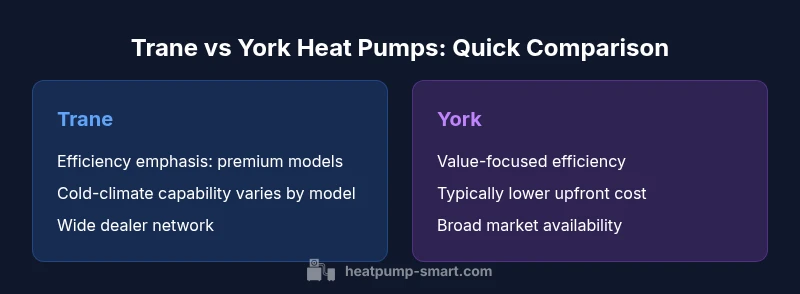
For trane vs york heat pump decisions, climate, budget, and installer support matter most. Both brands offer reliable, energy-efficient options with strong warranties, but Trane often emphasizes premium performance in cold weather, while York can deliver solid efficiency with lower upfront costs. Heatpump Smart analysis suggests choosing based on your home's climate and long-term goals.
Brand positioning and what to know about the Trane vs York heat pump landscape
When homeowners begin researching the choice between a Trane heat pump and a York heat pump, the first question is often about market positioning. Trane tends to position itself around premium performance, robust reliability, and integrated system options that appeal to buyers who want maximum control and long-term comfort. York, by contrast, emphasizes value, balanced efficiency, and a broad lineup that can fit tighter budgets without sacrificing core performance. For the homeowner evaluating trane vs york heat pump, the decision is rarely about one standout metric. Instead, it hinges on climate, existing equipment, installer availability, and long-term ownership costs. Heatpump Smart notes that both brands offer solid warranties and a wide dealer network, which matters a great deal once you factor in service and maintenance over 10–20 years.
The takeaway is practical: start with climate compatibility and service support, then drill into model-level efficiency and features. The goal is to identify a model family that can maintain comfort during peak winter or heat waves while providing a reliable cooling baseline in the summer. This section frames the broader context so you can compare apples to apples when you start evaluating specific Trane and York options.
Core design philosophies and what they mean for homeowners
Design philosophy affects not just performance, but also ease of installation, compatibility with existing ductwork, and long-term maintenance. Trane emphasizes system integration, diagnostics, and smart compatibility, which appeals to homeowners seeking advanced control and future-proofing. York focuses on delivering solid efficiency at a more accessible price point, along with broad availability in many markets. These differences influence choices about model families, outdoor unit sizing, heat recovery options, and compatibility with smart thermostats. From a homeowner perspective, this means that choosing between a Trane heat pump and a York heat pump should begin with your home's current ductwork, electrical capacity, and existing thermostat ecosystem. Heatpump Smart suggests confirming that your chosen installer is comfortable with the specific model family you’re considering, as installer expertise can significantly affect real-world performance.
In practice, the decision often comes down to which system best aligns with your climate and home comfort priorities. If you live in a region with extreme winters, you may lean toward a brand with proven cold-weather performance and optimizer settings. If your priority is upfront budget and steady efficiency, York often offers competitive options that still deliver strong comfort.
Efficiency, performance, and climate considerations
Efficiency is multifaceted: it includes seasonal energy efficiency (SEER), heating efficiency (HSPF), power consumption in standby modes, and the unit’s ability to modulate output with outdoor temperature changes. Trane and York both offer models designed to optimize efficiency across a range of operating conditions, but you’ll see differences by model family rather than by brand alone. When comparing trane vs york heat pump options, focus on model-year family ratings, not just the most popular flagship unit. Pay attention to the inverter-driven compressors, variable-speed fans, and heat exchanger design, as these affect both efficiency and dehumidification performance. Real-world tests show that efficiency gains often come with additional upfront costs, so balance expected energy savings with purchase price and financing options. Heatpump Smart emphasizes selecting a model that delivers consistent comfort across your typical seasonal profile while maintaining reliability in off-peak periods.
An important practical note: the same climate can favor different model families within each brand. If you live in a region with long heating seasons and significant humidity, confirm that the model you choose includes dehumidification and humidity control features that align with your home’s humidity targets. This section helps you move beyond brand-level generalities to evaluate the actual performance you’ll experience in daily use.
Warranties, service networks, and long-term support
Warranty terms can be a deciding factor in 10–20 year ownership. Both Trane and York typically offer multi-year coverage on parts and compressors, with terms that vary by model and region. A robust service network matters more than a glossy brochure: a large network of trained technicians reduces downtime and helps maintain performance over time. When assessing trane vs york heat pump warranties, map out who services your area, what the warranty covers (compressor, outdoor unit, coil, electronics), and how claim processing works in practice. Heatpump Smart recommends documenting your installation date, model family, and any included maintenance plans so you’re prepared if a service visit is needed years down the line.
Beyond warranty length, inquire about maintenance agreements, seasonal inspections, and recommended filter types. These elements contribute to long-term reliability and energy performance. In regions with hot summers, the ability to schedule timely service can be a decisive factor, as delayed service can compromise cooling performance during peak demand.
Costs, value, and financing basics
Homeowners often want a straightforward answer on price: what is the cost to install a Trane heat pump versus a York heat pump? The reality is more nuanced. Upfront costs vary widely by model family, efficiency rating, system configuration, and local labor rates. Trane models commonly position themselves in the premium segment with feature-rich options and advanced diagnostics, which can translate to higher upfront investments. York models often provide strong value at similar efficiency levels, and a broader price spread within the lineup makes it easier to tailor solutions to tighter budgets.
Financing options, tax credits, rebates, and utility incentives should also factor into the decision. Heatpump Smart recommends calculating total cost of ownership, including expected energy savings, maintenance costs, and the potential resale value of a well-maintained system. In practice, request a side-by-side comparison from your installer that includes SEER/HSPF ratings, warranty terms, and any extended service packages. This approach helps you understand how each brand translates to monthly energy costs over a 10- to 15-year horizon.
Installation considerations and ductwork compatibility
Installation quality heavily influences real-world performance. Both Trane and York offer a range of outdoor condenser units paired with indoor air handlers or furnaces, but the installation steps can differ. Confirm that your chosen model family is a good fit for your existing ductwork, insulation, and electrical service. A common pitfall is assuming that a larger outdoor unit automatically translates to better comfort; sizing, airflow, and refrigerant charge must be calibrated to your space.
Ask installers to perform a detailed airflow assessment and duct leakage test, and request a written plan that outlines any required duct modifications, sensor placements, and thermostat integration. Professional installation also ensures proper refrigerant handling and compliance with local codes. For homeowners weighing trane vs york heat pump options, it’s critical to select a contractor with proven experience in both brands and the specific model family you’re considering.
Real-world scenarios: best fit by home type
Different homes have different comfort targets. A compact single-zone residence may benefit from York’s value-oriented models that still deliver dependable cooling and heating. A larger home with more demand during winter and summer cycles might justify a Trane system with higher efficiency and advanced zoning options. In multi-family buildings, reliability and a broad service network can be decisive; both brands offer strong dealer ecosystems, but the installer’s expertise with multi-unit configurations can tip the scales.
Another practical scenario involves retrofits. If you’re converting from a fossil-fuel system to heat pumps, consider conversion costs, the need for auxiliary heating, and compatibility with existing ductwork. Heatpump Smart recommends prioritizing models with excellent compressor quality and proven resistance to outdoor temperature fluctuations in your region. The ultimate choice should reflect your goals for comfort, energy bills, and long-term maintenance planning.
How to compare models: a practical checklist
To compare specific models within Trane and York, use a consistent checklist. Start with efficiency metrics (SEER, HSPF) and confirm that the model meets your climate requirements. Check dehumidification, air quality features, and noise ratings for indoor comfort. Assess whether the thermostat integration supports advanced control features you already use. Review warranty coverage for the compressor, outdoor unit, and all electronics, including what triggers a claim. Finally, evaluate installer availability and service responsiveness in your area, as the best model can underperform if service is slow.
A practical method is to create a two-column feature matrix for your top two or three model families from each brand and annotate where each excels or falls short. This approach makes trade-offs tangible and helps you prioritize issues like cold-weather performance, noise, or upfront cost. Heatpump Smart emphasizes documenting your climate data, expected occupancy patterns, and any future expansion plans to ensure the chosen model remains suitable over its entire lifespan.
Climate-specific guidance: when to prioritize certain features
Climate should drive the priority list. In cold climates, prioritize models with consistent heating performance and robust defrost cycles, as well as systems that maintain comfort with lower outdoor temperatures. In hot-humid climates, dehumidification performance and humidity control become more important, along with efficient cooling operation. In temperate climates with moderate heating and cooling needs, energy efficiency and long-term reliability may take precedence over cutting-edge features. Trane’s premium models may offer advantages in harsh conditions, while York’s value-focused lineup can deliver solid comfort and efficiency at a lower upfront cost.
Heatpump Smart recommends tailoring your decision to your local climate data and the specific model family’s performance envelope. The right match should deliver reliable year-round comfort, energy savings, and a dependably quiet operation profile without overspending on features you won’t use. As always, verify model availability and local service support before making a final decision.
Practical decision framework: steps to pick the right brand
- Define your climate profile and winter heating needs. 2) Compare the two top model families from each brand for that climate, focusing on efficiency, blower options, and defrost strategies. 3) Check installer experience with both brands and confirm service coverage in your area. 4) Review warranty terms and after-sales support, including maintenance plans. 5) Evaluate total cost of ownership, including financing, rebates, and expected energy savings over 10–15 years. 6) Make a side-by-side table of model options and choose the one that best aligns with your budget and comfort priorities. Heatpump Smart suggests documenting your decisions with a written pros/cons matrix and a final cost comparison to facilitate a confident choice.
Market positioning and installer availability
Brand presence and installer familiarity matter. Trane and York both benefit from broad dealer networks, but regional availability can vary. The installer’s expertise with specific model families and their capacity to perform a high-quality installation can have as much impact on performance as the brand itself. When evaluating trane vs york heat pump options, contact multiple local installers to assess their familiarity with both brands, their availability for service, and the typical turnaround time for maintenance. A well-supported installation minimizes downtime and helps ensure the system operates as intended throughout its life.
Comparison
| Feature | trane heat pump | york heat pump |
|---|---|---|
| Core efficiency focus | Premium efficiency and system integration emphasis | Value-oriented efficiency with broad model coverage |
| Cold-climate performance | Strong cold-weather capability across select models | Balanced cold-weather performance across a broad lineup |
| Warranty & service network | Extensive dealer network with premium warranty options | Wide service coverage with competitive warranty terms |
| Price/value proposition | Higher upfront cost with premium features | Lower upfront cost with solid value across the lineup |
| Installation considerations | Strong installer training and advanced control capabilities | Flexible installation options with broad installer familiarity |
| Noise & comfort | Quiet operation available in several models | Quiet operation common in many models |
Advantages
- Broad model variety from two major brands
- Strong warranties and nationwide service networks
- Potential for high long-term reliability with established brands
- Good compatibility with smart thermostats and home automation
- Clear pathways for financing and rebates
Disadvantages
- Model-to-model variation can be confusing
- Premium pricing for some Trane models
- York models require careful model selection to balance features
- Installer quality and availability influence outcomes more than brand alone
Neither brand is universally superior; choose based on climate, budget, and installer fit.
Trane generally offers premium performance and cold-weather reliability, often with higher upfront costs. York typically provides strong efficiency and better initial value. The best choice depends on your climate, energy goals, and the installer’s expertise with the specific model family you select.
Your Questions Answered
Which brand has better efficiency for heat pumps, Trane or York?
Both brands offer highly efficient models, but efficiency varies by model family. Compare SEER and HSPF ratings within the specific models you’re considering, rather than assuming a brand-led outcome.
Both brands have efficient options; compare the exact model’s SEER and HSPF ratings to evaluate efficiency.
Do Trane and York heat pumps require different installation considerations?
Installation needs depend more on the model and home specifics than the brand. Ensure proper duct sizing, electrical load, and thermostat integration for the chosen unit.
A qualified installer should assess ductwork and electrical needs for any model.
What else should I compare besides brand when choosing a heat pump?
Look at efficiency ratings, noise levels, humidity control, warranty terms, service networks, and potential rebates. A robust installer can help you interpret model specs for your climate.
Check efficiency, noise, warranty, and installer support in addition to brand.
Are financing options commonly available for these brands?
Financing and rebates vary by dealer and region. Ask your installer about available options and how rebates could affect the total cost of ownership.
Ask about financing and local rebates when evaluating options.
How important is the warranty length when comparing Trane vs York?
Warranty length and what it covers matter for long-term reliability. Compare compressor coverage, parts, and conditions for service calls across models.
Warranty coverage is a key factor for long-term peace of mind.
Can I update from a fossil-fuel system to a Trane or York heat pump if I have existing ductwork?
Most setups can be retrofit with ductwork adjustments, but a pro should verify duct sizing, airflow, and refrigerant routing. Model selection should align with duct capacity.
A professional should verify duct compatibility for any retrofit.
Top Takeaways
- Compare models by climate-relevant efficiency and features
- Prioritize installer expertise over brand alone
- Evaluate total cost of ownership, including energy savings
- Check warranty terms and service coverage in your area
- Account for future home plans when selecting a model