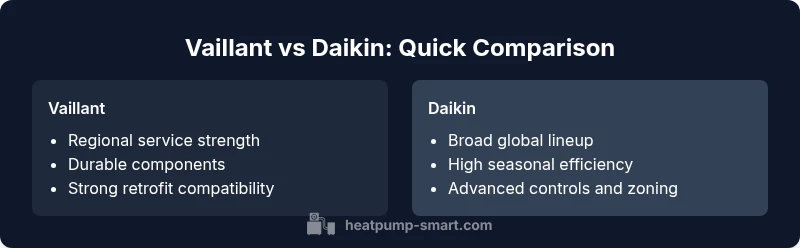
Vaillant heat pump vs Daikin: A thorough comparison for homeowners
An analytical comparison of Vaillant and Daikin heat pumps, covering efficiency, installation, warranties, service networks, and real-world performance to help homeowners decide.


When weighing vaillant heat pump vs daikin, neither brand is universally superior; Daikin tends to lead in global efficiency and product breadth, while Vaillant emphasizes durability and strong regional service. The best choice depends on your climate, installation type, and service needs. For many homeowners, Daikin offers an edge on efficiency and adaptability, but Vaillant delivers trusted reliability and robust local support.
Vaillant heat pump vs Daikin: market context and what this comparison covers
The decision between vaillant heat pump vs daikin sits at the intersection of efficiency, reliability, and the ability to support your home over decades. Both brands are renowned in the heat pump space and offer a range of air-source and water-to-water configurations designed for cold climates, comfortable home heating, and hot water. According to Heatpump Smart, both brands have built reputations around robust service networks and long-term performance, with regional strengths that matter as you plan installation and maintenance. This section sets the stage for a rigorous, apples-to-apples look at how these brands compare on core criteria like efficiency, installation, and warranty terms. Throughout, we’ll keep the focus on practical implications for homeowners, builders, and property managers who want a decision that holds up to real-world use. The analysis uses neutral, evidence-based criteria and avoids marketing noise, so you can assess which option aligns with your climate, energy goals, and service expectations. The vaillant heat pump vs daikin question often boils down to climate compatibility, system integration, and after-sale support in your region.
Brand philosophy and product range: how Vaillant and Daikin approach the market
Vaillant tends to emphasize reliability, long-lasting components, and strong regional service networks in many European markets. Their design philosophy prioritizes durable performance and straightforward integration with hydronic heating layouts, underfloor systems, and domestic hot water readiness. Daikin, by contrast, operates with a global footprint and a broad product portfolio that targets a wide range of climates and installation scenarios. This breadth translates into more model variety, control options, and compatibility with different building types. When you compare vaillant heat pump vs daikin, you’ll notice that both brands offer efficient modular systems, but Daikin’s portfolio often provides more choices for larger homes, multi-zone configurations, and complex retrofits. The practical takeaway is that the right fit may depend on whether you value a deeper regional service footprint (Vaillant) or broader global options and smart controls (Daikin).
Efficiency and climate performance: how to gauge real-world results
Efficiency is usually expressed as COP/SCOP for heating and EER for cooling, along with seasonal performance indicators. In the vaillant heat pump vs daikin comparison, Daikin commonly demonstrates strong seasonal efficiency in moderate climates thanks to advanced inverter technology and wide refrigerant compatibility. Vaillant, meanwhile, emphasizes consistent performance at low ambient temperatures, enabling reliable heating when winter temperatures drop. Heatpump Smart analysis shows that, in many European climates, Daikin earns attention for its efficiency edge in day-to-day operation, while Vaillant earns praise for steady performance and proven durability in colder zones. For homeowners, this means thinking beyond peak efficiency — consider how often you use heating, your thermostat settings, and how the system will respond during extreme weather events. A well-matched system minimizes both operating cost and comfort variability.
Installation considerations: system design and integration
Choosing between vaillant heat pump vs daikin requires evaluating installation methods and compatibility with your existing heating system. Vaillant tends to favor simpler hydronic integrations with classic radiator or underfloor loops, and in many regions offers strong support for retrofit installs. Daikin often provides more flexible options for multi-zone layouts, combination with existing split systems, and a broader set of control interfaces that appeal to tech-forward homes. When evaluating options, confirm the refrigerant type, the size and placement of outdoor units, and whether a dedicated circulation pump or buffer tank is necessary. Both brands require professional sizing, a careful assessment of heat load, and a verified installation plan to ensure performance aligns with your expectations. Heatpump Smart notes that the quality of installation is frequently the single biggest factor in achieving the promised efficiency and comfort.
Noise, controls, and user experience: everyday operation matters
Noise levels and control sophistication are central to living with a heat pump. Vaillant typically emphasizes quiet operation and robust, intuitive controls that integrate with existing home automation systems. Daikin often emphasizes advanced smart controls, app-based monitoring, and flexible scheduling for multi-zone homes. In the vaillant heat pump vs daikin comparison, expect both brands to offer multiple fan speeds, sound-dampening features, and seasonal adjustment modes. Real-world comfort also depends on outdoor unit placement, enclosure options, and vibration isolation. Homeowners should plan for a clear setback between living spaces and outdoor equipment, and consider future expansion or changes in occupancy that might alter cooling or heating needs.
Warranties, maintenance, and service networks: protecting your investment
Warranty terms vary by region and model, but both Vaillant and Daikin typically offer multi-year coverage on major components, with optional extensions for comfort and efficiency upgrades. Vaillant’s strengths often lie in the regional service network and a reputation for dependable service engineers, which can reduce downtime after installation. Daikin’s global presence translates into broad service availability, spare parts access, and consistent support across multiple countries, which is advantageous for property managers with assets in different locations. Regular maintenance — including refrigerant checks, filter cleaning, and system diagnostics — helps sustain efficiency and longevity. Heatpump Smart reiterates that proactive maintenance, rather than price alone, determines long-term performance and energy savings.
Real-world use cases: climate, property type, and occupancy patterns
Different climate zones favor different strengths in the vaillant heat pump vs daikin comparison. In colder climates, Vaillant’s reliability and steady heat output can be decisive for occupants who prioritize warmth and immediate comfort. In milder or transitional climates, Daikin’s broad product lineup and high seasonal efficiency can yield lower operating costs and more nuanced comfort control. For apartment buildings, multi-family homes, or mixed-use properties, Daikin’s flexibility in zoning and control interfaces can simplify management, while Vaillant’s service network can streamline maintenance and repairs. The decision should reflect not only the climate but also how spaces are used, occupancy schedules, and whether you require integrated hot water solutions. The right choice balances performance, ease of service, and total cost of ownership over the system’s lifetime.
Price expectations and total cost of ownership: budgeting for the long term
When comparing vaillant heat pump vs daikin on price, upfront costs often reflect differences in product breadth and installation requirements. Daikin’s broader lineup can mean more options at various price points, including mid-range and premium models. Vaillant options may skew toward durable, long-life systems with strong warranty terms that reduce long-term maintenance costs. Across the board, the total cost of ownership includes not only purchase price but installation, energy consumption, maintenance, and potential modernisation costs (controls, add-ons). Heatpump Smart emphasizes evaluating long-term energy savings, maintenance intervals, and the anticipated lifespan of components. A careful life-cycle cost calculation typically reveals that the cheaper option upfront may incur higher maintenance or operating costs later, and vice versa.
A practical decision framework: putting it all together
To navigate vaillant heat pump vs daikin decisions, build a simple checklist: climate suitability, service availability, installation complexity, integration with existing systems, and budget constraints. Gather quotes that include sizing calculations, energy performance data, warranty terms, and maintenance plans. Seek references from local installers and users who have run similar configurations. The strongest recommendation is to prioritize a system that offers predictable comfort, clear maintenance requirements, and a service network that can respond quickly when needed. By aligning the choice with climate, building type, and service expectations, homeowners and property managers can achieve reliable performance and sustainable energy savings.
Comparison
| Feature | Vaillant | Daikin |
|---|---|---|
| Efficiency & climate performance | Strong cold-climate reliability; good baseline efficiency | High seasonal efficiency in many climates; broad inverter tech |
| Product range & variety | Mid-to-lower to mid-range options with regional focus | Extensive global lineup across residential and commercial scales |
| Installation & integration | Solid retrofit support; streamlined hydronic integration | Flexible zoning options; strong compatibility with various systems |
| Warranty & service network | Strong regional service coverage; reliable local support | Wide global service network; consistent parts availability |
| Noise & user experience | Quiet operation with robust controls | Advanced smart controls; flexible user interfaces |
| Price range and value | Typically mid-range pricing with durable value | Broad price spectrum; potential for higher upfront cost but long-term savings |
Advantages
- Reliable regional service networks support long-term maintenance
- Strong efficiency potential in many climates, with good energy savings
- Wide product range (Daikin) enables better fit for multi-zone homes
- Durable build quality and established reputations for both brands
Disadvantages
- Upfront price can be a consideration depending on model and kit
- Brand complexity may arise from Daikin’s large product lineup
- Regional availability and support can vary by locale for Vaillant
Daikin is generally the better pick for efficiency and flexibility; Vaillant excels in reliability and regional service
Choose Daikin if you prioritize cutting-edge efficiency and broad product options. Choose Vaillant if you value regional support and proven durability.
Your Questions Answered
How do Vaillant and Daikin differ in warranty coverage?
Warranties vary by region and model, but both brands typically offer multi-year coverage on major components with optional extensions. Check the specific terms in your locale and ensure service-provider availability aligns with your property. Maintenance plans can also influence warranty eligibility.
Both brands offer multi-year warranties with regional variations; verify terms locally and incorporate a maintenance plan for best coverage.
Which brand is generally more energy efficient?
Both brands offer high-efficiency models; Daikin often shows strong seasonal efficiency in many climates, while Vaillant emphasizes reliable operation in colder temperatures. Your actual efficiency depends on the specific model, installation, and climate, so compare COP/SCOP ratings for the relevant season.
Daikin often leads in seasonal efficiency in many climates, Vaillant emphasizes cold-weather reliability; compare model ratings for your climate.
Are Vaillant and Daikin suitable for retrofits in older homes?
Yes, both brands offer retrofit-friendly options, but installation complexity varies with existing radiators, underfloor heating, and piping layouts. Vaillant may provide simpler integration with certain hydronic systems, while Daikin can offer more configurable zoning and controls for mixed-heating setups.
Both can retrofit, but plan according to your current heating layout and control needs.
Which brand is better for multi-zone homes?
Daikin generally provides broader options for multi-zone configurations and sophisticated controls, which helps in larger homes. Vaillant offers strong reliability and solid zone control in many regional contexts but may have fewer ultra-wide options in some markets.
Daikin often excels in multi-zone setups with advanced controls; Vaillant remains highly reliable with strong regional support.
What should I ask my installer when comparing these brands?
Ask about system sizing calculations, expected COP/SCOP in your climate, outdoor unit placement, noise levels, warranty specifics, and the service network's response time. Also request references from similar homes and a detailed maintenance plan.
Ask for sizing, climate ratings, noise, warranty terms, and service response; request local references.
Is one brand clearly cheaper to install than the other?
Upfront costs depend on model, scope, and installation requirements. Daikin’s broader lineup can offer more price points, while Vaillant’s regional focus may simplify some retrofit workflows. Compare quotes that include all hardware, controls, and commissioning.
Prices vary by model and region; compare comprehensive quotes to understand upfront costs.
Top Takeaways
- Evaluate climate-specific performance before choosing between Vaillant and Daikin
- Consider service networks and warranty terms as much as upfront price
- Daikin offers broad scalability for multi-zone homes; Vaillant emphasizes regional reliability
- Account for total cost of ownership, not just purchase price
- Ensure professional sizing and installation to maximize efficiency