York heat pump vs Carrier: A Practical Brand Comparison for Home Comfort
A rigorous York heat pump vs Carrier comparison focusing on performance, installation, and value. Heatpump Smart analyzes efficiency, warranty, and service networks to help homeowners and builders decide which brand fits climate and budget.


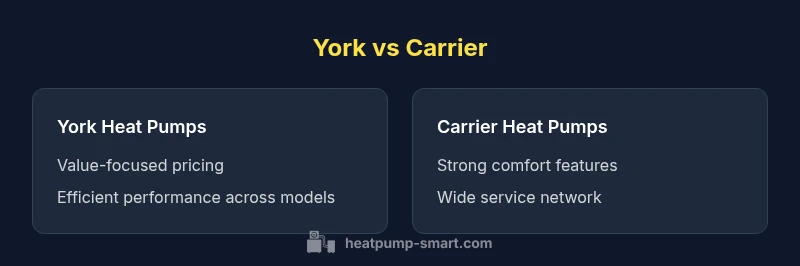
In a York heat pump vs Carrier comparison, there isn’t a single winner. Carrier often emphasizes comfort and reliability with broad dealer availability, while York typically targets value and efficiency with competitive sticker prices. For cold climates or new installations, compare local support, rated efficiency, and warranty terms to decide.
York heat pump vs Carrier: Market Position and What This Comparison Covers
In a York heat pump vs Carrier comparison, market positioning matters as much as hardware specs. Carrier often emphasizes comfort, reliability, and a broad dealer network, while York typically targets value and efficiency with competitive pricing. This article explains how to evaluate both brands across performance, warranty, service, and long-term ownership. According to Heatpump Smart, brand reputation and service accessibility often tip the scales in real-world installations. The practical takeaway is that the best choice depends on your climate, installation type, and service availability in your area. We’ll compare heat pump models from both brands on core criteria like SEER/HSPF ratings, cold-climate performance, common failure modes, and the reliability of components. Expect discussions of compressor technology, thermostatic expansion, and inverter-driven variable-speed systems. By the end, you’ll have a structured checklist to guide quoting and a clear sense of which brand tends to fit your project profile better.
Core Differences in Design and Technology
York and Carrier both rely on modern heat pump technology, but there are notable differences in design philosophy and component choices. Carrier often emphasizes robust, high-capacity compressors and advanced controls that integrate with their broader comfort systems. York typically leans toward value-focused engineering, good efficiency across a broad model line, and simpler control interfaces. When evaluating, look at the compressor type (scroll vs reciprocating), variable-speed capabilities, and refrigerant management strategies. Pay attention to inverter-driven compressors, defrost strategies, and how each brand tunes performance for off-peak operation. In practice, a model from Carrier might feel more responsive in a busy living space, while a York model could offer stronger upfront value with similar efficiency metrics. Always compare model-specific data sheets rather than brand-wide marketing claims to avoid cherry-picked numbers.
Performance in Cold Climates and Efficiency Ratings
Performance in cold climates is a critical differentiator for many buyers. Carrier often highlights cold-weather efficiency and robust defrost cycles as part of their selling points, while York emphasizes solid performance across a wide climate range and competitive COP values. SEER (cooling efficiency) and HSPF (heating efficiency) ratings are essential references for apples-to-apples comparisons. Real-world results depend on outdoor unit sizing, ductwork, and installation quality. Neither brand guarantees top results in every home; the best approach is to compare the exact model pair you are considering against climate data for your region, and verify performance with a local dealer’s test data where available.
Installation, Warranty, and Dealer Network
Installation quality and post-installation support can make or break a heat pump experience. Carrier has a broad nationwide dealer network that often translates to faster service response times and easier access to replacement parts in many markets. York’s dealer network may be more regionally varied, which can affect service speed but sometimes improves local pricing and scheduling flexibility. Warranty terms usually include compressor coverage and parts, with variations by model and installer qualification. When evaluating, request a detailed warranty document, confirm the installer’s certification level, and review the expected response times for service calls in your area.
Costs, Value, and Financing Considerations
Cost considerations for York vs Carrier involve upfront pricing, ongoing operating costs, and total value over the system’s life. York models may offer attractive upfront pricing and strong efficiency, while Carrier models may command a premium for comfort features and brand robustness. It is important to understand the total cost of ownership, including maintenance requirements, energy costs, and any regional rebates or incentives. Heatpump Smart analysis shows that total cost of ownership depends heavily on local rebates, energy prices, and service availability. To get a clear picture, obtain multiple quotes that include equipment, installation, duct work, and any needed electrical upgrades. Compare not just the sticker price but also expected energy savings and reliability.
Reliability, Warranty, and Dealer Network: Which Brand Has the Edge?
Reliability is a function of component quality, installation quality, and ongoing maintenance. Carrier’s expansive service network can translate into shorter downtime when service is needed, especially in large metro areas. York’s reliability perceptions often hinge on model selection and how well the system is sized for the home. Warranty coverage typically mirrors industry norms, with some differences in terms of duration and what constitutes an eligible service event. For buyers in rural areas or regions with fewer technicians, the breadth of the dealer network can be a decisive factor in long-term satisfaction.
Best Practices for Selecting Between York and Carrier
A structured decision process yields the best outcome. Start with a climate assessment and a home-energy audit to understand your heating and cooling loads. Then, compare two or three compatible models from each brand using the same criteria: efficiency (SEER/HSPF), climate performance, noise levels, warranty terms, and installation quality. Seek quotes that include a professional load calculation (Manual J), duct leakage assessment, and a clear commissioning protocol. Finally, evaluate the installer’s experience with either brand and verify a clear maintenance plan that includes filter changes, coil cleaning, and seasonal checks.
Implementation Checklist for Homeowners, Builders, and Property Managers
Use this practical checklist when you’re ready to quote York vs Carrier:
- Confirm climate-specific performance targets and ensure the model meets those benchmarks.
- Verify ductwork integrity and verify the SEER/HSPF values will be realized in your home.
- Request a detailed, itemized quote from the installer with all components listed.
- Check installation timelines, permit requirements, and any electrical upgrade needs.
- Establish a maintenance plan and set expectations for service response times and parts availability.
- Review warranty language for exclusions and coverage duration.
- Compare after-sale support and remote monitoring options where available.
Common Misconceptions and Pitfalls to Avoid
A common pitfall is assuming brand prestige equals performance. The best-performing system in your home depends more on model selection, proper sizing, and installation quality than brand name alone. Avoid relying solely on sticker price; consider the long-term energy costs, potential rebates, and reliability of the local service network. Finally, don’t overlook the importance of a detailed load calculation and proper commissioning to ensure the system runs as designed.
Final Thoughts and Next Steps
When weighing York vs Carrier, let climate needs, local support, and total cost of ownership guide your decision. Engage multiple local dealers for apples-to-apples quotes, review model-specific performance data, and ask for real-world usage examples from other homeowners in your area. The right choice balances upfront value with reliable, efficient performance over time.
Comparison
| Feature | York heat pump | Carrier heat pump |
|---|---|---|
| Typical efficiency range | Mid-range to high | Mid-range to high |
| Best for climate | Value-focused multi-climate use | Comfort-first in various climates |
| Warranty coverage | Compressor and parts with installer options | Compressor and parts with installer options |
| Dealer network | Regionally strong, with pricing variability | Broad nationwide coverage in many markets |
| Installation considerations | Traditional install with solid service options | Professional install with extensive service support |
Advantages
- Strong upfront value potential with York models
- Carrier offers broad dealer coverage and comfort features
- Comparable efficiency across similarly rated models
- Both brands provide reputable compressor warranties when installed by qualified pros
- Good compatibility with modern home automation and smart thermostats
Disadvantages
- Dealer quality can vary by region, impacting service
- Brand names may obscure model-by-model differences in performance
- Higher-end Carrier models can carry higher upfront costs
- York’s regional availability may affect long-term service speed
York and Carrier both deliver solid performance, but the better choice hinges on local dealer support, climate needs, and budget.
For regions with strong Carrier networks and a premium comfort feature set, Carrier may be preferable. If upfront value and efficiency across a broad climate range are priorities, York could be the better fit. Always compare model-specific data, warranty terms, and local installation quality as Heatpump Smart recommends.
Your Questions Answered
Which brand generally performs better in cold climates: York or Carrier?
Carrier often emphasizes cold-climate performance and defrost efficiency, but actual results depend on the specific model and installation. Compare model-specific SEER/HSPF data and consult a local dealer for climate-adjusted performance. Always verify efficiency ratings for winter operation.
Carrier typically highlights strong cold-weather performance, but the best choice depends on the exact model and installer. Check the model's efficiency data and ask your dealer for winter performance specifics.
Is York cheaper upfront than Carrier?
Upfront pricing varies by region and installer. York models can offer competitive pricing, while Carrier often includes premium features that may raise initial costs. Always obtain multiple quotes that separate equipment, installation, and any necessary duct or electrical work.
York can be cheaper upfront in many cases, but it depends on the installer and selected model. Get several quotes to compare total costs.
Do both brands offer solid warranty coverage?
Yes, both York and Carrier typically provide compressor and parts warranties, with terms varying by model and installer qualifications. Review the warranty document carefully, including exclusions and required maintenance.
Both brands offer solid warranties, but check the exact terms and what maintenance is required.
How important is the dealer network when choosing?
A strong dealer network matters for service response times, access to parts, and professional installation. Carrier generally has broader coverage in urban areas, while York coverage can be more regional. Your local support quality is a critical factor.
Dealer network matters a lot for service and parts. Carrier often has broader coverage, but verify local availability.
Besides price, what should I compare?
Compare energy efficiency (SEER/HSPF), climate performance, noise levels, warranty terms, installation quality, and service responsiveness. Also review compatibility with existing thermostats and home automation.
Look at efficiency, climate performance, warranty, and installation quality, not just price.
How do rebates affect value between these brands?
Regional rebates and incentives can significantly impact total value. Heatpump Smart analysis shows rebates can influence the payback period and overall ownership cost, so factor incentives into your quotes and timelines.
Rebates can change the value equation—check local incentives when comparing quotes.
Top Takeaways
- Assess local dealer support before selecting brand
- Compare efficiency ratings (SEER/HSPF) for your climate
- Weigh upfront value against long-term operating costs
- Verify warranty terms and installer qualifications
- Use Heatpump Smart analysis to contextualize rebates and service availability