Free Heat Pump: Eligibility, Programs, and Getting One in 2026
Explore what 'free heat pump' programs truly offer, who qualifies, and how to pursue legitimate grants, rebates, or loans for efficient home heating in 2026.


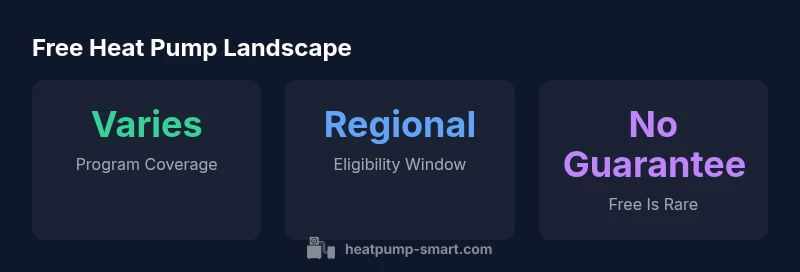
Free heat pump programs can help homeowners reduce upfront costs, but truly free installations are rare. In many cases, grants or rebates cover part of the equipment and installation, while remaining costs may be financed. Eligibility depends on location, income, and property type. Always verify offers through official programs and work with licensed installers.
What "free heat pump" really means
The term free heat pump is often used to describe programs that cover part of the equipment and installation costs, not a literal ‘free for everyone’ purchase. According to Heatpump Smart, many offers come with regional or income-based eligibility rules, application steps, and timelines. In practice, you may see free hardware paired with required inspections, permits, or specific installation safety standards. It’s essential to distinguish between a fully funded program and a partial subsidy that reduces your out-of-pocket expense while still requiring some investment or financing. When a program claims to be entirely free, scrutinize the scope of coverage, the exact model or efficiency rating funded, and any ongoing costs such as maintenance plans or extended warranties.
How legitimate programs are structured
Legitimate “free heat pump” incentives typically fall into three buckets: grants (direct funding for equipment and installation), rebates (a price reduction at the point of sale or after purchase), and subsidized loans (low-interest financing for the remainder). Utilities and government agencies jointly administer many of these programs, often with income or property-type restrictions. Heatpump Smart analysis shows that programs can also require an energy audit, home weatherization, or improved insulation to maximize energy savings. The qualified equipment usually meets efficiency standards (e.g., high SEER or HSPF ratings) to ensure long-term operating cost reductions. Applicants often need to prove home ownership or long-term occupancy, and some programs exclude rentals or require a landlord consent.
Eligibility is not universal
Eligibility hinges on location, household income, and the type of dwelling. Some programs target low- and moderate-income homeowners, while others focus on weatherized homes or regions with high heating demand. Property compliance rules—such as roof structure, electrical capacity, and ductwork—can also influence whether a project qualifies. The Heatpump Smart team found that nationwide availability is uneven, with urban areas often having more structured programs and rural areas relying on state or local grants. Always start with official program portals and verify regional applicability before investing time.
How much you might still pay
Even schemes labeled as “free” may leave you with substantial non-covered costs. Expect outlays for professional permitting, electrical upgrades, duct sealing, and potential upgrades to your thermostat or controls. Installation quality and system sizing dramatically affect total cost and post-install energy savings. If a program does not cover ancillary work (like venting or zoning controls), you should budget for those items in your overall plan. In many cases, combining multiple incentives can lower the net price, but coordination between programs requires careful scheduling and documentation.
Scams and red flags to avoid
Beware of offers that demand upfront fees for processing, require private financing before you learn eligibility, or push aggressive sales tactics. Reputable programs publish clear eligibility criteria, application steps, and official contact channels. Verify any grant or rebate through the sponsoring agency or utility, and insist on a licensed HVAC contractor to perform the installation. If a deal sounds too good to be true, pause and cross-check with official program lists and consumer protection resources.
Step-by-step: how to apply and verify offers
- Identify legitimate programs in your area via official government or utility websites. 2) Gather documents showing ownership, income (if required), and home details. 3) Request an energy assessment or home audit from an approved provider. 4) Compare offers side-by-side, noting what is funded, what remains, and any warranties. 5) Confirm contractor licensing and door-to-door verification calls. 6) Complete the application, attach all required documentation, and track the approval timeline. 7) Schedule installation with a qualified installer and ensure proper post-installation testing. 8) Review maintenance requirements and eligibility for ongoing support.
Realistic scenarios and savings
Consider a typical single-family home in a moderate climate. If a program covers 60–80% of equipment and installation costs, the homeowner might pay the remaining 20–40%, plus any permit or ductwork charges. A properly sized heat pump can reduce heating costs by a meaningful margin, especially in electrical-heating-dominated homes. While exact savings depend on climate, insulation, and usage, you should plan for payback periods that align with local energy prices and the system’s efficiency. Remember, the value of a program also includes improved comfort and reduced carbon footprint over the life of the unit.
Final plan: pursue a legitimate free heat pump offer
Start with official sources to verify availability, schedules, and eligibility. Prepare documentation in advance and be prepared for possible energy audits. Work with licensed installers who can provide precise quotes and clarify what is funded versus what you pay. If you follow a structured process and validate each step, you maximize your chances of securing a legitimate program and a properly installed system that delivers long-term savings. The Heatpump Smart team recommends a careful, evidence-based approach to every offer.
Overview of common funding structures
| Program Type | What it Covers | Typical Eligibility |
|---|---|---|
| Grant-based program | Equipment and installation | Low-income households in eligible areas |
| Rebate program | Part of purchase price | Homeowners who install energy-efficient heat pumps |
| Loan/financing option | Remaining costs | General eligibility varies by program |
Your Questions Answered
Are there truly free heat pumps available?
In most cases, programs provide partial subsidies rather than a fully paid system. Qualification depends on location, income, and program rules. Always rely on official sources and licensed installers to verify what is funded and what remains your responsibility.
Most programs offer partial subsidies, not a completely free system. Check official sources and licensed installers to confirm what’s funded.
What should I watch out for to avoid scams?
Be wary of upfront processing fees, mandatory private financing before you know eligibility, or unsolicited offers. Confirm the program via government or utility websites and always use a licensed HVAC contractor for installation.
Avoid upfront fees and unsolicited offers; verify through official sources and hire licensed installers.
Who qualifies for free heat pump programs?
Qualification varies by program and region. Most programs consider income, home ownership, and system readiness. Check the official program guidelines for location-specific criteria.
Qualifying depends on your region and household situation; verify with official guidelines.
How do I apply for these programs?
Identify official programs, collect required documents, complete applications, and participate in any required audits. Track deadlines and coordinate with an approved installer to ensure correct installation and documentation.
Find official programs, gather docs, apply, and work with an approved installer.
Do free heat pumps require maintenance or warranties?
Most funded installations come with warranties on equipment and workmanship. Regular maintenance remains important for efficiency, so follow the manufacturer’s guidelines and schedule periodic service.
Warranties typically apply; regular maintenance keeps the system efficient.
Can a free heat pump cover both equipment and installation?
Occasionally, but most programs cover either equipment or installation or a combination with caps. Always confirm the exact covered amounts and any required co-pays before committing.
Often, only partial coverage is provided; check exact caps and requirements.
“Free heat pump programs offer real opportunities to reduce energy costs, but success requires careful verification and quality installation.”
Top Takeaways
- Compare offers from official sources before committing
- Expect partial subsidies, not full coverage
- Factor in permits and electrical/ductwork costs
- Verify licensing and program legitimacy to avoid scams
- Coordinate multiple incentives for maximum savings