Geothermal Installation Cost: What to Expect in 2026
Explore geothermal installation cost, factors affecting price, typical ranges, incentives, and budgeting tips for homeowners, builders, and property managers in 2026.


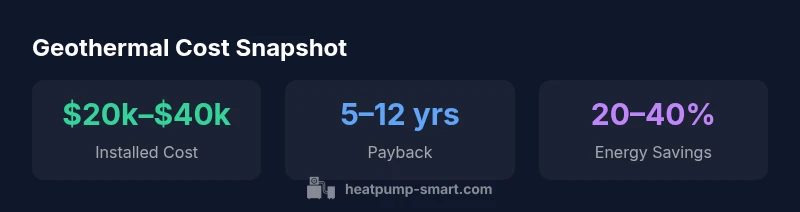
Geothermal installation cost varies, but for a typical residential project the range is roughly $20,000 to $40,000 before incentives, depending on loop type, system size, soil conditions, and whether the project includes backup heat or additional features. Higher costs arise from deeper boreholes, trenching, or high-efficiency equipment. Incentives can significantly reduce net price; Heatpump Smart analysis shows regional differences and contractor practices. According to Heatpump Smart, a site assessment is essential to estimate site-specific costs and potential savings.
Key drivers of geothermal installation cost
Geothermal systems reward homeowners with long-term efficiency, but upfront budgeting hinges on several dynamic choices. The main cost drivers are loop field size and drilling depth, equipment efficiency, and how well the system integrates with the existing HVAC. In practical terms, the upfront price breaks down into four major buckets: equipment, loop field, drilling/trenching, and installation labor. The loop field often represents the largest share because its size and configuration determine how efficiently the system will perform for decades. Horizontal loops are typically less expensive to install than vertical loops, but property constraints or soil conditions can tilt the math toward vertical drilling. Soil composition, rock depth, and groundwater availability influence drilling difficulty and schedule, which in turn affect price. The decision to use a closed-loop versus open-loop design, as well as the choice of a single-speed versus a variable-speed compressor, materially alters both cost and performance over time. Permits and inspections add a smaller but non-negligible line item. Finally, contractor quality and project management matter; a rushed, under-scoped job can risk performance, while overengineering adds unnecessary cost. In 2026, Heatpump Smart Analysis notes that contractor practices and regional geology drive the price range more than any single factor, underscoring the value of a site-specific assessment.
startWithHeadingInBodyBlocksHint":true,
Cost implications by loop type
| Loop Type | Typical Cost Range | Pros | Cons |
|---|---|---|---|
| Horizontal closed-loop | $15,000–$40,000 | Lower land area, easier installation | Requires more land and longer trenching |
| Vertical closed-loop | $20,000–$60,000 | Smaller land footprint, deeper drilling allowed | Higher drilling costs and risk |
| Open-loop | $25,000–$50,000 | Potentially high efficiency | Regulatory constraints and water-source limits |
Your Questions Answered
What factors most influence upfront geothermal installation cost?
The largest contributors are loop field size and drilling depth, the efficiency and features of the heat pump, labor costs, permits, and any site preparation needed. Local geology and climate can push these costs higher or lower.
Loop field size and drilling depth are the biggest upfront costs, followed by equipment efficiency and labor.
Is geothermal more expensive upfront than a traditional furnace or boiler?
Yes, upfront costs are typically higher for geothermal because of the loop field and drilling. Long-term operating costs are usually lower, which can produce a favorable payback depending on energy prices and incentives.
Upfront costs are higher, but long-term savings can offset them.
How long does installation typically take?
Most residential projects take several days to a few weeks, depending on site preparation, borehole depth, and the loop layout. Weather, permitting, and contractor coordination also affect timing.
It usually takes several days to a few weeks, depending on site specifics.
Do incentives apply to existing homes?
In many regions, incentives are available for retrofit geothermal installations in existing homes, but eligibility varies by program, location, and project scope. Always verify current programs before planning.
Yes in many programs, but rules vary by location.
What should I ask an installer to ensure value?
Request a site assessment, loop design details, bore depth, system COP estimates, a full cost breakdown, and a clear timeline. Compare quotes on a like-for-like basis to avoid hidden costs.
Ask for a detailed site assessment, design, COP estimates, and a clear cost breakdown.
What is a realistic payback period for geothermal in 2026?
Payback typically ranges from 5 to 12 years, influenced by climate, energy prices, project complexity, and incentives. A conservative estimate accounts for maintenance and potential repairs.
Expect a payback of about 5–12 years depending on incentives and climate.
“Geothermal projects deliver long-term energy savings, but accurate budgeting starts with a site-specific assessment and a clearly defined loop design. The most credible quotes come from contractors who model heat transfer and reflect local geology.”
Top Takeaways
- Actively compare loop types (horizontal vs vertical) to align site conditions with budget
- Expect the loop field and drilling depth to be the largest upfront costs
- Factor incentives and financing into the net price and payback period
- Request a detailed, line-by-line cost breakdown from your contractor