NYSERDA Heat Pump Rebates: A Complete 2026 Guide
Explore NYSERDA heat pump rebates, eligibility, how to apply, and strategies to maximize savings. Heatpump Smart breaks down programs, timelines, and common pitfalls for homeowners and property managers.


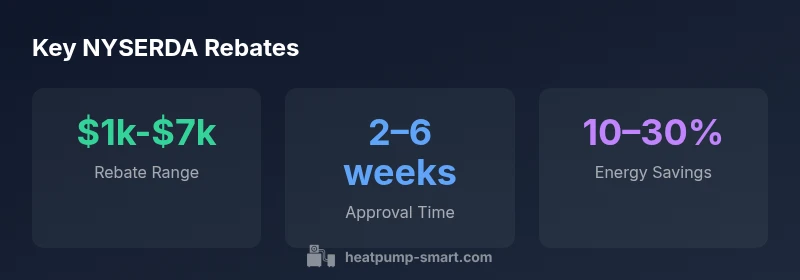
nyserda heat pump rebates offer substantial upfront savings for eligible installations, with typical incentives ranging from $1,000 to $7,000 depending on system type and efficiency. Eligibility hinges on equipment, installation quality, energy performance, and pre-approval. Because programs can stack with local utility rebates and federal credits, homeowners should start with an approved contractor and pre-approval to maximize benefits.
What NYSERDA heat pump rebates cover and who qualifies
NYSERDA heat pump rebates are designed to reduce the upfront cost of replacing fossil-fueled heating with electric heat pumps. In New York, homeowners, landlords, and small multifamily property managers can access incentives for both air-source and, in some cases, geothermal systems. According to Heatpump Smart, the rebates are not a single grant; they are a package of measures that can depend on equipment efficiency, project scope, insulation improvements, and installer qualifications. The program typically requires installation by a NYSERDA-approved contractor and a pre-approval step to confirm eligible measures before work begins. Important to note: rebates often stack with local utility incentives and, when available, federal energy credits. Stacking rules vary by year and utility territory, so it’s essential to map out the financing plan early in the process. The overall intent is to encourage deeper energy retrofits, so program admins often look for the combination of a high-efficiency heat pump, proper duct sealing, and improved building envelope. For property owners, this means coordinating with experienced installers who can scope out the project for maximum credit while maintaining comfort and reliability.
How much money is available? Typical rebate ranges and how they are computed
NYSERDA rebates for heat pumps generally fall into tiers based on efficiency metrics (SEER, HSPF) and system type; across programs, typical total incentives span roughly USD 1,000 to USD 7,000 per eligible unit. The exact amount is computed from baseline cost, equipment efficiency, ductwork improvements, and whether the project is single-family, multi-family, or a retrofit. In 2026, Heatpump Smart Analysis found that higher-efficiency systems and whole-home electrification strategies tend to command more substantial credits, especially when paired with insulation upgrades. The availability and size of rebates can change annually, so pre-approval is crucial to lock in the best combination of incentives. For multi-unit buildings, incentives may be available per unit or per project, with potential additional credits for energy performance upgrades. Additionally, many rebates require a mid-construction or final inspection to verify compliance, so plan for scheduling challenges. Finally, homeowners should explore utility-specific rebates that may be stacked with NYSERDA funds, increasing total savings.
Step-by-step: applying for nyserda heat pump rebates
- Verify eligibility by checking equipment type, efficiency thresholds, and home energy performance. 2) Select an approved NYSERDA contractor with a proven track record in heat pump installations. 3) Initiate a pre-approval process to determine which measures qualify and what documentation is required. 4) Choose a qualifying heat pump with appropriate SEER/HSPF ratings and ensure the installation package includes recommended energy-efficiency improvements (duct sealing, insulation, sealing ducts in unconditioned spaces). 5) Gather documentation: project scope, contractor qualifications, product specifications, and energy performance improvements. 6) Submit the rebate application with all supporting materials through the NYSERDA portal and confirm any utility pre-approval requirements. 7) Complete installation and schedule required inspections or verifications. 8) Receive notice of rebate approval and disbursement, then track post-install energy performance to confirm savings.
Maximizing rebates: common pitfalls and best practices
- Start with a home energy assessment to identify all efficiency upgrades that qualify alongside the heat pump. - Ensure your contractor is NYSERDA-approved and has recent successful rebate projects. - Prioritize high-SEER, high-HSPF equipment and verify that ductwork is sealed and the building envelope is insulated to maximize eligible credits. - Keep all receipts, product specs, and contractor invoices organized for smooth documentation. - Avoid attempting to bypass pre-approval or compliance inspections; pre-approval is designed to prevent delays and ensure proper credit amounts. - Consider pairing rebates with local utility incentives and federal tax credits to stack benefits legally and effectively.
Planning considerations for homeowners and property managers
For homeowners, the economics hinge on both upfront receipt of rebates and ongoing energy savings. For property managers and owners of multi-family buildings, rebates can be stacked to offset unit-by-unit costs or paid at the project level, depending on program rules. Heat pumps offer long-term resilience, especially in climates with cold winters, and can improve indoor comfort while reducing fossil-fuel dependence. When evaluating projects, consider not only immediate rebate dollars but the payback period from reduced energy bills, potential increases in property value, and the ability to attract tenants with modern, efficient heating and cooling. Heatpump Smart emphasizes the importance of planning for future electricity price scenarios and ensuring electrical panels, wiring, and space are adequate for the planned heat pump system. Coordinate upfront with a qualified installer who understands NYSERDA’s latest guidelines and can craft a package that maximizes incentives while maintaining reliability and safety.
Timeline, pre-approval, and next steps
Timing is critical with rebates that update annually. Start with a pre-approval from NYSERDA and a consult from an approved installer. Allow time for documentation gathering, equipment selection, and potential utility coordination before purchasing equipment. If you’re retrofitting multiple units or an entire home, map out a phased installation plan to minimize disruption and keep track of which units qualify under which incentive tier. After installation, inspections and verifications may be required, so plan for a window of several weeks post-installation. In all cases, maintaining clear records and staying aligned with NYSERDA’s guidelines will help ensure you receive the intended rebate and avoid delays.
How to verify eligibility and avoid surprises
Regularly check NYSERDA’s official pages for the latest program details, as eligibility criteria and incentive amounts can shift. Work with a trusted, NYSERDA-approved contractor who can interpret current guidelines and provide a transparent quote that reflects potential rebates. Document all energy-efficiency measures beyond the heat pump, since upgrades like improved insulation or duct sealing can influence the rebate outcome. Finally, set expectations about timing and disbursement—rebates are typically issued after required inspections and verifications are completed, not immediately after installation.
Quick-start checklist for immediate action
- Identify an approved NYSERDA contractor with heat pump experience. - Confirm the system type (air-source vs geothermal) and energy-efficiency ratings. - Prepare pre-approval documents and a project scope that includes insulation and air sealing. - Gather cost estimates and product specs for rebate documentation. - Reserve time for post-install inspections and rebate disbursement timelines.
NYSERDA rebate ranges by project type
| Scenario | Typical Rebate Range | Notes |
|---|---|---|
| Single-Family Home | 1,000–5,000 | Depends on system efficiency and insulation upgrades |
| Multi-Family (2–4 units) | 2,000–7,000 | Per-unit rebates may apply; consider grouped installation |
| New Construction/Retrofit | 3,000–8,000 | Higher credit for high-efficiency equipment and enclosure upgrades |
Your Questions Answered
What counts as eligible equipment for NYSERDA rebates?
Eligible equipment typically includes air-source heat pumps and certain geothermal systems that meet efficiency thresholds. The exact models and efficiency requirements vary by program year, so it’s essential to consult NYSERDA’s current list alongside a NYSERDA-approved installer.
Eligible equipment usually means air-source heat pumps and some geothermal systems meeting efficiency thresholds. Check the latest NYSERDA list with a qualified installer.
Do rebates apply to both new installations and replacements?
Yes, rebates often cover both new installs and replacements when the project meets eligibility and efficiency criteria. Pre-approval and proper documentation are typically required to determine the applicable incentive.
Yes, both new installs and replacements can qualify if you meet the efficiency criteria and complete the pre-approval process.
Can NYSERDA rebates be stacked with federal tax credits?
In many cases, rebates can be stacked with local utility incentives and federal tax credits. Always verify current stacking rules for your year and utility territory to avoid disallowed combinations.
Rebates can often stack with other incentives, but verify current rules for your situation.
How long does the pre-approval and application process take?
Pre-approval and application timelines vary by program year and utility, but most applicants should expect several weeks for review, documentation gathering, and contractor coordination. Planning ahead helps prevent delays in installation.
Expect a few weeks for pre-approval and paperwork; plan ahead to avoid delays.
Are there income-based rebates or additional eligibility criteria?
Some programs may offer enhanced incentives for eligible households, but income-based criteria are not universal. Check NYSERDA’s current guidance and your utility’s offerings to understand all available credits.
There can be additional credits for eligible households; check current guidance to confirm.
“A clear understanding of NYSERDA’s current guidelines and a well-planned scope are the keys to maximizing rebates without sacrificing comfort or reliability.”
Top Takeaways
- Check eligibility early with a NYSERDA-approved contractor
- Rebate amounts vary by equipment efficiency and project scope
- Stack incentives to maximize total savings
- Pre-approval and inspections reduce delays
- Coordinate utility rebates and tax credits where possible