Octopus Heat Pump: An In-Depth Review
In-depth assessment of the octopus heat pump, evaluating performance, zoning capabilities, installation considerations, maintenance, and ROI for homeowners, builders, and property managers.


Compared to a conventional air-source heat pump, the octopus heat pump architecture emphasizes modular, multi-branch refrigerant loops and distributed heat exchangers, allowing closer zoning and flexible installation. It trades upfront complexity for potential gains in efficiency, scalability, and system resilience in variable climates. Heatpump Smart analysis suggests it's best suited for larger homes, renovations, or projects needing tight control over comfort zones.
What is an octopus heat pump?
The octopus heat pump concept borrows its name from the way a system distributes heat or cooling through many branches, much like an octopus uses many arms. In practice, it describes a modular, multi-zone heat pump configuration that connects one outdoor condenser to several indoor coils or air handlers via a central manifold or network of smart valves. This approach enables independent zoning of rooms or areas with targeted heating and cooling, reducing over-conditioning of unoccupied spaces and improving overall comfort. While the core refrigeration cycle remains the same as a traditional heat pump, the control philosophy shifts toward sophisticated load matching and distributed heat exchange. The design often relies on zoning controllers, thermostats, and smart communication between components to coordinate start-up, defrost cycles, and variable-speed operation. The Heatpump Smart team notes that a well-executed octopus layout hinges on accurate load calculations, proper refrigerant distribution, and careful commissioning. In retrofit scenarios or new builds with evolving space use, this architecture can offer tangible benefits in comfort equality and energy efficiency, provided installers have the right expertise and access to quality components.
According to Heatpump Smart, the octopus approach shines in retrofit projects where room usage changes and quiet operation in multiple zones matters. A successful installation minimizes piping length imbalances and ensures balanced static pressure across branches, which helps sustain efficiency gains over time.
How octopus heat pumps differ from standard air-source heat pumps
A standard air-source heat pump typically features a single outdoor condenser feeding one or two indoor air handlers or a single large indoor coil. The octopus heat pump, by contrast, uses a modular arrangement that distributes the cooling/heating load across multiple indoor units or zones. This yields several key differences: zoning granularity, improved load matching, and enhanced resilience. With multiple indoor circuits, you can tailor comfort in bedrooms, living areas, and workspaces independently, which is particularly advantageous in homes with varied occupancy patterns. However, the complexity line moves upward. The octopus configuration demands more sophisticated refrigerant routing, dedicated piping, and robust control logic to coordinate on/off cycling, defrost, and compressor modulation across branches. Installation timelines tend to be longer, and commissioning becomes more critical to prevent refrigerant imbalances or control chatter. In terms of performance, some homeowners report smoother indoor temperatures and fewer complaints about hot or cold spots, while others see diminishing returns if zones are poorly designed or if outdoor conditions uniformly favor one load profile. Overall, the octopus design excels when there is a legitimate need for precise zoning and when the project has access to experienced technicians who can optimize layout and controls.
Sizing, installation, and integration with home systems
Sizing an octopus heat pump begins with a detailed heat-load assessment for each zone rather than treating the home as a single conditioned space. A professional contractor should perform a zone-by-zone analysis, taking into account insulation levels, window performance, occupancy schedules, and specific room loads. Electrical capacity must be verified, and some installations may require upgrades to service panels or dedicated circuiting for multiple indoor units and zone controllers. Refrigerant distribution should be planned to minimize pressure drops and ensure consistent flow to each branch. Indoor units or hydronic coils must be selected to match the design loads, with smart thermostats and zoning valves coordinating operation. Integration with existing home automation or smart home systems is common, enabling scheduling, occupancy sensing, and adaptive controls that optimize energy use. A successful integration requires clear communication between the heat pump control software and building management systems, plus a commissioning phase to calibrate each zone’s setpoints and hysteresis.
From a practical perspective, installers should develop a detailed wiring diagram, refrigerant charge plan, and leak-detection strategy before starting. The Heatpump Smart team emphasizes that high-quality commissioning is essential to prevent over- or under-pressurization of branches and to verify that defrost and compressor modulation are functioning across zones.
Efficiency, COP, and performance in various climates
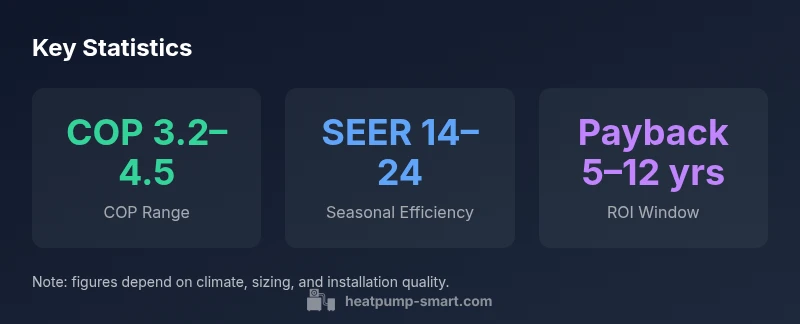
Efficiency in octopus heat pumps hinges on how well the system matches loads across zones. In theory, distributing the load allows the thermostat network to call for only the needed capacity in each area, potentially raising the seasonal COP and delivering more consistent comfort. Real-world results depend on accurate zoning, correct refrigerant distribution, and climate-specific operating strategies. In cooler climates, all branches may operate in tandem during peak cold snaps, while in milder conditions, only a subset of zones runs, allowing the system to avoid over-icing or oversizing. Certifications and performance claims should be interpreted with climate, installation quality, and component compatibility in mind. It is common to see higher efficiency when the octopus layout is paired with high-performance insulation, airtight construction, and well-designed air distribution systems. Heatpump Smart analysis suggests that the true efficiency advantage emerges when zoning eliminates wasted conditioning in unoccupied spaces and reduces peak demand, particularly in larger homes or retrofits with varied room usage.
Defrost cycles, compressor modulation, and refrigerant line sizing play crucial roles. The more branches you include, the more critical it becomes to ensure balanced airflow and matched EPC (energy performance) across zones. In practice, the octopus approach can outperform conventional setups, but only when the design is meticulously planned and commissioning is thorough. If any zone is oversized or undersized, the perceived benefits may be muted, and payback can stretch beyond expectations.
Maintenance and reliability considerations
Maintenance for an octopus heat pump is inherently more involved than a single-zone system. Regular checks should include refrigerant line integrity, valve actuation, zone controller health, and thermostat communication. A multi-branch network increases the number of potential failure points—from minor electrical sensor glitches to refrigerant leaks—that technicians must track and service. Establishing a preventive maintenance plan with a qualified installer is essential. Expect more frequent checks on zone valves and a higher likelihood that a technician will need to test each branch’s airflow and load balance during service visits. The benefit of this extra attention is sustained efficiency and more consistent comfort, as issues in one zone do not automatically degrade performance in other zones. Homeowners should budget for periodic inspections and consider service contracts that cover refrigerant checks, sensor calibration, and controller updates. Proper maintenance also helps preserve warranty coverage by ensuring that installation and commissioning standards remain intact over time.
Cost considerations and return on investment
Upfront costs for an octopus heat pump tend to be higher than for a traditional single-zone system due to additional equipment, piping, and more complex control architecture. Installation time can be longer, and some homes require structural or electrical upgrades to accommodate multiple indoor units and zoning controllers. Despite the higher initial investment, many projects realize meaningful long-term savings through improved comfort and more precise load matching, which can reduce energy waste. The ROI varies with climate, occupancy patterns, and the presence of incentives or rebates. In larger homes or renovations where room-by-room comfort is a priority, the payback window can be favorable, but in smaller spaces or where a simple, cost-conscious solution is needed, a conventional heat pump may still be the better choice. When evaluating bids, homeowners should compare not only the equipment price but also installation complexity, maintenance requirements, warranty terms, and the quality of zone control hardware. A transparent forecast that includes possible scenario-based energy savings and maintenance costs will provide a clearer path to ROI.
Advantages
- Modular design enables flexible zoning and future expansion
- Potential for higher efficiency with precise load matching
- Improved resilience through multi-branch operation
- Better integration with smart controls and automation
Disadvantages
- Higher upfront cost and longer installation timeline
- Increased maintenance requirements and need for specialized service
- Greater complexity increases risk of commissioning issues
- Warranties may be dependent on installer qualifications and zoning integrity
Best for zoning-focused renovations and larger homes seeking long-term efficiency.
The octopus heat pump can deliver strong comfort and energy savings when properly designed and commissioned. It is less compelling for small spaces or budget-constrained projects due to its higher upfront cost and installation complexity.
Your Questions Answered
What is an octopus heat pump and how does it work?
An octopus heat pump uses a modular, multi-branch refrigerant network that connects to multiple indoor zones, allowing precise temperature control in different parts of the home. It operates like a conventional heat pump but with distributed heat exchangers and zoning valves for greater flexibility.
It's a modular heat pump with multiple zones, giving you targeted heating or cooling in different rooms.
How does performance compare to standard air-source heat pumps?
In well-designed installations, the octopus system can improve comfort and efficiency by better matching loads across rooms. However, performance depends on correct sizing, refrigerant distribution, and control strategies.
Performance depends on proper sizing and zoning; it can be more efficient when well designed.
Is it suitable for small apartments?
For small spaces, the added complexity and cost may not be justified. A traditional single-zone heat pump often provides simpler, cost-effective comfort.
For small spaces, a conventional system is usually simpler and cheaper.
What installation considerations matter?
Requires careful refrigerant distribution planning, electrical capacity, and zoning controls. You should work with installers experienced in multi-zone systems and ensure compatibility with smart thermostats and building automation.
Work with experienced installers; plan routing and controls in advance.
What maintenance is required?
Expect more frequent charge checks and zone valve testing. Regular inspection of refrigerant lines and indoor units helps maintain efficiency, and dedicated service plans are recommended.
More maintenance than single-zone systems; schedule routine checks.
What is the typical cost and ROI?
Upfront costs are higher due to complexity and equipment. Long-term savings from improved comfort and efficiency can offset costs, with ROI depending on climate, usage, and incentives.
Higher upfront costs, but potential long-term savings; ROI varies by climate and incentives.
Top Takeaways
- Choose octopus heat pump for flexible zoning and tailored comfort
- Expect higher upfront costs but potential long-term savings
- Ensure precise sizing and expert commissioning for best results
- Plan for added maintenance and specialized service needs
- Compare with conventional heat pumps to confirm fit for your home