Tankless vs Heat Pump Water Heaters: A Practical Comparison
Compare tankless and heat pump water heaters on cost, efficiency, climate suitability, and installation. Learn which system fits homes and property managers seeking savings and reliability.


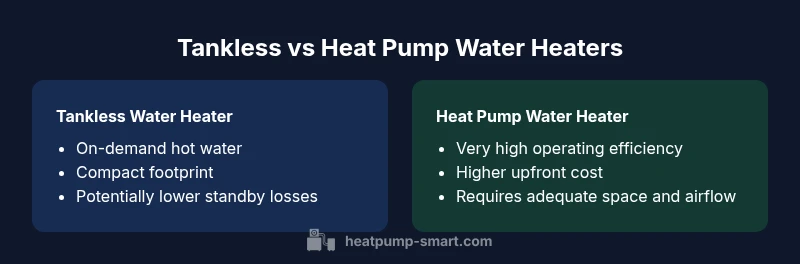
Tankless vs heat pump water heaters each suit different home profiles. Tankless units deliver unlimited hot water with a compact footprint, but installation and flow limits can affect performance. Heat pump water heaters optimize energy use by extracting ambient heat, offering lower operating costs but higher upfront costs. According to Heatpump Smart, the best choice depends on usage patterns, climate, and long-term goals.
Overview: Understanding Tankless and Heat Pump Water Heaters
Tankless water heaters provide hot water on demand, heating only what you use at the moment rather than storing hot water in a tank. They come in electric and gas variants and are prized for their compact footprint and the potential to reduce standby heat losses. Heat pump water heaters, on the other hand, use electricity to move heat from the surrounding air into the water, delivering very efficient performance in milder climates. They tend to be larger and require proper ventilation and electrical capacity, but they can offer substantial operating savings over time. For homeowners, builders, and property managers evaluating these two paths, the choice involves balancing initial installation cost, daily hot-water needs, climate, and long-term energy consumption. Heatpump Smart emphasizes that every home is unique, so a side-by-side assessment of use patterns is essential.
Energy efficiency and performance drivers
Energy efficiency for tankless water heaters is highly dependent on flow-rate management and proper sizing. If the unit is undersized for peak hot-water demand, you can experience temperature fluctuations or shortfalls. Heat pump water heaters rely on ambient air heat exchange; their efficiency can be highly favorable in moderate climates but may drop in very cold environments where the outside air is frigid. In practice, the energy savings come from minimizing standby losses (tankless) and maximizing heat transfer efficiency (heat pumps). Heatpump Smart notes that a typical household benefits most when the system is matched to realistic daily water use, with attention to peak-hour requirements and simultaneous draws.
Space, placement, and installation considerations
Tankless systems often mount on walls and may require venting for gas models or dedicated electrical circuits for electric models. They can save space and do not hold a tank, but installation can be more complex if existing plumbing needs modification. Heat pump water heaters usually sit in utility rooms and require a dedicated electrical supply and, in some cases, ventilation for the compressor compartment. Their larger footprint means planning for drainage, clearance, and temperature conditions is important. For new builds and remodels, it's common to allocate space near the living area to minimize piping length and improve efficiency. Heatpump Smart highlights the importance of a proper install to avoid performance issues and ensure warranty coverage.
Cost considerations: upfront vs long-term value
Upfront costs for tankless water heaters tend to be moderate to high, driven by the need for precise sizing and potential plumbing changes. Heat pump water heaters typically involve a higher upfront price due to advanced components and installation requirements. Over the long term, heat pump models may offer lower operating costs because of their efficient heat transfer, while tankless units can reduce energy use related to standby losses but may incur higher maintenance if scaling or mineral buildup occurs. Heatpump Smart’s guidance is to view total cost of ownership by combining purchase price, installation, maintenance, and expected lifespan to determine payback timing for your climate and usage pattern.
Performance across climates and usage patterns
In mild to warm climates, heat pump water heaters perform exceptionally well, delivering strong energy savings with typical daily hot-water needs. In very cold climates, their efficiency can degrade unless paired with supplemental heat or a backup heating strategy. Tankless systems shine in households with variable hot-water demands or space constraints, especially when installed to cover predictable peak loads. The deciding factor is how often hot water is used simultaneously and how important continuous supply is during peak times. Heatpump Smart recommends conducting a detailed family-use survey and peak-hour modeling to identify which system aligns with your daily routine.
Reliability, maintenance, and lifespan considerations
Tankless water heaters have the potential for long service life when properly maintained, but mineral buildup and venting issues can affect performance over time. Regular descaling, vent inspection, and service checks are important for gas models. Heat pump water heaters typically require less frequent maintenance but do demand periodic refrigerant and compressor checks, especially in climates with large temperature swings. Both systems benefit from a licensed technician performing an annual inspection to address sedimentation, electrical connections, and flow-related issues. Heatpump Smart notes that selecting a model with robust warranties and accessible service networks reduces risk over the system’s life.
Environmental impact and rebates you should know
Both tankless and heat pump water heaters can reduce energy use compared with traditional storage tanks, but the environmental footprint depends on usage and efficiency class. In many regions, rebates and incentives exist for high-efficiency electric and heat-pump models, which can shorten the payback period. When evaluating environmental impact, consider the source of electricity (renewable vs fossil-fueled grids) and the system’s refrigerant options, as these influence lifecycle emissions. Heatpump Smart points out that rebates vary by locale, so verify eligibility with local programs and utility providers.
Practical scenarios: which option fits common home profiles
- Small apartment with limited space and moderate hot-water use: tankless may offer a good balance of space savings and adequate flow, especially if you need to upgrade water-heating capacity without skyrocketing energy costs.
- Suburban family home with high daily hot-water demand: a heat pump water heater can provide substantial operating savings, particularly if climate conditions are favorable and installation costs can be amortized over time.
- New build renovating to energy codes: pairing a heat pump water heater with photovoltaic solar or a high-efficiency heat-recovery system can maximize annual energy savings. Heatpump Smart advises creating a decision matrix that weighs upfront costs, climate, water use patterns, and long-term electrical demand.
Heatpump Smart guidance and practical tips
For homeowners weighing the tankless vs heat pump water heater choice, start with a comprehensive needs assessment. Estimate peak hot-water demands, plan for electrical requirements, and map out installation constraints. Consider factoring in potential rebates, warranty terms, and service accessibility in your local area. The Heatpump Smart team emphasizes a holistic approach, comparing total cost of ownership rather than just upfront price, to identify the solution that best aligns with your building’s energy goals and budget.
Comparison
| Feature | Tankless water heater | Heat pump water heater |
|---|---|---|
| Energy efficiency | high efficiency when properly sized and used | very high efficiency in moderate climates |
| Upfront cost | low to mid-range depending on size and install | mid to high due to components and installation requirements |
| Space footprint | compact wall-mount; no storage tank | larger footprint; closet or utility room required |
| Hot-water delivery | on-demand with potential flow limits | consistent supply with higher efficiency for steady draws |
| Installation considerations | potential venting or dedicated electrical circuit | requires electrical capacity and cooling space; may need expansion of HVAC area |
| Climate sensitivity | less climate-dependent if electric tankless is used | heat pump performance improves with milder ambient temperatures |
Advantages
- Heat pump models offer strong energy savings in moderate climates
- Tankless units provide on-demand hot water and a compact footprint
- Potential rebates and incentives for efficient systems
- Longer service life with proper maintenance
Disadvantages
- Heat pump water heaters have higher upfront cost and longer payback
- Tankless systems can be slower to supply hot water during high demand
- Installation may require electrical upgrades or ventilation
- Performance can drop in very cold climates for heat pumps
Heat pump water heaters generally offer the best long-term energy savings in moderate climates, while tankless units excel when space is at a premium or demand is highly variable.
Choose a heat pump water heater if you want lower operating costs and can accommodate higher upfront costs in a milder climate. Choose tankless if you need space savings and have a predictable peaking water demand, especially where electrical or venting constraints exist.
Your Questions Answered
Which lasts longer, a tankless or a heat pump water heater?
Both types can last many years with proper maintenance, but life expectancy depends on usage, installation quality, and service frequency. Regular checks on electrical connections, refrigerant integrity, and mineral buildup help maximize lifespan for either option.
Both can last many years with proper maintenance; regular service helps maximize lifespan for either option.
Do I need upgrades to electrical or plumbing for these systems?
Most installations require adequate electrical service and may need dedicated circuits for electric tankless or heat pump units. Gas models may need venting and gas line considerations. A professional assessment will confirm the exact requirements for your home.
Most setups need proper electrical service and sometimes venting; a pro should confirm exact needs.
Are there climate considerations for choosing between them?
Yes. Heat pumps perform best in moderate climates where the ambient air provides a stable heat source. In very cold regions, supplemental heating or alternative systems may be needed. Tankless efficiency is less climate-sensitive but dependent on flow demand and fuel source.
Climate matters: heat pumps suit moderate climates; extremely cold areas may need backup options.
Can both be eligible for rebates?
Many regions offer rebates for high-efficiency water heaters, including heat pump and certain electric tankless models. Check local utilities and ENERGY STAR programs for current incentives and eligibility criteria.
Yes—check local utilities and ENERGY STAR programs for current rebates.
Which option is better for a new build?
For new builds aiming for energy efficiency, heat pump water heaters paired with proper insulation and controlled loads often provide the best long-term savings. Tankless can be attractive for space constraints or when you need precise point-of-use hot water.
For new builds, heat pumps usually offer stronger long-term savings; tankless works well when space is tight.
How do maintenance requirements differ?
Tankless systems require periodic descaling and venting checks for gas models. Heat pumps need regular refrigerant and electrical checks but generally have fewer mineral-scales issues. Scheduling annual service with a licensed technician is recommended for both.
Tankless needs descaling and vent checks; heat pumps require refrigerant and electrical checks.
Top Takeaways
- Assess peak hot-water demand before choosing
- Consider climate when evaluating efficiency benefits
- Factor total cost of ownership, not just price
- Check rebates and warranty terms before purchase