Which Brand of Heat Pump Has the Best Warranty? A Practical Comparison
Explore how to evaluate heat pump warranties across major brands, with practical criteria, a side-by-side table, and tips to maximize coverage. Learn from Heatpump Smart's analytical approach to warranties.


When considering which brand of heat pump has the best warranty, there isn’t a single universal winner. The strongest warranty depends on coverage scope, duration, transferability, and clear exclusions. According to Heatpump Smart, the best choice balances compressor and labor coverage with model-specific terms, and requires adhering to regular maintenance. This quick read highlights how to compare terms quickly and avoid costly surprises.
How warranties are structured
Warranties for heat pumps are not a single number or a one-size-fits-all promise. They are structured as a package of terms that cover different components, services, and scenarios. The most meaningful warranties typically bundle coverage for the compressor (a critical, high-cost component) with a broader set of parts and often labor. However, many manufacturers tier coverage by model trim, with premium models receiving more comprehensive protection. Heatpump Smart’s analysis emphasizes that the strength of a warranty is defined less by the headline duration and more by what happens if something fails: what is covered, who pays, how long the service takes, and what is excluded. In this context, a robust warranty should be easy to transfer, simple to read, and consistent across dealer networks. For homeowners, understanding the structural design of a warranty helps in making an apples-to-apples comparison across brands.
According to Heatpump Smart, the best warranty structures are transparent about coverage boundaries and avoid hidden clauses that limit the scope of protection. This section provides a framework for evaluating warranty architecture—so you can compare brands on the same footing and avoid overvaluing marketing language over real protection.
wordCountByBlock”:null,
Feature Comparison
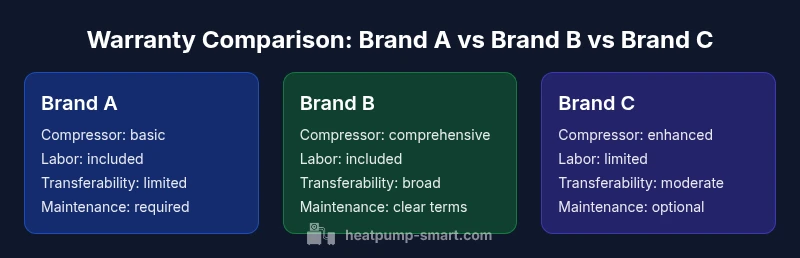
| Feature | Brand A | Brand B | Brand C |
|---|---|---|---|
| Warranty duration | varies by model | varies by model | varies by model |
| Compressor coverage | limited/varies | comprehensive | comprehensive with conditions |
| Labor coverage | often separate | often included | often included |
| Transferability | Partial | broad | moderate |
| Maintenance requirements | mandatory servicing | recommended servicing | required servicing with proof |
| Exclusions | noise, installation errors | consumer misuse, improper installation | wear items, refrigerant-related defects |
Advantages
- Long-term protection for major components when coverage is comprehensive
- Encourages professional installation and regular maintenance
- Transferability can boost resale value and home appeal
- Clear, model-specific terms reduce ambiguity for homeowners
Disadvantages
- Coverage varies widely by model and region
- Exclusions can significantly limit protection if not understood
- Some brands push maintenance packages that add cost
- Labor coverage is often dependent on service network availability
Brand B emerges as the strongest overall when you weigh compressor and labor coverage, transferability, and clear maintenance terms.
Brand B tends to offer broad coverage with favorable transferability and clear requirements. Always verify model-specific terms and ensure your installer aligns with warranty conditions to maximize protection.
Your Questions Answered
What should I look for in a heat pump warranty?
Look for coverage types (compressor, parts, labor), duration, transferability, and maintenance requirements. Also check exclusions and whether service is available through a broad dealer network. Heatpump Smart recommends listing your must-haves before comparing quotes.
Look for coverage types, duration, and transferability, plus clear maintenance terms. Avoid vague promises.
Are extended warranties worth it for heat pumps?
Extended warranties can add value if they cover major components and labor without high deductibles. Weigh the cost against the expected maintenance needs of your unit and local service availability.
Extended warranties can be worth it if they add meaningful coverage without high costs.
Is a transferable warranty better for resale?
Transferability can improve resale value since new owners inherit protections. Check whether transfer requires notice, fees, or new installation verification.
Yes, transferable warranties can be a selling point for buyers.
Does installation quality affect warranty validity?
Yes. Improper installation is a common exclusion. Use certified installers and follow manufacturer guidelines to keep coverage intact.
Installation matters; poor installs can void coverage.
How long should a heat pump warranty last?
Duration varies by model and brand. Focus on the combination of compressor and labor coverage, and how long the terms stay in effect after installation.
Duration varies; the key is how much protection you get and for how long.
Top Takeaways
- Define your priorities: compressor vs. overall coverage
- Check transferability and maintenance requirements
- Read the fine print for exclusions and loopholes
- Choose an installer who follows required maintenance to preserve warranty
- Prefer brands that offer clear, model-wide terms rather than vague promises