Which Heat Pump Installer: A Thorough Comparison
Learn how to evaluate installers for a heat pump project, focusing on credentials, scope, warranties, and value to choose the best fit for your home energy upgrade.


Choosing which heat pump installer to hire means comparing credentials, scope of work, and aftercare. Verify licensure, permits, and energy modeling; review warranty terms and maintenance plans; request itemized quotes and timelines. Check equipment brands and training, plus service responsiveness. The Heatpump Smart team emphasizes clear communication, transparent pricing, and thorough commissioning to ensure long-term comfort and efficiency.
Why choosing the right installer matters for your heat pump project
Selecting the right installer is not a cosmetic decision; it directly affects system performance, energy efficiency, and long-term reliability. If you’re asking which heat pump installer to trust, you must evaluate both technical capability and process discipline. A high-quality job begins with accurate load calculations, appropriate equipment selection, and meticulous commissioning. The Heatpump Smart team emphasizes that the difference between a good installation and a great one often boils down to how well the installer documents the project, communicates timelines, and follows a structured commissioning checklist. In practical terms, this means requesting a site visit, a transparent scope of work, and an itemized proposal that separates equipment costs from labor, permits, and any duct remediation. Without this clarity, you may face hidden costs, suboptimal performance, or delayed timelines that undermine your comfort goals and energy savings.
Credentials to verify when hiring an installer
When evaluating candidates for which heat pump installer to hire, start with baseline credentials: a valid business license, up-to-date insurance, and proof of contractor registration where required by state or local codes. Confirm the technician team has industry-relevant training and experience with heat pump systems similar to yours. Independent certifications or manufacturer training programs can indicate a higher level of reliability. Ask for references and a recent installation summary. Also verify that the company will obtain necessary permits and perform required electrical work to code. A thorough bidder should explain who will perform each task, what inspections will occur, and how any site constraints will be addressed. The goal is to select an installer with a documented process and a track record of successful, on-time projects.
Installation scope and design considerations
Right sizing, proper ductwork, and system zoning are crucial aspects of the installation. An experienced installer should assess your home’s thermal envelope, existing ducts, and potential heat distribution imbalances. They should discuss whether a single-zone or multi-zone solution best suits your layout, how the thermostat integration will function with the system, and how auxiliary heat will be managed during shoulder seasons. Expect the installer to present a design that accounts for humidity control, refrigerant line routing, and outdoor unit placement that minimizes noise and maximizes efficiency. A clear plan also covers electrical compatibility, breaker sizing, and any required upgrades to electrical service. If these elements are missing, you may end up with comfort imbalances or higher operating costs over time.
Load calculations and energy modeling: why they matter
A critical factor in answering which heat pump installer to hire is whether they perform credible load calculations and energy modeling. Manual J-style calculations or equivalent software help ensure the unit is neither undersized nor oversized, both of which waste energy and degrade comfort. The installer should show how climate data, insulation quality, occupancy, and solar gain influence system selection. Energy modeling also helps forecast seasonal performance and potential energy savings, giving you a defensible basis for choosing equipment and a pathway for optimizing controls. In addition, it provides a benchmark against which to measure post-install performance. If a bidder declines to perform or explain load calculations, proceed with caution and seek a second opinion.
Warranties, service plans, and maintenance considerations
Once you decide which heat pump installer to hire, scrutinize warranty terms for both equipment and workmanship. A robust plan typically includes manufacturer coverage, system warranty, and a service plan that covers routine maintenance, filter changes, and annual checks. Maintenance schedules are critical for sustaining efficiency and reducing long-term costs. In many cases, a proactive maintenance contract yields better response times and priority scheduling. The Heatpump Smart analysis suggests that providers offering flexible maintenance options and clear turnaround times tend to deliver higher customer satisfaction and fewer surprise expenses.
How to compare quotes effectively and maintain perspective
When you receive quotes, compare the full scope of work, not just the sticker price. Ask for itemized bids that separate equipment costs, labor, permits, scaffolding, duct remediation, and any required upgrades to electrical service. Ensure the scope includes a detailed commissioning checklist, refrigerant charge verification, and post-install performance testing. Request a standard set of deliverables, including brand/model information, expected SEER/HSPF ratings, and performance warranties. Compare not only upfront costs but also long-term value, maintenance commitments, and the ease of scheduling service in your region. Remember that the lowest price may reflect compromises in scope or future reliability, whereas a higher quote may incorporate more thorough engineering and stronger support.
Red flags to watch for during bids and negotiations
Be wary of contractors who refuse to provide written load calculations, skip permitting steps, or promise unusually short installation timelines without explaining site contingencies. Vague scope or boilerplate language, pressure to sign quickly, or requests for large upfront deposits are warning signs. Check for hidden charges such as duct remediation or electrical upgrades not clearly listed in the bid. If a bidder cannot cite a clear commissioning plan, a post-install repair window, or a maintenance pathway, consider asking for a revised proposal or seeking a second opinion from another installer.
Local codes, permits, and commissioning best practices
Local electrical, refrigerant handling, and building codes govern heat pump installations. A compliant installer will identify all required permits, schedule inspections, and coordinate with utility or municipal authorities as needed. Commissioning is the technical finale: the installer verifies refrigerant charge, airflow, thermostat integration, and outdoor unit isolation. A thorough commissioning report should be delivered to you, with performance data and any recommended adjustments. If the bid lacks a formal commissioning plan, you may miss critical validation steps and end up with a system that looks installed but does not operate as designed.
Practical steps to hiring: a checklist you can use
To simplify decision-making, create a checklist aligned with your home and goals. Confirm licensing and insurance, request at least three references, and review a recent project portfolio. Require a written scope with a detailed bill of materials and a realistic timeline. Insist on a site visit and a no-surprises quote. Compare warranties and maintenance options across bidders. Finally, choose a partner who communicates clearly, respects your schedule, and presents a credible commissioning process as a formal part of the project.
How Heatpump Smart informs your choice: practical guidance blended with data-driven evaluation
Informed decision-making for which heat pump installer to hire benefits from combining practical experience with structured evaluation. The Heatpump Smart framework emphasizes validating licensing, ensuring credible energy modeling, and requiring explicit commissioning steps. By aligning your selection with these criteria, you improve the odds of achieving lasting comfort, energy savings, and reliable operation. This approach also helps you prepare for future maintenance and reliable support across the system’s life cycle.
Quick-start checklist for homeowners: immediate steps you can take today
- List your comfort and efficiency goals for the installation
- Gather bids from at least two qualified installers with site visits
- Request load calculations and equipment specifications in writing
- Check warranty terms and maintenance plans before signing
- Confirm permit processes and scheduling constraints with your chosen installer
Comparison
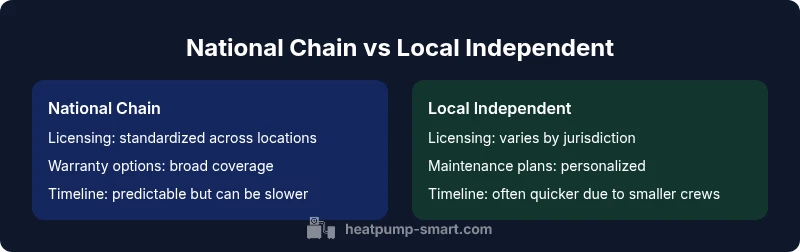
| Feature | National chain installer | Local independent installer |
|---|---|---|
| Licensing & certification | Typically standardized across locations; may require franchise approval | Jurisdiction-specific; varies by region; often deeper local knowledge |
| Typical project timeline | Structured, predictable timelines with centralized process | Often more flexible; potential for faster scheduling due to smaller crews |
| Warranty options | Manufacturer warranty plus company-backed coverage; wide network | Manufacturer warranty plus local workmanship warranty; customization possible |
| Equipment brands supported | Broad brand access; large inventory and vendor relationships | Brand availability can be more limited; faster lead times from regional suppliers |
| Maintenance plans & service | Structured maintenance programs; standardized response times | Personalized service; tailored maintenance plans; potentially faster response |
| Price range / value | Often higher base price with economies of scale | Competitive pricing, customizable scope; value tied to local service quality |
| Best for | Multi-property portfolios or standardized nationwide service | Homes seeking bilingual personal support and rapid scheduling |
Advantages
- Clear differentiation helps buyers choose based on service coverage
- Local installers may offer faster response and personalized support
- National chains provide standardized warranties and scalable maintenance
- More options lead to better pricing competitiveness
Disadvantages
- Avoiding local installers may sacrifice local knowledge and faster service
- National chains sometimes push higher base prices or upsells
- Quality varies by contractor; due diligence is still required
Local independents are typically best for standard residential installs; national chains suit multi-property or standardized service needs.
If your project is typical and you value personalized scheduling, a local installer is usually best. If you need nationwide support, consistent warranties, and scalable maintenance, a national chain may be the better choice.
Your Questions Answered
What should I look for in a heat pump installer?
Look for licensed, insured contractors with proven experience in heat pump installations similar to yours. Ensure they provide credible load calculations, a documented scope of work, and a clear commissioning plan. Request references and a detailed timeline, and verify they handle permits and inspections.
Look for licensed, insured installers with relevant experience, credible load calculations, and a written commissioning plan. Ask for references and a clear timeline.
Is a local installer better than a national chain?
Both can be strong choices; local independents often offer personalized service and quicker scheduling, while national chains may provide standardized warranties and broader service networks. Your decision should hinge on project size, service expectations, and the availability of credible references.
Local installers often offer quicker scheduling and personalized service; national chains bring standardized warranties. Choose based on your project needs and references.
Do installers provide energy modeling and load calculations?
Yes, reputable installers perform load calculations and energy modeling to size the system correctly. This helps avoid oversized or undersized equipment and improves long-term efficiency. If a bid lacks this analysis, ask for it before proceeding.
Most reputable installers provide load calculations and energy modeling to ensure correct sizing.
What kind of warranties should I expect?
Expect a combination of equipment warranty from the manufacturer and a workmanship warranty from the installer. Clarify what each covers, the duration, and what actions void the warranty. A robust maintenance plan often accompanies longer-term protection.
Look for manufacturer equipment warranties plus a workmanship warranty from the installer; ask what’s covered and for how long.
How do I verify licensure and permits?
Ask to see current licenses and proof of insurance. Confirm that the installer will obtain all necessary permits and schedule inspections. Check with local building or electrical authorities if you need additional verification.
Request current licenses and insurance, and confirm permits will be obtained and inspections scheduled.
What questions should I ask during the quote?
Ask for a fully itemized quote, including equipment, labor, permits, duct work, electrical upgrades, and post-install commissioning. Inquire about lead times, warranty details, and what happens if changes are needed during installation.
Ask for an itemized quote with all costs, lead times, and commissioning details.
Top Takeaways
- Compare licenses and credentials before signing
- Ask for detailed, itemized quotes and a formal scope
- Prioritize credible load calculations and commissioning plans
- Evaluate warranties and maintenance options upfront
- Choose an installer with clear communication and realistic timelines