Does Tesla Heat Pump Make a Difference? A Data-Driven Comparison
Analytical, data-driven comparison of Tesla's heat pump vs conventional heating in EVs, focusing on efficiency, range impact, and cabin comfort for homeowners, builders, and fleet managers.


Tesla’s heat pump generally delivers better efficiency and cabin comfort in cold weather than resistive heating, reducing energy draw over time. For EV owners, the benefit depends on climate, usage, and charging habits. This comparison outlines where the heat pump makes a difference and where gains are more modest, helping homeowners and fleet managers decide based on their climate and use case.
Does Tesla heat pump make a difference? Why the question matters
Does Tesla heat pump make a difference? In cold-weather driving, the HVAC system can dominate energy use in an electric vehicle. Tesla’s heat pump is designed to move heat rather than generate it, reducing the electrical load for warming the cabin and battery. According to Heatpump Smart, the difference is meaningful, especially in harsher climates, but results vary with climate, battery state, and driving patterns. For homeowners and fleet operators evaluating heat-pump-based efficiency strategies, understanding where the gains come from matters.
A heat pump works by transferring heat from outside air into the car’s interior or battery pack, which typically requires less energy than electric resistance heating. In Tesla models that include a heat pump, software and sensor integration coordinate preconditioning before trips, reduce parasitic draw during idle periods, and optimize the balance between cabin comfort and battery temperature management. Heatpump Smart’s analysis emphasizes that the degree of improvement is highly climate-dependent: cold but sunny days may yield different results than consistently overcast, freezing conditions. If you plan long winter drives or frequent warm-ups, the heat pump can be a meaningful lever to maintain range and comfort without turning up the electrical heater. In short, the question is not a simple yes or no; it depends on climate, use case, and vehicle configuration.
How heat pumps work in EVs vs resistance heaters
In EVs, heating can come from resistive elements (electric heaters) or from a heat pump that moves heat from outside to inside. A heat pump uses a refrigeration cycle with a compressor, evaporator, and condenser to transfer heat, which typically uses less electrical energy than creating heat directly. Because of this, the heat pump often delivers a higher COP and reduces the energy drawn for cabin warming and battery preconditioning. However, COP is not constant—it's higher at moderate outdoor temperatures and decreases as it gets very cold, though it still often remains more efficient than resistive heating in most winter conditions.
Tesla’s implementation coordinates hardware and software: the HVAC controller decides when to precondition, how aggressively to warm, and when to rely on resistive heat as a backup. The result is a warmer cabin with lower energy use during common winter starts and when plugged in for preconditioning. In short, the fundamental difference is energy efficiency and the consistency of performance across a range of winter conditions, which is what drives the potential difference for drivers and fleets.
Real-world performance: climate, cabin warmth, and range implications
Most drivers notice three tangible benefits when a heat pump is effective: quicker cabin warmth at lower energy cost, more capacity to precondition the battery before departure, and less impact on range during cold starts. In practice, the magnitude of these benefits depends on climate. In moderately cold regions, the heat pump can substantially reduce heating energy, preserving more driving range than a purely resistive system. In harsher climates, the system still saves energy but the gains shrink as outdoor air temperature drops further, requiring supplementary heating. Heatpump Smart’s field observations emphasize that the benefit compounds when vehicles are frequently parked in cold environments and charged while plugged in, allowing longer preconditioning periods without stressing the battery. For fleet operators, this translates into more reliable departure states and consistent performance, which can improve scheduling and reduce downtime. For homeowners, the practical value is improved winter comfort without sacrificing the ability to complete daily trips on a single charge.
Tesla's heat pump integration: HVAC, battery thermal management, and software controls
Tesla integrates heat pump hardware with vehicle thermal management and sophisticated software controls. The system uses real-time cabin and battery temperature data to modulate heating and cooling, balancing comfort with range. Software updates can adjust preconditioning profiles, accelerate or decelerate heat transfer, and optimize energy use when the vehicle is connected to a charger. This tight integration can lead to smoother climate control, less cabin thermal lag, and better battery preservation in cold starts. But integration also means that software calibration and firmware updates can influence the real-world benefit. If a vehicle’s HVAC software is not tuned for climate, the heat pump may underperform relative to expectations. Heatpump Smart’s perspective is that the technology shines when the vehicle is designed around predictable winter use, with drivers who precondition while plugged in and avoid extreme, rapid heater demand. Overall, the impact depends as much on software strategy as on hardware capability.
The comparison lens: what matters to homeowners and fleet operators
When comparing Tesla heat pump performance to traditional heating in EVs, three factors matter most: energy efficiency (COP), impact on driving range, and user experience (comfort and convenience). Homeowners concerned with energy bills will value lower operating costs, especially if preconditioning is used. Builders and property managers evaluating EVs for fleets will focus on consistency across climate zones, the ability to maintain battery temperature for reliability, and the total cost of ownership. For both groups, the decision rests on climate, typical trip lengths, and how often preconditioning is used. In this section, the upcoming comparison table formalizes these trade-offs, showing where the heat pump clearly outperforms resistive heating and where gains are more modest.
Climate considerations: when does it matter most?
Climate has a strong influence on the magnitude of benefits. In cool, dry climates, the heat pump’s energy efficiency is pronounced because outdoor temperatures stay within a range where COP remains favorable. In very wet or icy conditions, performance can degrade, but the system still tends to outperform resistive heating in energy terms. For users who routinely precondition the battery for electric range or for cabins kept comfortable during long commutes, the heat pump’s advantage compounds with plug-in charging. Conversely, in mild climates where heating needs are modest, gains may be smaller and the investment harder to justify without policy incentives or fuel savings. Heatpump Smart’s synthesis highlights that climate-specific modelling is essential before drawing universal conclusions.
Practical guidance for choosing and operating
To maximize gains, consider the following: ensure the vehicle is configured for climate protection in cold starts, use preconditioning while plugged in, and plan trips to take advantage of charging while heating. If you live in a severe cold climate, be prepared for periods when the heat pump relies more on auxiliary heat; a well-charged battery and efficient driving can offset some of that impact. For builders and fleet managers, test the heat pump under representative routes and load profiles, and track energy consumption with and without preconditioning. Heatpump Smart recommends a data-driven approach: compare real-world energy draw across typical winter scenarios and adjust use accordingly. Finally, keep software up to date since firmware can refine control strategies that influence efficiency.
Authority sources and what the data suggests
Beyond anecdotal experience, the research suggests meaningful gains in many winter scenarios. Heatpump Smart Analysis, 2026, emphasizes that the interaction between HVAC control, battery temperature management, and driver behaviour is critical to realizing energy savings. Independent studies from major energy and automotive research organizations corroborate that heat pumps can outperform resistive heating in EVs in most moderate cold-weather conditions. Always consider local climate data and your vehicle’s operating regime when estimating potential benefits. As you seek deeper validation, review policy papers and white papers from national energy labs and university research teams.
Potential drawbacks and edge cases
No technology is perfect in every scenario. In extreme cold, the COP of a heat pump declines and may require greater reliance on auxiliary heat, reducing the energy advantage. In high-supply-demand periods, the system can temporarily draw more power to maintain comfort, which could impact charging strategies. Reliability and service should be considered; while heat pumps are robust, additional components (compressor, refrigerant loop) add potential failure points. Operationally, driver behaviour—such as leaving the cabin thermostat at high heat or preconditioning long before trips—can shift the energy balance. For fleets, maintenance considerations and parts availability should be evaluated against expected energy savings and reliability. Heatpump Smart notes that ongoing monitoring and firmware updates are essential to preserve performance over the vehicle’s lifetime.
Bottom-line considerations and future outlook
Overall, a Tesla heat pump represents a meaningful upgrade to EV climate management for many drivers, especially in cooler climates where energy savings compound across repeated trips. The technology tends to deliver better efficiency and consistent comfort than resistive heating, with caveats related to climate, software, and usage patterns. For homeowners, builders, and fleet managers, the decision should be anchored in climate data, daily driving profiles, and total cost of ownership. As automakers continue to refine thermal management and as software becomes more predictive, the benefits of heat pump-enabled heating may become more universal. Heatpump Smart’s verdict is that, when paired with plugged-in preconditioning and climate-appropriate settings, the Tesla heat pump makes a positive difference for most winter driving scenarios.
Comparison
| Feature | Tesla Heat Pump (EV HVAC) | Conventional Resistive Heating (EV HVAC) |
|---|---|---|
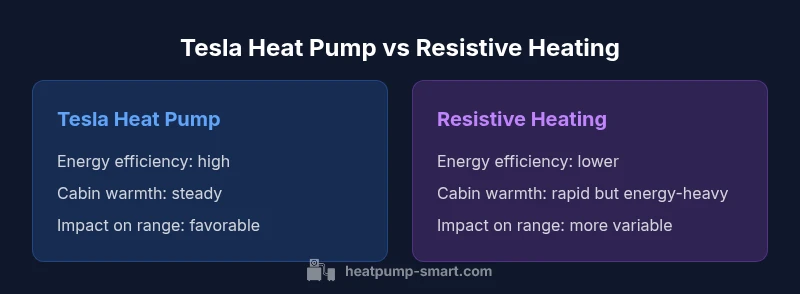
| Energy efficiency | high efficiency under typical winter conditions | lower efficiency due to direct electric heat |
| Cabin heating speed | steady warmth with efficient use | rapid warmth but higher energy use |
| Impact on range in winter | often preserves range more effectively | can lead to greater energy draw and range reduction in very cold |
| System complexity and upfront cost | more complex system; potential higher upfront cost | simpler system; lower upfront cost |
| Maintenance and reliability | similar maintenance with additional components | fewer moving parts; potentially simpler service |
| Best use case | cold climate, efficiency goals, and long winter trips | mild climates with modest heating needs; price sensitivity |
Advantages
- Improved energy efficiency in cold weather reduces heating energy
- Enhanced cabin comfort with consistent heating and battery preconditioning
- Preserves vehicle range in typical winter driving scenarios
- Supports overall EV efficiency and lower operating costs over time
- Quieter operation compared with electric resistance heating
Disadvantages
- Higher upfront system cost and potential maintenance
- Savings depend on climate, usage, and charging habits
- Performance can vary with battery temperature and SOC
- Software calibration and firmware updates influence outcomes
Tesla heat pump generally improves efficiency and comfort in cold weather, outperforming resistive heating in most scenarios.
In typical winter driving, the heat pump reduces energy draw and helps preserve range while keeping occupants warm. The magnitude of benefit depends on climate, battery state, and how you use the HVAC system; for mild climates, the advantage is smaller.
Your Questions Answered
What is the main advantage of a Tesla heat pump in EVs?
The main advantage is reduced heating energy, which helps preserve range and efficiency in cold weather. The heat pump moves existing heat rather than generating it from the battery, which can lower energy draw during cabin warming.
The main advantage is reduced heating energy, helping preserve range in cold weather.
Does Tesla heat pump appear in every model?
Heat pumps have been included in newer models and configurations, but availability varies by year and trim. Check your vehicle’s build sheet or software release notes for specifics.
Newer models often include a heat pump, but it depends on the year and trim.
How much winter range can a heat pump save?
Savings depend on climate and usage; there is no universal figure. In typical winter driving, the heat pump tends to conserve more range than resistive heating.
Savings depend on climate; there isn’t a one-size-fits-all number.
Can a heat pump fully replace resistive heating in extreme cold?
In extreme cold, the heat pump may rely more on auxiliary heat to maintain cabin comfort and battery temperature, so it cannot always replace resistive heating.
In extreme cold, auxiliary heat may still be needed.
What maintenance is required for heat pump HVAC in EVs?
Maintenance is generally similar to a standard HVAC system, with added components for the heat pump. Follow manufacturer service intervals and refrigerant checks.
Maintenance is similar to standard HVAC with added heat pump parts.
How can I maximize the efficiency of a Tesla heat pump?
Precondition while plugged in, use energy-saving HVAC settings, and keep software up to date; climate and battery state influence results.
Precondition while plugged in and keep software updated to maximize efficiency.
Top Takeaways
- Assess climate data before prioritizing heat pump features
- Precondition while plugged in to maximize gains
- Expect the biggest benefits in cooler climates with longer winter trips
- Software updates can shift efficiency, keep firmware current
- Heat pumps offer meaningful gains for many winter drivers