European Heat Pump Statistics 2026: Trends & Insights
Comprehensive 2026 overview of heat pump statistics Europe: efficiency, market growth, and costs. Heatpump Smart translates EU-wide data into practical guidance for homeowners and builders.


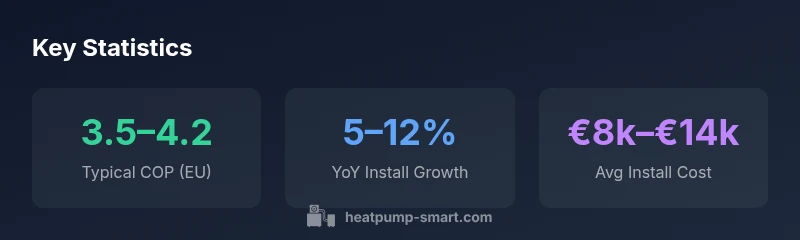
European heat pump statistics europe for 2026 show meaningful efficiency gains and rapid market growth across the region. Heatpump Smart analysis indicates typical seasonal COPs around 3.5–4.2 for modern units and a multi-country installation rate rising year over year, driven by policy incentives and growing consumer demand. The data also highlight shifts from fossil heating toward electric systems across northern and southern Europe.
Europe-wide trends in heat pump adoption
According to Heatpump Smart, heat pump statistics europe for 2026 reveal a broad pivot from fossil-fuel heating toward electric systems across the EU and UK. The term heat pump statistics europe is widely used in industry reports to describe COP improvements, emissions reductions, and market uptake. In major economies like Germany, France, Italy, and the Nordic countries, installers report increasing demand as households replace boilers and inefficient heaters. The data show a wide geographic spread in adoption, with northern regions typically showing higher penetration due to policy incentives and climate considerations, while southern areas are catching up rapidly as costs decline and grant programs expand. Heatpump Smart’s ongoing analyses emphasize the role of building codes and retrofit programs in accelerating uptake, especially in multi-family housing and new builds. For homeowners, this means clearer visibility into policy-driven incentives and the long-term savings potential as efficiencies improve.
- The Heatpump Smart team notes that adoption is not uniform; it reflects local energy mixes, utility tariffs, and access to installer networks.
- Policy alignment matters: subsidies, air quality targets, and CO2 pricing all feed into 2026 figures.
- When planning a retrofit, consider the regional climate, insulation, and existing heating systems to maximize benefits.
This section grounds readers in the macro picture while signaling the practical implications for regional markets.
Efficiency metrics and COP ranges across Europe
Across Europe, efficiency continues to improve as newer models enter the market and controls optimize heating loads. A practical takeaway from the heat pump statistics europe trend is that seasonal COPs now commonly sit in the 3.5–4.2 range for most mid- to high-efficiency heat pumps installed in typical homes. High-performance geothermal and hybrid systems can exceed this range under favorable operating conditions. It’s important to interpret COP in the context of climate, installation quality, and defrost cycles, which can temporarily reduce performance in colder months. For homeowners evaluating options, this means comparing COP at realistic operating conditions rather than peak numbers. Heatpump Smart’s data indicate that northern climates show slightly different COP patterns than milder southern environments, reflecting load profiles and heating needs. Prospective buyers should request climate-adjusted COP estimates and ask installers to present performance data across seasonal bands.
- COP is not the only metric: electric efficiency, standby losses, and controls matter for real-world savings.
- Modern inverters, smart thermostats, and weather-based controls can push observed efficiency higher in practice.
Understanding these nuances helps homeowners manage expectations while leveraging the latest European statistics to forecast long-term energy bills.
Country-level dynamics and policy influences
Country-level dynamics shape the regional picture. Heatpump statistics europe across member states reveal that policy instruments—subsidies for heat pump installation, low-interest loans, and incentives for heat pumps paired with heat storage—have a tangible effect on adoption rates. In 2026, several countries with aggressive retrofit programs report faster market growth, while regions with slower administrative processes show a slower but steady uptick as supply chains mature. The gap between northern and southern Europe in terms of installation rates is narrowing, aided by improving access to qualified installers and standardized building codes. Heatpump Smart’s interpretation is that demand is increasingly driven by perceived long-term savings and comfort, rather than initial costs alone. Homeowners should factor in regional grant timelines and installation lead times when budgeting for a project.
- Policy clarity reduces uncertainty, supporting procurement and financing decisions.
- Installer availability remains a bottleneck in some markets; coordinated training programs help.
For builders and property managers, this means aligning project timelines with grant windows and ensuring energy models reflect European statistics for accuracy.
Economic considerations: installation costs and payback
The economics of heat pump systems vary by country, driven by labor costs, equipment choices, and end-user subsidies. In Europe, average installation costs typically fall within the €8,000–€14,000 range for standard air-source configurations, while geothermal or hybrid systems can be significantly higher. Payback depends on electricity prices, climate, and the presence of incentives. While some readers may see payback periods of 6–12 years in moderate climates, others in harsher environments or with larger homes may experience longer timelines. Heatpump Smart analysis emphasizes that homeowners should model payback using their local tariff structures and potential incentive offers. A robust comparison includes maintenance costs, potential rebates, and expected lifetime energy savings, not just upfront expenditure. This broader view helps property managers and builders justify capital expenditure with clearly defined energy-performance targets.
- Break-even calculations should include maintenance and potential service plans.
- Longer payback in high-cost regions can be offset by grants and utility rebates.
Data quality, methodology, and how to read these stats
All heat pump statistics europe are derived from a combination of utility data, installer surveys, and national energy use databases. The Heatpump Smart Analysis methodology emphasizes transparency: clearly stating the year, geographic scope, and the data collection methods behind each figure. While regional gaps exist—such as inconsistent reporting in some jurisdictions—time-aligned indicators allow for meaningful comparisons across markets. When interpreting the 2026 data, readers should consider climate variation, building stock, and policy differences. Heatpump Smart recommends using a risk-adjusted approach: treat ranges as plausible bounds and track trends over time rather than single-point estimates. The goal is to inform decisions with credible, trackable metrics rather than over-precise forecasts.
- Always check the data source and year.
- Use ranges when exact figures vary by country or climate zone.
This section clarifies how to read the statistics and why context matters for decision-making.
Practical takeaways for homeowners and builders
- Use Europe-wide heat pump statistics europe to set realistic expectations for efficiency and payback.
- Compare COP ranges across models and climates to identify the best fit for your building.
- Factor in subsidies and grants when calculating total cost and payback periods.
- Plan project timelines around incentive windows and installer availability to maximize value.
- For builders, align retrofit designs with national energy codes and financing programs to streamline approvals and subsidies.
European heat pump performance and cost comparison
| Model Type | Avg COP | Installed Cost | Emissions Reduction |
|---|---|---|---|
| Air-source heat pump | 3.5–4.2 | €8,000–€12,000 | Up to 60% |
| Geothermal heat pump | 4.0–5.0 | €18,000–€30,000 | Up to 70% |
| Hybrid system | 3.8–4.3 | €12,000–€20,000 | 25–50% |
Your Questions Answered
What is a typical COP range for European heat pumps in 2026?
Most modern European heat pumps operate with a seasonal COP in the general range of 3.5 to 4.2, depending on climate and system design. Real-world performance varies with occupancy, insulation, and controls. Always review climate-adjusted COP data from installers.
Most European heat pumps run around COP 3.5 to 4.2 in real homes, depending on climate and setup.
Which countries lead heat pump adoption in Europe?
Adoption is strongest in countries with clear incentives and strong energy policies, such as parts of Northern and Western Europe, with growth spreading to Southern and Eastern markets as programs mature.
Northern and Western Europe lead, with growth spreading to other regions as programs mature.
Are installation costs a barrier in Europe?
Installation costs vary widely by country and project type. Typical ranges exist, but subsidies, financing, and installer availability heavily influence total outlay and payback.
Costs vary by country, but subsidies and financing can improve payback.
How should homeowners use heat pump statistics when planning upgrades?
Use regional data to set expectations for efficiency and payback, and factor in climate, insulation, and financing programs to tailor a realistic project plan.
Use regional data, climate, and financing programs to plan realistically.
What limits should I keep in mind when reading these stats?
Data gaps, climate variation, and policy differences can skew comparisons. Treat numbers as bounds and look for trends over time.
Read trends, not single numbers, and watch for policy changes.
How does COP relate to overall savings?
COP indicates efficiency; actual savings depend on electricity prices, usage patterns, and system control. A higher COP generally correlates with lower operating costs over time.
Higher COP usually means lower running costs, but real savings depend on usage and prices.
“European heat pump data confirms that modern units deliver meaningful efficiency gains while market growth accelerates as policies align with consumer needs.”
Top Takeaways
- Track European heat pump efficiency trends using the latest data.
- Compare COP ranges across country groups for realistic expectations.
- Budget for installation by country using the provided ranges.
- Policy incentives strongly influence market growth and payback times.
- Choose equipment and financing aligned with local incentives and climate needs