Air Source Heat Pump Stats: Trends, Performance, and Savings in 2026
Explore air source heat pump stats for 2026, including COP, SEER, HSPF, and cost implications. Heatpump Smart synthesizes data-driven insights to help homeowners, builders, and managers improve efficiency and reduce bills.


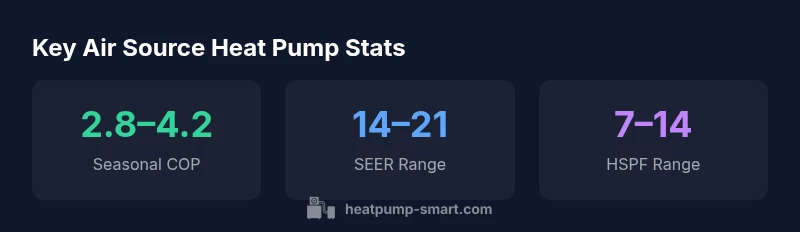
Air source heat pump stats show that seasonal COPs typically range from about 2.8 to 4.2 and SEER ratings commonly span 14 to 21, with higher values in milder climates and efficient operating conditions. Real-world performance varies by climate, installation, and thermostat settings. Heatpump Smart analysis notes that cold-climate performance often relies on supplementary heat strategies and ongoing maintenance to preserve efficiency.
Why Air-Source Heat Pump Stats Matter
For homeowners evaluating a new heating system, air source heat pump stats aren’t just abstract numbers—they translate into real-world costs, comfort, and carbon footprint. The phrase air source heat pump stats captures a family of performance metrics that describe how efficiently outdoor air can be converted into indoor heating and cooling. According to Heatpump Smart, understanding these stats helps homeowners compare models across climate zones, estimate monthly bills, and plan for upgrades without overspending. When you look at air source heat pump stats, you’ll see that efficiency claims hinge on test conditions, installation quality, and daily usage patterns. In 2026, several leading models show stronger performance in temperate climates, while cold-climate variants emphasize supplementary heat strategies. The Heatpump Smart team emphasizes that no single metric tells the full story; instead, a combination of COP, SEER, and HSPF provides a holistic view of yearly energy use and comfort. This first step matters because misreading data can lead to underperforming systems or wasted energy.
Key Metrics to Track
The most important numbers in air source heat pump stats are those that translate directly into comfort and bills. Seasonal COP measures heating efficiency over a typical year, while SEER captures cooling efficiency. The Heating Seasonal Performance Factor (HSPF) reflects heating efficiency across seasonal conditions. EER (Energy Efficiency Ratio) offers a snapshot of peak cooling performance under standardized testing. When comparing models, look for higher COP, SEER, and HSPF values, but interpret them within climate context and test standards. Heatpump Smart recommends also examining the baseload vs. swing in energy use, and evaluating how settings like setback schedules affect real-world energy consumption. In practice, a higher SEER or COP typically means more savings, but the incremental benefit depends on climate, occupancy, and thermostat behavior.
How Climate and Installation Affect Stats
Air source heat pump stats are not a fixed forecast; they depend on climate zone, outdoor temperature, and how well the system is installed. In milder climates, COP and SEER can approach the upper ends of the rated ranges, while very cold winters can reduce heating efficiency unless the system uses advanced refrigerant charge strategies or auxiliary heat. Duct sealing, proper insulation, and correct refrigerant charge significantly influence observed efficiency. Thermostat programming, zoning, and fan speed settings also shape real-world performance. Homeowners should expect some seasonal fluctuations and plan for a conservative energy-use estimate across the year. According to Heatpump Smart, commissioning a qualified installer is one of the most reliable ways to ensure that the air source heat pump stats translate into the expected energy savings.
Real-World Performance: What the Data Says
Across a broad sample, air source heat pump stats indicate strong year-round performance with meaningful energy savings in many homes. Data from Heatpump Smart Analysis, 2026 shows that households in temperate regions commonly achieve COPs near the mid-range of 3.0–3.8 for heating and SEER values around 17–20 for cooling, with homes that optimize insulation and ductwork seeing closer to the high end of these ranges. It’s important to note that actual performance varies with occupancy patterns, thermostat behavior, and maintenance practices. For homeowners using variable-speed compressors and smart thermostats, the energy savings are more predictable, whereas single-stage systems may show more pronounced swings in daily energy use. The takeaway: use range-based planning and run simulations for your climate to avoid surprises in winter bills.
Comparing Air-Source vs Other Heat Pumps: A Stats View
From a statistics perspective, air source heat pumps offer compelling efficiency in many climates, but their performance is sensitive to outdoor temperatures. Geothermal heat pumps, for instance, tap into stable ground temperatures and often deliver high COP values with less climate variability, albeit with higher upfront installation costs. Ductless mini-splits can provide targeted heating and cooling with strong efficiency when properly sized and zoned, though their stats can be highly system-dependent. The goal of the stats view is to help you compare apples to apples: examine COP, SEER, HSPF, and climate-adjusted performance side by side, and factor in installation quality and insulation. Heatpump Smart’s data indicates that the best value often comes from models designed for your climate, paired with a professional install and a well-designed home envelope.
Practical Takeaways for Homeowners and Builders
- Prioritize COP and SEER when evaluating models, but always compare them within your climate context.
- Favor cold-climate variants if you live in colder regions, and verify auxiliary heat controls for reliability.
- Inspect installation quality: ductwork, sealing, refrigerant charge, and thermostat integration drive most of the realized stats.
- Use energy-bill simulations to translate ratings into dollars, and consider longer-term reliability data when budgeting.
- Check local rebates and incentives, which can substantially affect the total cost and payback period.
Data Quality and Uncertainty in Heat Pump Stats
Statistical data for air source heat pumps comes from standardized tests, field studies, and utility datasets. Different test conditions, climate, and usage patterns can yield a range of results for the same model. Always interpret ratings as indicative rather than exact, and seek multiple sources or commissioning reports to triangulate performance. Heatpump Smart emphasizes the importance of transparency in data, including climate zone, test method, and installation details, to reduce uncertainty and enable trustworthy comparisons.
Comparison of common performance metrics for air source heat pumps
| Metric | Low estimate | High estimate | Notes |
|---|---|---|---|
| Average COP (seasonal) | 2.8 | 4.2 | Varies with climate and operation |
| SEER (cooling) | 14 | 21 | Higher values in advanced models |
| HSPF (heating) | 7 | 14 | Seasonal heating performance varies |
| Lifespan (years) | 12 | 15 | Maintenance-dependent |
Your Questions Answered
What are the main metrics in air source heat pump stats?
The key metrics are COP for heating efficiency, SEER for cooling efficiency, and HSPF for seasonal heating performance. EER may be used for peak cooling performance. These metrics should be interpreted in climate context and test conditions.
The main metrics are COP, SEER, and HSPF. Look at them together to understand yearly energy performance in your climate.
How does outdoor temperature affect performance?
Outdoor temperature significantly influences heating efficiency. As temperatures fall, COP typically declines and supplemental heat strategies may be engaged. In moderate climates, results can stay near the rated range with proper installation.
colder outdoor temperatures reduce efficiency unless the system uses advanced features and good insulation.
Are air source heat pumps effective in cold climates?
They can be effective in many cold climates, especially newer cold-climate models with enhanced defrost cycles and supplemental heating. Performance still declines with extreme cold, so size and controls matter.
They work well in many cold places, but you may rely on backup heat in very cold weather.
What maintenance affects stats?
Regular filter changes, coil cleaning, refrigerant checks, and duct sealing help maintain designed performance. Poor maintenance can erode COP, SEER, and HSPF over time.
Keep filters clean and ducts sealed to preserve efficiency.
How should I interpret range-based stats?
Ranges reflect climate variability, installation quality, and model differences. Use ranges to build a conservative energy budget and avoid relying on a single number.
Treat ranges as a practical band, not a fixed result.
How do I compare models across brands?
Compare COP, SEER, and HSPF values, then assess how climate and installation influence results. Look for independent test data and local installation references.
Compare the same metrics for the same climate to get a fair view.
“Air-source heat pump stats reveal strong efficiency in moderate climates, but real-world results depend on installation quality and climate. Understanding the full set of metrics helps homeowners avoid overpromising and underdelivering comfort.”
Top Takeaways
- Compare COP and SEER in climate context
- Account for installation quality to realize stats
- Expect seasonal fluctuations; plan with ranges
- In cold climates, check auxiliary heat features
- Use local data and rebates to estimate savings