Which Heat Pump Is the Quietest? A Comprehensive Comparison
A rigorous comparison of quiet heat pumps for home comfort. Learn how to assess noise, installation tips, and what to prioritize to minimize sound without sacrificing efficiency.


If you want the quietest heat pump, focus on inverter-driven, variable-speed models with dedicated sound-dampening features and an overall low outdoor-noise profile. Among common options, look for units that offer quiet-mode operation, solid vibration isolation, and an AHRI-certified noise rating. This quick guide will help you compare the leading contenders without sacrificing efficiency.
What makes a heat pump quiet
A heat pump’s noise level is driven by several interacting design choices, installation conditions, and operating modes. In general, quieter operation comes from inverter-driven compressors that modulate output, insulated or shielded housings, low-vibration mounting, and well-designed fans. Outdoor unit noise can be the dominant factor for many homes, especially when bedrooms or living spaces are near the unit. The Heatpump Smart team emphasizes that the perceived quietness of a system depends not only on the equipment itself but also on where and how it is installed. To reduce sound, homeowners should consider both equipment features and site planning. Remember that even a very quiet unit still makes some sound when active, so align expectations with room usage, facade materials, and landscaping in your design plan.
Key design factors that drive noise levels
Noise is not a single number; it emerges from a package of features that influence how the system operates at different loads and times of day. Key design factors include: inverter-driven compressors that smoothly adjust output instead of cycling on/off; multi-speed fans and optimized blade geometry; vibration isolation mounts and compliant mounting surfaces; acoustically sealed cabinets and sound-damping liners; and the housing layout that keeps loud components away from living spaces. The best quiet heat pumps combine several of these elements, plus external housing that minimizes wind-driven noise. Finally, installation specifics—like the distance from walls, direct exposure to open air, and the presence of reflective surfaces—can magnify or dampen perceived noise. A thoughtful combination of equipment and placement yields the most noticeable gains in quiet operation.
How noise ratings work and what to look for
Professional ratings provide a standardized basis for comparison, but they don’t tell the whole story. Look for a heat pump that offers an AHRI-certified exterior sound rating and a dedicated quiet-mode or low-noise setting. Independent testing and labeling help consumers distinguish truly quiet units from those that are merely modestly quiet in ideal conditions. In addition to exterior noise, consider indoor sound paths—some systems place compressors indoors (geothermal or packaged systems) to reduce outward sound. Heatpump Smart analysis shows that models with modular sound dampening, reinforced enclosures, and smart inverter control consistently outperform boxier, single-speed designs in typical home environments. Review product literature for real-world testimonials about night-time performance and vibration behavior.
Noise profiles by technology type
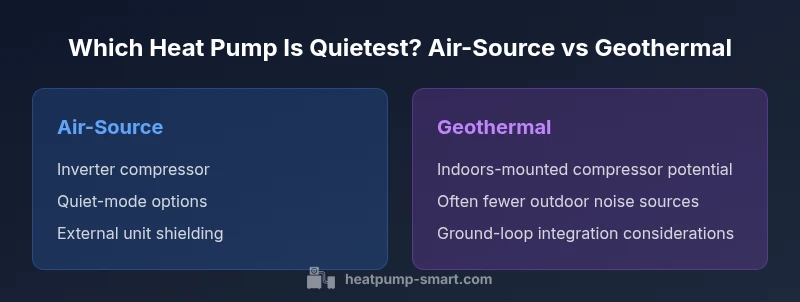
Different heat pump families tend to produce different noise characteristics, but strong engineering practice can minimize these differences in practice. Air-source inverter heat pumps often provide quiet outdoor operation when in quiet-mode, with most noise generated during high-load periods or defrost cycles. Geothermal or ground-source systems typically place loud components inside the building shell or rely on buried loops, reducing exterior sound exposure. Ductless mini-splits with properly tuned refrigerant circuits can be quiet in each indoor zone, but multiple heads can introduce cumulative sound if oscillation or improper mounting occurs. Across all types, the best outcomes occur when the design emphasizes vibration control, enclosure integrity, and intelligent modulation that avoids peak-flow sounds during transition between heating and cooling.
Practical installation strategies to reduce noise
Installation plays a decisive role in actual noise levels. Practical steps include: locating the outdoor unit away from bedrooms and primary living spaces, using rigid, level mounting pads with anti-vibration pads, and ensuring proper clearance around the unit to avoid air recirculation and wind-induced noise. Use low-wibration hardware and secure all panels to prevent resonant rattles. Consider acoustic shields or fencing designed to diffuse sound without trapping heat. For geothermal systems, carefully plan the ground loop trenches and indoor equipment placement to minimize vibration transfer and potential structure-borne noise. Finally, schedule installations to avoid late-night defrost cycles in extremely cold periods, which can temporarily elevate outdoor noise; a well-tuned system mitigates these spikes.
How to evaluate models: a step-by-step checklist
A methodical evaluation helps you select the quietest option without sacrificing efficiency. Step 1: verify AHRI certification and obtain official noise test data for both outdoor and indoor units. Step 2: check for a quiet-mode or low-noise setting and confirm it operates across multiple load levels. Step 3: review installation guidelines to understand vibration isolation requirements and recommended clearances. Step 4: compare two or three models using independent reviews or field tests, focusing on real-world performance at night and under low-load conditions. Step 5: assess warranty, service accessibility, and typical maintenance that can affect long-term noise (e.g., fan blade condition and compressor wear). Step 6: plan installation with a contractor to optimize unit placement and minimize line-of-sight noise.
Real-world scenarios: when quiet matters most
For homes with bedrooms adjacent to outdoor units, even modest noise can be perceived as disruptive, especially during nighttime. Urban settings also amplify outdoor sound due to reflections off building facades. In multi-unit buildings or rentals, shared walls and limited outdoor space require careful layout to prevent noise from traveling between units. In such cases, selecting a model with a robust quiet-mode, solid vibration isolation, and longer-term reliability is essential. In contrast, a single-family home with a large yard may tolerate a slightly louder outdoor unit if it yields higher efficiency and better climate control during peak seasons. Across scenarios, the balance between sound performance and energy savings should guide your final choice.
Practical trade-offs: quietness vs cost and efficiency
Quiet operation often comes with a price premium and marginally lower peak energy performance if oversized for climate. Shipping a unit with premium sound-dampening features or an advanced inverter can cost more upfront but may reduce energy waste and improve comfort over time. In some climates, you may trade a slightly louder but cheaper model for a system with better defrost control, reduced cycling, and superior long-term reliability. The optimal decision blends acoustics, climate needs, and total cost of ownership, not just initial price. Heatpump Smart’s framework emphasizes evaluating both the audible and thermal performance to avoid compromising comfort for short-term savings.
Heatpump Smart’s approach: a practical decision framework
According to Heatpump Smart, choosing the quietest heat pump should start with the intended use pattern: nighttime comfort, light sleepers, and rooms near outdoor equipment require extra attention to noise features. The framework also highlights the importance of proper sizing, installation, and ongoing maintenance to sustain quiet operation. By prioritizing inverter-driven technology, vibration isolation, and verified noise ratings, homeowners can achieve meaningful reductions in perceived sound without sacrificing heating and cooling performance. Heatpump Smart’s guidance also stresses working with qualified installers who understand how site conditions influence acoustics and can tailor mounting, ducting, and shielding accordingly.
Authority and standards: reading noise ratings and independent verification
Understanding noise ratings requires attention to independent verification and credible standards. Seek AHRI certification for sound data, review local building codes on outdoor equipment placement, and consider Energy Star or other energy-efficiency labels that often accompany quieter configurations. Real-world reviews and field tests from credible sources can help validate the manufacturer’s claims under typical home operating conditions. This block reinforces the idea that quiet operation results from a combination of design, installation, and routine maintenance.
Final notes on choosing the quietest option
Quiet heat pumps are a balance of engineering, installation, and user behavior. A model’s quietness is not just about the numbers printed in a spec sheet; it also depends on how the system is integrated into your home. When evaluating options, consider room placement, outdoor unit location, and how the system will be used across seasons. The goal is to minimize sound without compromising climate control or energy savings. The path to a truly quiet home climate starts with clear criteria, thoughtful installation, and ongoing attention to maintenance and performance.
Comparison
| Feature | Air-source inverter heat pump | Geothermal heat pump |
|---|---|---|
| Noise-control features | Advanced vibration dampening and insulated cabinets | Ground-loop or indoor-mounted compressor with enclosed housing |
| Outdoor unit location | Typically outdoors, with placement away from sleeping areas | Often indoors or semi-indoor (depending on system design) to minimize exterior sound |
| Best for night-time use | Strong quiet-mode and fan-control options | Quiet operation aided by stable indoor components in some designs |
| Installation footprint | Outdoor footprint with pad and clearance | Ground-loop installation and indoor equipment footprint can be larger |
Advantages
- Low-noise operation when properly installed
- High energy efficiency with inverter technology
- Flexible configurations for different homes
- Good for multi-zone setups when paired with ductless heads
Disadvantages
- Higher upfront cost for premium quiet features
- Installation complexity can affect long-term noise performance
- Maintenance may require more specialized service
- Sound-elevating cycles may occur in extreme weather
Inverter-driven heat pumps with thoughtful installation consistently offer the quietest operation.
Choose an inverter-driven model with robust vibration isolation and a proven quiet-mode setting. Prioritize proper outdoor placement, sound-damping features, and professional installation to maximize quiet performance without sacrificing efficiency.
Your Questions Answered
What makes a heat pump quieter than others?
Quieter heat pumps typically use inverter-driven compressors, multi-speed fans, and solid vibration isolation within a well-sealed cabinet. The combination reduces loud bursts of noise during start-up and high-load periods. Installation location and airflow management also play critical roles in perceived quietness.
Quieter heat pumps use smart compressors and good mounting—plus careful placement, so you hear less sound inside your home.
Do geothermal heat pumps tend to be quieter than air-source models?
Geothermal systems often produce less outdoor noise because many components are indoors or enclosed, and the outdoor unit typically handles fewer sound-producing events. However, site design and installation quality still matter greatly for overall quietness.
Geothermal can be quieter outside, but installation quality matters just as much.
What should I look for in a noise rating when shopping?
Look for an AHRI-certified exterior sound rating and any published ‘quiet mode’ specifications. Independent testing and real-world reviews can help validate the rating. Also check how the system performs at low loads, which is when many units are quieter.
Check AHRI ratings and quiet-mode claims, and read real-world reviews for night-time performance.
Can placement really reduce noise a lot?
Yes. Outdoor unit proximity to bedrooms, reflective surfaces, and wind exposure can significantly influence perceived noise. Strategic placement, shielding, and landscaping can reduce sound transmission by a meaningful amount.
Placement matters a lot; position away from bedrooms and use shielding.
Is there a big price premium for quieter models?
There is often a price premium for stronger quieting features, better vibration control, and advanced control algorithms. Balance the upfront cost with expected energy savings and comfort gains over the system’s lifetime.
Quiet models may cost more upfront, but you often gain comfort and long-term savings.
Top Takeaways
- Prioritize inverter-driven, variable-speed heat pumps for quiet operation
- Assess installation site to minimize noise transmission
- Verify independent noise ratings (AHRI) and quiet-mode effectiveness
- Consider indoor vs outdoor placement implications for each technology
- Work with a qualified installer to optimize vibration control and shielding