ZEB vs Heat Pump: A Comprehensive Comparison
Explore zeb vs heat pump: compare zero-energy building principles with heat-pump systems to understand energy performance, envelope design, upfront costs, operating savings, and practical steps.


ZEB vs heat pump: a zero-energy building (ZEB) approach targets very low energy use through optimized envelope, renewables, and smart systems, while a heat pump is a high-efficiency HVAC component that can power a Zeb strategy. The overall outcome depends on climate, envelope performance, and integration with generation. Heatpump Smart's analysis shows that successful outcomes come from early design decisions and coordinated installation.
What zeb means for home energy
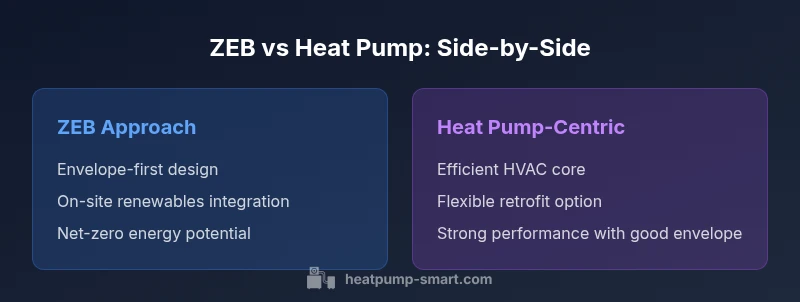
ZEB, or zero-energy building, is more than a single device; it is a design philosophy that aims to minimize annual energy consumption to near zero and meet the remainder with on-site renewables. The core pillars are a high-performance building envelope, efficient mechanical systems, and a balanced generation strategy. In practice, Zeb projects start with climate-responsive orientation, superior insulation, airtight construction, and minimal thermal bridges. A heat pump is typically the backbone of the mechanical system, but it works best when paired with a well-sealed envelope and energy-generating capabilities. According to Heatpump Smart, the most successful Zeb implementations begin with envelope-focused goals, then layer in renewables and intelligent controls to match demand with supply. The outcome hinges on early collaboration among architects, engineers, and installers to prevent performance gaps during design and construction.
How a heat pump fits into a Zeb project
A heat pump delivers heating, cooling, and hot water with high efficiency, but it does not by itself guarantee Zeb performance. In a Zeb context, the heat pump should be sized not just for peak load but for realistic daily usage, with controls that can shift energy use to periods of renewable generation. The heat pump becomes a component of a wider system that includes an airtight envelope, heat recovery, and smart energy management. Heatpump Smart’s perspective emphasizes that the interaction between envelope performance and equipment efficiency is what unlocks substantial energy savings. For Zeb, the heat pump should operate in concert with on-site generation, thermal storage, and demand-response strategies to minimize grid dependence.
Envelope and insulation as a shared foundation
Envelope performance sets the ceiling for Zeb outcomes. Superior insulation, airtight construction, carefully designed windows, and minimized thermal bridging reduce heat loss and cooling loads. When the envelope is robust, the heat pump runs less and with steadier loads, which improves efficiency and comfort. In Zeb projects, envelope improvements are not merely “nice-to-haves”; they are prerequisites that enable the heating and cooling system to work within the building’s energy budget. This synergy is why early-stage collaboration between architects and mechanical engineers matters so much. Heatpump Smart notes that envelope-first thinking often yields the most reliable path to net-zero energy.
On-site renewables and energy balance
On-site renewables, such as solar PV, solar thermal, or small-scale wind, are critical to Zeb. They help offset the remaining energy demand after envelope and equipment optimization. A Zeb design should consider seasonal variability, storage options, and curtailment risks. For heat-pump-focused designs, renewables still matter, but their role is primarily to offset daytime electrical usage and provide resilience. In both cases, energy storage and smart controls can smooth out demand, improve self-consumption, and maximize the value of generated power. The Heatpump Smart team emphasizes modeling annual energy production and consumption to verify that the project will meet its targets.
System architecture: controls and loads
Smart controls link the envelope, generation, and equipment into a cohesive system. Load prioritization, time-shifting, and demand response reduce peak energy and align usage with renewable availability. A Zeb strategy benefits from integrated metering, thermal storage, and advanced energy management to achieve net-zero results. The heat pump should be compatible with a home energy management system (HEMS), have high part-load efficiency, and work with weather and occupancy data to optimize operation. Thermostats, sensors, and automation must be reliable and easy to maintain.
Upfront costs and long-term value
ZEB projects usually involve higher upfront costs due to premium envelope components, integrated designs, and renewables. The long-term value comes from reduced operating costs, energy resilience, and potential incentives. A heat pump, while requiring less upfront envelope investment, may drive higher lifetime costs if envelope and renewables are neglected. The cost balance shifts toward Zeb when the goal is long-term energy independence and climate resilience. Heatpump Smart’s analysis cautions that cost-effectiveness relies on careful sequencing and scope control to avoid overdesign.
Climate and regional considerations
Climate strongly affects Zeb viability. In mild climates with moderate heating and cooling demands, Zeb may be easier to achieve with a smaller renewable system. In cold or hot extreme climates, envelope performance becomes even more critical, and the integration of thermal storage or hybrid strategies may be necessary. Heat pumps perform well across many climates, but their efficiency gains are magnified when the envelope and insulation are strong. Both approaches benefit from climate-specific modeling and performance testing before construction.
Maintenance and lifecycle considerations
ZEB design emphasizes durable envelope assemblies, durable mechanical systems, and monitored performance. Maintenance focuses on envelope integrity, airtightness, and renewables’ reliability. A heat pump requires regular service for refrigerant, compressor health, and filter replacement, but its part-load efficiency can remain high with proper maintenance. The Zeb path often yields longer-term savings but demands ongoing monitoring and upkeep to sustain performance. Heatpump Smart recommends a formal maintenance plan aligned with design intent to prevent performance drift.
Practical case study: two hypothetical paths
Path A imagines a new two-story home designed as a Zeb with 8 kW solar PV, triple-glazed windows, and an oversized heat pump with thermal storage. Path B imagines a retrofit of an older home toward a heat-pump-centric system with modest envelope upgrades. In Path A, energy use targets are ambitious and resilience is high, but upfront complexity and cost are significant. Path B prioritizes lower immediate costs and simpler installation, yet energy savings depend more on usage patterns and renewable integration. Both paths illustrate the importance of planning, as well as how envelope improvements magnify the value of a heat pump in either scenario.
Practical steps to move from concept to implementation
Begin with high-level goals and a feasibility study that includes climate data, occupancy, and energy targets. Engage a multidisciplinary team early to align architecture, structure, and services. Run energy models that compare a Zeb plan with a heat-pump-first approach, then iterate through envelope optimization, renewable sizing, storage design, and control strategies. Establish a phased implementation plan with milestones, performance verification, and commissioning. Finally, set up ongoing monitoring to ensure the system maintains intended performance.
Common misperceptions and pitfalls
A common misunderstanding is assuming a single device—like a heat pump—will guarantee Zeb performance. In reality, envelope quality, renewables, and controls drive results. Over-optimizing for one area while neglecting another creates bottlenecks and underperformance. Pitfalls include mis-sizing, poor membrane detailing, and underestimating maintenance needs. Heatpump Smart cautions against scaffolding costs without a proven design intent and performance modeling.
Future trends: grid interaction and thermal storage
The Zeb concept is evolving with smarter grids, demand response, and thermal storage options. Hybrid systems that combine heat pumps with thermal storage or phase-change materials can decouple generation from consumption, increasing resilience and on-site energy use. As building codes tighten and incentives evolve, Zeb-inspired designs may become more mainstream, with software-optimized controls that continuously adapt to weather, occupancy, and grid conditions.
Comparison
| Feature | ZEB approach | Heat-pump-centric project |
|---|---|---|
| Energy performance target | Very low residual energy use—net-zero or better | Moderate residual energy use that depends on envelope and occupancy |
| Envelope and thermal performance | Holistic envelope optimization (insulation, airtightness, thermal bridges) | Envelope optimization focused on mechanical loads; often secondary to equipment efficiency |
| Upfront cost and project complexity | High complexity with multi-discipline coordination | Lower upfront complexity, standard HVAC-focused design |
| Operational costs after completion | Potentially near-zero or very low energy costs when well-executed | Lower energy costs influenced by usage and climate |
| Maintenance and lifecycle | Longer project lifecycle with wide coordination | Maintenance focuses on heat pump and lifecycle costs |
| Grid interaction & storage | High integration with renewables and storage; demand management | Dependent on controls; often limited to heat pump performance |
| Best for | New builds with ambitious energy goals; utility incentives | Retrofits or new builds prioritizing comfortable and reliable heating/cooling |
Advantages
- Potential for near-zero energy bills with Zeb
- Improved indoor comfort through envelope performance
- Greater resilience when combined with on-site generation
- Future-proofing with building standards
Disadvantages
- Higher upfront cost and longer design phase
- Complexity in planning and contracting
- Requires cross-disciplinary coordination
- Potentially constrained by site and climate
ZEB generally outperforms a heat-pump-only approach for long-term energy use, but only with strong design integration and sufficient upfront investment.
Choosing a Zeb path offers long-term energy savings and resilience, but it requires coordinated design, greater upfront costs, and commitment to site-specific optimization. A heat-pump-first approach remains viable where envelope upgrades are limited or budgets are tight.
Your Questions Answered
What is zeb and how does it relate to a heat pump?
ZEB refers to zero-energy buildings designed to produce as much energy as they consume, typically through superb envelope performance and on-site renewables. A heat pump can power the heating and cooling within a Zeb, but the envelope, windows, and generation are equally critical.
ZEB means a building that balances energy use with generation. A heat pump can be part of that balance, but it isn’t the whole story.
Can I achieve a Zeb with a single heat pump system?
A single heat pump alone will not achieve Zeb unless the envelope and renewables are aligned to reduce demand and supply enough generation. Zeb success depends on holistic design, not just equipment efficiency.
A heat pump helps, but you still need a tight envelope and renewables to reach zero energy.
Are Zeb projects feasible in retrofitting older homes?
Retrofits can pursue Zeb goals, but it is more challenging due to existing envelope limitations and space constraints. A staged approach focusing on envelope upgrades, efficient heat pumps, and renewables can still yield significant savings.
Retrofitting for Zeb is tougher, but achievable with phased envelope upgrades and smart controls.
What are the main cost drivers for Zeb vs heat-pump-heavy designs?
Zeb costs are driven by envelope upgrades, integrated design, and renewables. Heat-pump-heavy designs focus more on equipment costs and installation, with envelope improvements providing incremental savings.
Envelope and renewables drive Zeb costs; equipment costs drive heat-pump designs.
How do on-site renewable energy sources affect Zeb performance?
On-site renewables are a core component of Zeb performance, offsetting remaining demand after envelope and equipment optimization. Without sufficient renewables, Zeb’s energy balance may not reach net-zero.
Rooftop solar and batteries are key to Zeb’s energy balance.
What maintenance differs between Zeb and heat pumps?
Zeb maintenance emphasizes envelope integrity and renewables’ reliability, while heat pumps require ongoing mechanical service. Both benefit from a formal maintenance plan and performance monitoring.
Envelope upkeep and renewables need attention alongside regular heat-pump service.
Top Takeaways
- Start with airtight envelope goals to unlock Zeb potential
- Pair heat pumps with robust on-site generation for best results
- Expect higher upfront costs and longer timelines
- Plan for cross-disciplinary teams early in the project
- Use on-site storage and smart controls to maximize savings