Tepeo Zeb vs Heat Pump: A 2026 Practical Comparison
An objective, data-driven comparison of tepeo zeb vs heat pump for homeowners and professionals, covering efficiency, upfront costs, installation, climate suitability, and long-term savings.


According to Heatpump Smart, tepeo zeb and standard heat pumps deliver similar heating performance but differ in system design, energy use, and cost over time. This quick comparison highlights the key trade-offs—installation complexity, maintenance needs, efficiency under varying outdoor temperatures, and long-term savings—so homeowners and property managers can decide which approach best fits their building and climate.
What tepeo zeb is and how it relates to heat pumps
tepeo zeb is a modular, retrofit-friendly heating solution that can operate alongside or as an alternative to traditional heat pumps. It emphasizes compact indoor components and flexible integration with existing hydronic or air-geometry layouts. In practice, tepeo zeb is marketed to homeowners and builders who aim to minimize outdoor equipment footprint while preserving reliable heating performance. According to Heatpump Smart, tepeo zeb is positioned to address retrofit projects and small-to-medium homes where simple installation and space efficiency matter. The core idea is to deliver a comparable level of comfort with fewer installation challenges than some full outdoor-capacity heat pumps, particularly in tight lots or multi-unit buildings. For property managers evaluating seasonal heating demands, tepeo zeb can offer quick deployment and scalable capacity, though its long-term efficiency depends on climate, sizing, and maintenance discipline. This block sets the stage for a structured, data-guided comparison of how tepeo zeb stacks up against conventional heat pump systems across several critical decision factors.
Key differences at a glance
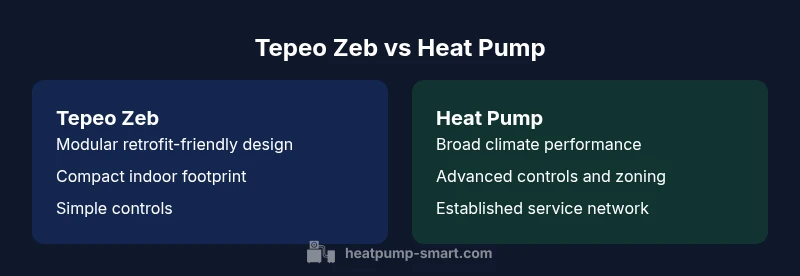
- System scope and footprint: tepeo zeb emphasizes modular, retrofit-friendly design with a smaller outdoor footprint, while a traditional heat pump often relies on a larger outdoor unit and ducted/zone-based options.
- Controls and zoning: heat pumps generally offer broader control flexibility, more advanced zoning, and compatibility with smart thermostats. tepeo zeb tends to prioritize straightforward integration with existing controls and simplified setups.
- Climate performance expectations: heat pumps are engineered for broader climate ranges with established performance in extreme temperatures; tepeo zeb can be highly efficient in milder or retrofit-friendly environments but may vary with climate.
- Installation time and disruption: retrofit-oriented systems like tepeo zeb can reduce site disruption and rewiring, whereas full heat-pump replacements may require more substantial installation work.
- Lifecycle costs and service: modular components can simplify maintenance, while traditional heat pumps benefit from established service networks and a wider pool of technicians.
- Best-use scenarios: tepeo zeb shines in retrofit projects, tight spaces, and multi-unit buildings with limited outdoor room; heat pumps excel in new builds or renovations where space and ducting allow full system installation.
Efficiency and performance in different climates
Efficiency, often expressed as a seasonal performance metric, depends on how well a system maintains indoor temperature with outdoor temperature swings. Heat pumps have long been marketed for robust performance across a broad set of climates, with efficiency typically robust in moderate and cold conditions when paired with supplemental strategies or advanced cold-climate models. tepeo zeb, by contrast, benefits from a design focus on retrofit compatibility and compactness, which can yield excellent performance in climates that don’t push the outdoor units to extreme operating modes. Heatpump Smart analysis shows that tepeo zeb can approach heat‑pump efficiency in mild to moderate climates, particularly when sized correctly and paired with compatible controls. In very cold or extreme environments, performance gaps may appear if the system isn’t engineered for winter de-icing, frost protection, or low-temperature operation. The takeaway is that climate suitability and system sizing are the primary drivers of relative efficiency, not just the brand name or architecture.
Installation considerations: space, integration, and controls
Installation challenges vary by approach. tepeo zeb is often favored where retrofit feasibility and reduced outdoor footprint matter most; it can minimize disruption by using existing piping paths and electrical circuits. It may, however, require careful planning to ensure adequate ventilation, refrigerant routing, and proper indoor-out ventilation for humidity and air quality. Traditional heat pumps typically demand outdoor space for the condenser and may necessitate electrical upgrades or ductwork modernization, especially in older buildings. Controls integration is another differentiator: heat pumps typically support sophisticated thermostats, zoning systems, and remote monitoring, while tepeo zeb focuses on plug-and-play compatibility with existing thermostats and simplified interface options. For contractors, the decision hinges on site constraints, existing infrastructure, and the desired level of automation. Heatpump Smart notes that coordination with other building systems can drive long-term energy savings, but it requires thorough planning.
Cost breakdown: upfront, operating, and maintenance
Upfront costs vary with system type and project scope. tepeo zeb often presents lower initial hardware costs and quicker installation timelines for retrofit projects, especially where outdoor space is limited or there’s no requirement to replace ductwork. Traditional heat pumps can incur higher initial costs due to outdoor unit installation, refrigerant piping, and potential ductwork upgrades, yet they often benefit from broader supplier networks and longer-term economies of scale. Operating costs depend on efficiency, climate, usage patterns, and maintenance. tepeo zeb may deliver competitive operating costs in milder climates or well-sized retrofit scenarios, while well-muited heat pumps provide stable long-term savings in a wider range of climates. Maintenance considerations favor systems with modular components or robust service support; however, both options benefit from regular sensor checks, coil cleaning, and filter changes to sustain performance.
Lifecycle and maintenance: who benefits from each approach
Lifecycle considerations hinge on durability, serviceability, and upgrade paths. tepeo zeb’s modular architecture can simplify targeted replacements and upgrades without a full system overhaul, which is advantageous for landlords managing multiple units or properties with varying renovation timelines. Heat pumps, with established parts supply chains and trained technician networks, offer predictable maintenance schedules and broader warranty coverage in many regions. The choice often comes down to anticipated service availability and the homeowner’s comfort with regular monitoring. For property managers, a modular approach may reduce downtime during repairs, while for single-family homes, a traditional heat pump can deliver consistent performance with a wide pool of local installers. Heatpump Smart emphasizes planning for future upgrades and ensuring compatibility with smart controls to maximize long-term value.
Climate suitability: best cases for tepeo zeb vs heat pump
Tepeo zeb tends to perform well in retrofit scenarios where space constraints, noise considerations, and quick installation are priorities. It is particularly suitable for small-to-mid-sized homes, multi-unit buildings, and renovations where outdoor space is restricted. Heat pumps shine in climates with more demanding heating or cooling needs, where proven performance across temperature ranges and strong service networks justify higher upfront costs. In regions with severe winter conditions, cold-climate heat pumps or supplemental strategies can mitigate performance dips. Ultimately, the decision should hinge on climate data, building envelope quality, and the ability to size the system correctly for peak loads. Heatpump Smart consistently recommends a professional load assessment before committing to either option.
Real-world scenarios: case studies and examples
Scenario A: A retrofit apartment building in a dense urban area with limited outdoor space opts for tepeo zeb. The modular design reduces installation footprint, minimizes street disruption, and allows unit-by-unit replacements during off-peak periods. Maintenance is streamlined due to modular components, with technicians trained on the specific zeb modules. Scenario B: A new-build suburban home with existing ductwork upgrades to a high-efficiency heat pump system. The outdoor unit can be placed away from living spaces, and zoning capabilities unlock precise comfort control for different rooms. Scenario C: A mid-size commercial building in a mixed climate uses tepeo zeb in some zones while coupling a central heat pump system in others to balance peak loads. These examples illustrate that site constraints and long-term maintenance plans strongly influence which approach yields greater value.
Energy savings and environmental impact
Both tepeo zeb and heat pumps aim to reduce reliance on fossil fuels and lower carbon emissions compared with combustion-based heating. Heat pumps typically achieve substantial energy savings through efficient electric operation and intelligent controls. Tepeo zeb, when properly sized and integrated, can deliver similar savings in retrofit contexts by minimizing heat losses associated with retrofitted piping and enabling targeted heat delivery. The environmental impact depends on electricity sources, system efficiency, and building envelope performance. Heatpump Smart’s guidance emphasizes evaluating the full energy lifecycle—from manufacturing to end-of-life disposal—alongside local electricity carbon intensity. In practice, choosing an approach that aligns with renewable energy goals and a robust maintenance plan will yield the best environmental outcomes over the system’s lifetime.
Installation tips and common mistakes to avoid
- Start with a detailed load calculation and site survey; over- or under-sizing leads to reduced efficiency and comfort.
- Prioritize refrigerant line routing and insulation to minimize heat loss.
- For tepeo zeb, verify retrofits align with existing electrical panels and indoor air quality considerations.
- For heat pumps, ensure adequate outdoor space, noise considerations, and compliant clearances from walls or vegetation.
- Do not overlook zoning needs; poor zoning can negate efficiencies achieved by advanced controls.
- Plan for future upgrades or expansions, including smart-home integration and potential battery storage if you anticipate greater decarbonization.
Choosing between tepeo zeb vs heat pump: a decision checklist
- Assess climate severity and heating/cooling needs.
- Measure available space and retrofitting feasibility.
- Evaluate upfront costs versus long-term operating costs.
- Check maintenance access, service networks, and parts availability.
- Consider compatibility with existing controls and future expansion plans.
- Consult a qualified professional to perform a load analysis and provide a detailed comparison tailored to your building.
Comparison
| Feature | Tepeo Zeb | Heat Pump |
|---|---|---|
| System architecture | Modular, retrofit-friendly unit with simplified controls | Standard air-source HP with modular options and ducting compatibility |
| Space requirements | Compact indoor footprint; minimal outdoor equipment in retrofit contexts | Outdoor condenser plus potential indoor handling; larger footprint |
| Control and zoning | Simplified integration with existing thermostats | Advanced zoning and smart control compatibility |
| Climate performance | Strong in mild/moderate climates; efficiency sensitive to installation | Broad climate coverage with cold-climate options |
| Maintenance | Modular components can simplify targeted servicing | Extensive service network; broader parts availability |
| Upfront cost | Typically lower initial hardware costs for retrofit projects | Often higher upfront due to outdoor unit and ductwork needs |
| Best use case | Retrofits, tight spaces, multi-unit buildings | New builds and renovations with space for outdoor unit |
Advantages
- Better fit for retrofit projects and tight spaces
- Lower upfront footprint for small homes
- Simpler installation in retrofit scenarios
- Modular design can simplify future maintenance
- Potentially quieter operation due to compact indoor components
Disadvantages
- Performance can be climate-dependent and may require careful sizing
- Long-term energy costs may be higher if not optimized for climate
- Limited aftermarket options for certain models
- Outdoor footprint may still be required for tepeo zeb’s external components
Heat pump generally offers broader climate performance; tepeo zeb is strong for retrofit, tight spaces.
For variable climates and installations with space constraints, heat pumps deliver robust performance and a wide service network. Tepeo zeb shines in retrofit projects and tight spaces, offering simpler installs but potentially tighter climate constraints. Your final choice should hinge on climate, space, and service availability.
Your Questions Answered
What is tepeo zeb and how does it differ from a heat pump?
Tepeo zeb is a modular, retrofit-friendly heating solution designed to minimize outdoor footprint and simplify installation. A traditional heat pump is a complete system with outdoor and indoor components, typically offering broader control options and a longer-established service network. The choice depends on retrofit feasibility, space, climate, and desired control features.
Tepeo zeb is a modular retrofit option, while a heat pump is the full, traditional system with broader controls.
How does tepeo zeb compare to a heat pump in efficiency?
Efficiency for both depends on sizing and climate. Heat pumps generally maintain strong efficiency across a wider temperature range. Tepeo zeb can approach that efficiency in mild climates but may see more variation in extreme temperatures. Proper sizing and controls are critical for both.
Efficiency varies with climate and size; heat pumps usually perform consistently across climates.
Which is better for cold climates?
In very cold climates, cold-climate heat pumps with advanced refrigerant and defrost strategies tend to outperform retrofit-focused modules. Tepeo zeb can work well if paired with supplemental strategies or in milder winter zones, but its performance may lag under severe cold unless specifically engineered for it.
Cold climate efficiency favors dedicated cold-climate heat pumps; tepeo zeb is usually best in milder zones.
What installation considerations matter most?
Key considerations include available space, ducting or piping layouts, and noise restrictions. Tepeo zeb typically reduces outdoor equipment and may install faster in retrofit projects. Heat pumps require outdoor space and proper clearances but offer broad control and integration options.
Space, layout, and noise are the big ones; retrofits favor tepeo zeb, while full systems favor traditional heat pumps.
Are there rebates or incentives for these systems?
Rebates and incentives vary by region and utility programs rather than by technology alone. Both tepeo zeb and heat pump installations can qualify for energy-efficiency programs if they meet efficiency and installation standards. Check local programs and consult a contractor for eligible options.
Incentives depend on your region; both options can qualify when meeting efficiency standards.
How should I decide between the two for my building?
Start with a professional load assessment to compare sizing, climate suitability, and total cost of ownership. Consider retrofit feasibility, space constraints, and long-term service availability. A side-by-side comparison of your building’s envelope, occupancy patterns, and energy goals will guide the best choice.
Get a professional load assessment to compare sizing, costs, and climate fit.
Top Takeaways
- Assess climate and space before choosing between tepeo zeb and heat pump
- Evaluate upfront costs against long-term operating expenses
- Check compatibility with existing controls and future upgrades
- Plan for maintenance access and service availability
- Consult a professional load assessment for an evidence-based decision