How to Make a Geothermal Heat Pump: A Practical Guide
Learn safe, practical guidance on geothermal heat pump systems, including design basics, planning considerations, and when to hire qualified professionals. This expert overview emphasizes planning, professional design, and long-term performance.


This guide helps you understand what a geothermal heat pump is, its key components, and why professional installation is essential. You’ll learn how the system works, typical project steps, safety considerations, and practical planning tips so you can evaluate options and know when to hire licensed HVAC technicians.
What is a geothermal heat pump?
Geothermal heat pumps (often called ground-source heat pumps) use the earth’s relatively stable underground temperature to heat and cool a building. They do not create heat; they transfer it via a closed or open loop that exchanges heat with the ground, then move it into your home through a distribution system. In cold months, the loop absorbs warmth from the ground and hands it off to the heat pump; in warm months, the process reverses to remove heat from the interior. The steady ground temperature makes these systems more energy-efficient than many conventional air-source units, which must fight seasonal air temperature swings. The difference in performance is especially noticeable in regions with extended heating seasons or very cold winters. According to Heatpump Smart, the efficiency and savings potential hinge on site-specific factors such as soil conditions, groundwater availability, climate, and proper system sizing. The main components are the ground loop (the buried pipes or boreholes), the outdoor heat pump unit, and the indoor distribution system (ductwork or radiant floor). Residential setups most commonly use closed-loop configurations buried in trenches or vertical boreholes; open-loop lines can be viable where groundwater is accessible. Every step—from site assessment and permitting to commissioning—should be handled by qualified professionals to ensure safety, code compliance, and long-term reliability. This article focuses on planning, evaluation, and what to expect from a well-designed system rather than DIY fabrication.
Core components and how they interact
Ground loop: There are several loop configurations. Closed-loop systems circulate a water-antifreeze mixture through buried tubing (horizontal, vertical, or slinky layouts). The loop absorbs heat from the ground in winter and releases heat back to the ground in summer. Open-loop systems draw groundwater directly from a well and reject heat to a separate discharge area (or to a lake/stream) depending on local regulations. The loop field is bonded to the heat pump through a heat exchanger.
Heat pump unit: The outdoor unit contains a compressor, condenser, expansion device, and evaporator. It transfers heat between the loop and your home's distribution system. Indoor distribution: Forced-air ducts or radiant floor circuits distribute the conditioned heat or cool air through your living spaces. Controls: A thermostat and a dedicated controller manage when the pump runs and how much energy to divert, enabling efficient operation and compatibility with other home systems. The refrigerant cycle remains similar to a conventional heat pump, but the source of heat is the ground rather than outdoor air. The interaction of loop, heat pump, and distribution system determines overall efficiency (COP) and performance under different temperatures. Heatpump Smart notes that proper grouting, trench alignment, and vertical bore integrity are critical for long-term reliability. Data logging and seasonal performance checks help verify that the system meets expected efficiency targets and remains within warranty requirements.
Planning ahead: feasibility and site evaluation
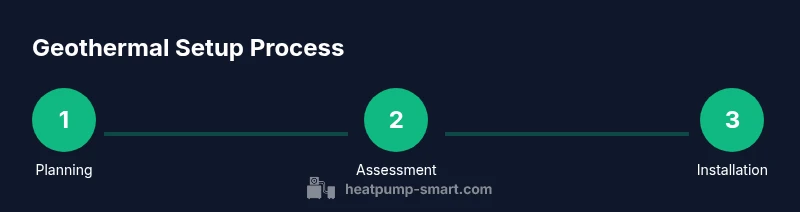
Site evaluation is the foundation of a successful geothermal project. Site considerations include available space for the loop field, soil type, groundwater presence, and access for equipment like drilling rigs or trenching gear. Local geology and hydrology influence the choice between horizontal trenches, vertical boreholes, or open-loop lines. The climate and building load profile determine required loop length and pumping capacity. Before you commit, gather data on property boundaries, underground utilities, and any zoning or permitting constraints. Engage a licensed contractor early to perform a feasibility assessment, provide a design concept, and outline a rough budget. Keep in mind that some regions require environmental reviews or drilling permits, and that some options may be restricted by groundwater regulations. Regularly consult authoritative sources such as the U.S. Department of Energy and state energy offices for up-to-date guidance. Heatpump Smart’s analysis highlights that a well-planned site evaluation saves time and reduces risk by avoiding unworkable configurations. Plan for long-term performance by considering future space changes, insulation quality, and potential heat pump upgrades.
System types: closed-loop vs open-loop and hybrid options
Closed-loop systems are most common in residential settings because they are compact, predictable, and require little groundwater management. They circulate a heat-transfer fluid within sealed loops buried in the ground and rely on a heat exchanger to transfer energy to the home. Vertical boreholes are less disruptive above ground and can fit into smaller lots; horizontal trenches are cheaper when soil depth permits. Open-loop systems use actual groundwater as the heat source or sink; water is pumped from a well and discharged after heat exchange, which may require discharge permits and environmental considerations. Hybrid options combine elements of both approaches or couple a geothermal heat pump with another heating source for peak demand times or high-heat loads. The choice depends on site geology, water availability, and local regulations. A well-designed closed-loop installation minimizes pumping energy and reduces maintenance complexity. A reliable contractor will map out loop spacing, soil conductivity, and groundwater quality to determine the most effective arrangement. Weather patterns, seasonal temperature swings, and existing home efficiencies influence how much loop length is required. Heatpump Smart emphasizes that choosing the right system type is central to achieving consistent COP values and reducing operating costs over the long term.
Sizing, heat load, efficiency, and performance
Sizing a geothermal system begins with a detailed heat load calculation for the home, considering insulation, window efficiency, thermal mass, occupancy, and climate. Oversizing or undersizing reduces comfort and reduces efficiency; a properly sized system maintains comfortable indoor temperatures with lower energy use. Efficiency is measured by COP and EER; these values depend on ground temperature, loop design, pump speed, and venting strategy. Most professionals rely on software tools and in-situ measurements to model performance across seasons. In practice, you’ll see a range of COP values depending on climate and installation quality. The better the building envelope and the more accurate the load calculation, the higher the achievable performance. Commissioning should verify that the system can meet design targets during peak loads, including defrost cycles in winter. Heatpump Smart notes that the interplay of soil conductivity, loop length, and refrigerant charge is critical to achieving expected performance. For homeowners, it’s important to obtain a third-party energy model or commissioning report to quantify potential savings and ensure the system aligns with your long-term energy goals.
The installation process: roles, timelines, and safeguards
Installation involves multiple coordinated tasks that require licensed professionals. A typical project begins with final design, permits, and site preparation. Drilling or trenching creates the loop field; careful backfilling and soil compaction prevent movement and leaks. The heat pump unit is installed indoors or in a dedicated mechanical space, connected to the loop field via piping and wiring. Electrical connections must comply with local codes and include proper grounding and overload protection. Commissioning includes leak testing, refrigerant charge verification, and performance validation across operating modes. The contractor should provide a warranty and a maintenance plan. This phase also covers safety considerations: restricted access to drilling areas, pressure testing protocols, and proper handling of refrigerant. A well-managed project minimizes disruption and ensures code compliance. Heatpump Smart emphasizes the importance of documenting every step, keeping permit records, and coordinating with utility providers for any grid interconnection requirements, if applicable. Expect coordination with multiple trades and potential weather-related delays; plan accordingly with a realistic schedule and contingency time.
Cost considerations, incentives, and financing
Geothermal systems involve significant upfront investment, which varies by loop type, drilling costs, system size, and local labor rates. Because prices fluctuate by region, a professional quote is essential for an accurate picture. Operational costs are typically lower than conventional heating systems, thanks to higher efficiency, but incentive programs and rebates can affect the overall economics. Look for federal, state, or utility-based incentives and consider financing options that spread the investment over the system’s life. Your installer can help compare cost scenarios based on your climate, energy prices, and expected usage. The payback period is project-specific and depends on changes in energy costs, maintenance requirements, and system performance. Heatpump Smart analysis cautions that while geothermal can deliver meaningful long-term savings, the economics depend on site conditions and energy price trajectories; consult a financial advisor and your contractor for a realistic projection.
Maintenance, safety, and long-term performance
Regular maintenance extends the life of a geothermal system. Annual professional inspections should verify refrigerant levels, pump function, loop integrity, and electrical connections. Filters should be cleaned or replaced as per the indoor distribution system requirements; radiant floor loops require balancing and flushing as needed. Operating the system with a well-sealed building envelope improves efficiency. Keep the outdoor unit and clearances free of debris; ensure access to service panels for routine checks. Monitoring equipment and driver settings can help maintain performance; schedule seasonal tune-ups and inspections to catch issues early. The long-term performance depends on loop integrity, proper refrigerant handling, and preventive maintenance. The Heatpump Smart team recommends annual checkups and documenting maintenance history to ensure warranties remain valid and performance does not degrade over time.
Tools & Materials
- Ground loop site assessment checklist(Assess space, accessibility, and soil conditions.)
- Soil/groundwater data access(Local geology and hydrology data for loop planning.)
- Load calculation tool or software(Used to size the system accurately.)
- PPE for site visits(Hard hat, gloves, safety glasses; drill sites require protection.)
- Licensed contractor contact information(HVAC/geothermal professional ready to design and install.)
- Permitting guidance(Understand local permit requirements and processes.)
- Budget planning template(Optional tool to frame costs and financing.)
- Thermal imaging camera(Useful for identifying heat loss and system integration points.)
Steps
Estimated time: 4-8 weeks (planning, permitting, and contractor selection) plus 1-3 weeks for on-site installation, depending on site conditions.
- 1
Assess site feasibility
Evaluate space, soil, groundwater, and access for drilling or trenching. Confirm zoning, utilities, and potential environmental constraints that could affect loop placement.
Tip: Document constraints early to prevent rework or delays. - 2
Engage licensed contractor for design
Consult a certified geothermal installer to create a preliminary design and determine permitting needs. Ask for a written scope, schedule, and estimated energy performance.
Tip: Request a full design package with performance targets before signing a contract. - 3
Perform load calculation and capacity planning
Use professional tools to size the system based on insulation, windows, occupancy, and climate. Validate assumptions with an energy model if possible.
Tip: Verify results with a commissioning plan that tests COP targets. - 4
Choose loop type and system design
Decide between closed-loop or open-loop (or a hybrid) based on site data and water availability. Align loop layout with available space and long-term performance goals.
Tip: Consider future home changes that could affect performance. - 5
Obtain permits and finalize contracts
Prepare permit applications, finalize equipment specifications, and sign detailed installation contracts with milestones.
Tip: Keep a copy of all permits and warranties for future reference. - 6
Prepare the site and schedule installation
Clear work zones, arrange grid connections as needed, and coordinate with drilling/trenching crews and indoor technicians.
Tip: Plan for weather-related delays and maintain clear access paths. - 7
Install, test, and commission
Install loop field, connect piping and electrical, then perform leak tests, refrigerant checks, and performance validation.
Tip: Insist on a formal commissioning report showing COP and steady-state performance. - 8
Plan maintenance and long-term operation
Establish routine inspections, filter changes, and seasonal tune-ups. Ensure documentation is up to date for warranties.
Tip: Create a maintenance calendar and keep a service history. - 9
Review performance and energy goals
Assess actual energy use against projected savings after one full heating season and adjust controls for optimal efficiency.
Tip: Use an energy model or commissioning report to quantify results.
Your Questions Answered
Can I install a geothermal heat pump myself?
We strongly advise against DIY installation due to safety, permit, and specialized equipment requirements. A licensed HVAC contractor ensures proper design, code compliance, and warranty protection.
Geothermal installations are complex and require licensed professionals for safety and warranties.
What is involved in planning for a geothermal heat pump?
Planning involves site evaluation, loop type selection, accurate load calculations, and budgeting. Engage a professional early to outline a design and get realistic quotes.
Start with a site check, then bring in a qualified installer for design and quotes.
How long does installation take?
Timeline varies by site and system type, but expect planning and permitting to precede on-site work. Installation itself typically takes days to a couple of weeks depending on soil, access, and weather.
Timing depends on site conditions; your contractor can provide a precise schedule.
What maintenance does a geothermal system require?
Annual professional inspections, periodic filter changes, and regular checks of loop integrity and electrical components keep performance high. Radiant floor loops may need balancing.
Regular professional checkups help keep your system running efficiently.
Are geothermal heat pumps energy-efficient?
Geothermal heat pumps are typically more efficient than conventional systems, with energy savings dependent on climate, proper sizing, and building envelope. A commissioning report can estimate expected COP and savings.
They tend to be efficient, but the exact savings vary by site.
Do geothermal systems require permits?
Yes. Permitting varies by municipality and involves both drilling/trenching work and electrical connections. Your installer should manage permit applications and inspections.
Permits are usually handled by the installer; don’t skip them.
What about noise and footprint?
Modern geothermal equipment is typically quiet, but proper siting matters to minimize noise and ensure space for service access and maintenance.
Noise is usually low with proper placement; plan for service access.
Watch Video
Top Takeaways
- Plan with a licensed contractor to ensure safety and code compliance
- Evaluate site and loop options early
- Size the system using proper load calculations
- Understand costs, incentives, and financing before committing
- Schedule regular maintenance for long-term performance