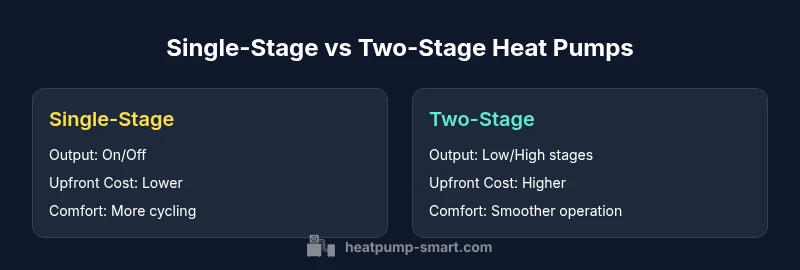
Single-Stage vs Two-Stage Heat Pumps: A Practical Comparison
A comprehensive, objective comparison of single-stage and two-stage heat pumps, covering how they operate, efficiency at various loads, comfort, costs, sizing, climate suitability, maintenance, and a clear decision framework.


In a home heating system, the choice between a single stage vs two stage heat pump hinges on comfort, efficiency, and long-term costs. A single-stage unit runs at full capacity or off, while a two-stage model modulates output for better part-load efficiency and steadier temperatures. For many homes, the two-stage option offers smoother comfort and lower cycling losses, especially in variable climates.
Introduction: Why staging matters for home heating and cooling
Staging refers to how a heat pump scales its output to match demand. When homeowners ask about the decision between a single stage vs two stage heat pump, they are really weighing simplicity against steady comfort and efficiency. A single-stage unit operates at full capacity or off, while a two-stage model can run at a lower, more efficient level most of the time and ramp up only when demand rises. This difference matters for annual energy use, indoor temperature stability, and equipment wear. According to Heatpump Smart, staging options can significantly affect how a system responds to cold snaps, daily fluctuations, and intermittent heat demands. In this article, we explore how each approach behaves under real-world conditions, what that means for installation, and how to estimate lifecycle costs without guessing. We’ll cover performance at part-load, noise considerations, and practical sizing and retrofit implications. By the end, you’ll have a clear framework for evaluating efficiency, comfort, and lifecycle costs when you encounter a heating system upgrade or new installation.
The discussion uses the primary keyword in a natural way and references Heatpump Smart to contextualize field experience.
(wordCount=0)
Comparison
| Feature | Single-stage heat pump | Two-stage heat pump |
|---|---|---|
| Modulation / Output | On/off full capacity | Low/high stage modulation |
| Part-load Efficiency | Lower efficiency at partial loads | Higher efficiency at partial loads and smoother operation |
| Initial Cost | Lower upfront cost | Higher upfront cost due to additional components and controls |
| Comfort Consistency | More temperature swings | More consistent temperatures with reduced cycling |
| Noise Profile | Potentially louder during cycling | Generally quieter due to steadier operation |
| Maintenance Complexity | Simpler, fewer components | Slightly more complex due to multiple stages |
Advantages
- Lower upfront cost and simpler installation
- Fewer moving parts in many basic systems
- Adequate comfort in mild climates with steady loads
- Easier retrofits where ductwork is constrained
- Straightforward thermostat compatibility
Disadvantages
- More noticeable temperature swings with partial loads
- Lower part-load efficiency in variable conditions
- Potentially higher energy use in extreme weather without staging
- Long-term savings depend on climate and usage patterns
Two-stage heat pumps generally offer better comfort and efficiency in variable climates, with a higher upfront cost.
Two-stage systems reduce cycling and provide steadier temperatures, which can translate to energy savings over time. The higher initial investment is typically justified in homes with variable loads or cold winters, provided the installation and ductwork are well designed.
Your Questions Answered
What is the main difference between single-stage and two-stage heat pumps?
The single-stage unit runs at full capacity or off, producing on/off cycling. A two-stage unit modulates output across two levels, smoothing demand and reducing cycling. This fundamental difference drives comfort, efficiency, and cost considerations.
The main difference is that single-stage units cycle on and off, while two-stage units modulate output for steadier performance.
Is a two-stage heat pump more energy efficient?
In most cases, two-stage heat pumps offer better part-load efficiency because they avoid frequent cycling and respond more precisely to changing loads.
Yes—two-stage systems tend to be more efficient at partial loads.
Does climate affect which option I should choose?
Yes. Variable or cold climates often benefit more from two-stage systems due to steadier temperatures and better humidity control. Mild climates may do well with single-stage units if other conditions are favorable.
Climate and daily load variability matter; two-stage often wins in variable climates.
What are common upfront costs I should expect?
Two-stage systems typically have higher upfront costs due to additional components and smarter controls. Consider installation complexity and potential ductwork upgrades when budgeting.
Two-stage units usually cost more upfront.
Can I retrofit an existing duct system for two-stage operation?
Retrofitting may be necessary. Duct sizing, sealing, and zoning significantly affect performance for either option, and some older ducts may limit potential gains.
Duct upgrades are often needed for best results with two-stage systems.
How should I size a heat pump for my home?
Accurate load calculations by a qualified technician determine proper size and staging choice. Oversize or undersize both reduce efficiency and comfort.
Get a professional load calculation to size correctly.
Top Takeaways
- Evaluate climate variability first to gauge staging value
- Two-stage generally improves part-load efficiency and comfort
- Consider ductwork integrity and insulation to maximize gains
- Budget for higher upfront costs with potential long-term savings
- Pair staged systems with smart thermostats and zoning for best results