Difference Between Heat Pump and Mini Split: A Comprehensive Guide
Explore the difference between heat pump and mini split, their work, installation, efficiency, and when to choose each option for home comfort and energy savings.


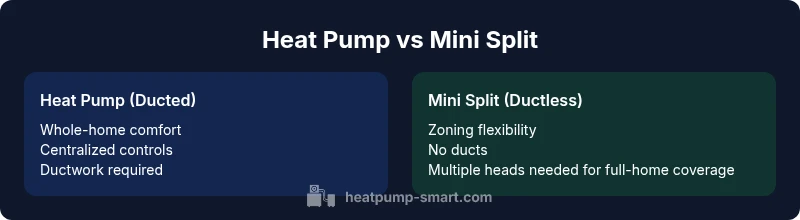
The difference between heat pump and mini split centers on form, installation, and zoning. A heat pump usually refers to a centralized system (often with ductwork) that conditions the entire home, while a mini split is a ductless, modular unit designed for targeted zones or smaller spaces. Both rely on refrigerant cycles to move heat and can be highly efficient when properly sized and installed.
Understanding the difference between heat pump and mini split
Understanding the difference between heat pump and mini split is essential for homeowners, builders, and property managers who want reliable comfort and energy savings. Both systems use refrigerant to move heat, but their form factor, installation requirements, and control options set them apart. According to Heatpump Smart, the difference between heat pump and mini split often comes down to whether you need a whole-home solution or targeted zoning, as well as how you plan to integrate with existing ductwork. This section lays out the basics so you can evaluate options without jargon or guesswork.
In practical terms, a heat pump with ductwork is often chosen when a home already has or plans to install a centralized distribution system, delivering uniform comfort across rooms. A mini split, by contrast, is a modular, ductless approach that shines when you want flexible zoning, retrofit convenience, or to condition spaces that lack ducts. The overarching goal is to match system capabilities with your space, climate, and budget while avoiding oversizing or undersizing.
How heat pumps and mini splits work: the core physics and configuration
Both heat pumps and mini splits operate on the same fundamental refrigeration cycle: a compressor moves refrigerant through a closed loop, absorbing heat indoors in cooling mode or extracting heat from the outdoors in heating mode. The difference lies in distribution and control. A ducted heat pump uses an air handler and a network of ducts to deliver conditioned air to every room, with a single outdoor unit doing the heavy lifting. A mini split uses one or more outdoor units connected to compact indoor heads mounted on walls or ceilings, each head controllable independently. This modular approach minimizes ductwork, reduces leaks, and allows zone-by-zone comfort. For homeowners, this means you can heat or cool only occupied spaces and adjust settings to reduce energy waste. The Heatpump Smart analysis highlights that performance hinges on proper sizing, refrigerant line length, and correct head placement.
Climate performance and use-case fit
Climate and space determine which technology delivers the best value. In milder or mixed climates, a central heat pump with ducts can provide evenly distributed comfort with fewer temperature gradients. In homes with irregular layouts, multiple wings, or retrofits lacking ductwork, mini splits excel by offering targeted comfort in bedrooms, home offices, sunrooms, or finished basements. In very cold climates, models with advanced refrigerants and auxiliary heat can maintain comfort, but performance may vary by temperature and system efficiency. The key is to assess expected heating and cooling loads, intended usage patterns, and whether zoning needs outweigh the convenience of a single thermostat. Heatpump Smart notes that climate-specific selection and professional sizing are critical to achieving predicted energy savings.
Sizing, efficiency, and energy costs
Efficiency metrics differ between the two approaches but share common goals. Heat pumps are evaluated with metrics like SEER and HSPF, while mini splits use similar scales on a per-head basis or for the entire system when multiple indoor units are tied to one outdoor condenser. In both cases, higher efficiency ratings generally translate to lower operating costs, but real-world savings depend on duty cycle, insulation, air sealing, and proper defrost strategies in cold weather. Heatpump Smart analysis shows that a well-sealed building with appropriately sized equipment offers noticeable energy savings relative to traditional electric resistance heating or older heat pump models. To capture maximum value, pair either system with smart controls and a well-tuned thermostat strategy.
Installation considerations, costs, and maintenance
Installation complexity is a major differentiator. Ducted heat pumps require ductwork design, runs, and sealing, which can add upfront cost and space considerations but pay off with uniform distribution. Mini splits demand less upfront infrastructure and are simpler to install in retrofit projects, but they involve mounting indoor heads, refrigerant piping, and outdoor units that may be visible in living spaces. Maintenance for both families includes filter cleaning and periodic professional checks; ducted systems rely on duct health and sealed connections, while ductless units require cleaning of indoor heads and condensate management. Understanding service access, warranty terms, and local incentives can influence the total life-cycle cost.
Practical decision framework: choosing by space, budget, and goals
A practical framework helps you decide between heat pump and mini split. Start by inventorying space: do you have existing ducts or is retrofitting difficult? Consider zoning needs: do you want to condition only occupied rooms or the whole home? Evaluate climate: is heating dominant, cooling dominant, or balanced? Lastly, align with budget and aesthetic preferences: is visible equipment acceptable, and can the initial investment be justified by long-term savings? The Heatpump Smart framework emphasizes balancing comfort, efficiency, and capital costs through honest sizing, professional consultation, and clear expectations about seasonal performance.
Real-world scenarios: case studies and common setups
Case studies reveal how homeowners employ heat pumps or mini splits to meet unique needs. In a retrofit project with limited space, a homeowner installs a three-head mini-split to satisfy bedrooms and a home office, achieving zoned comfort without a full duct overhaul. In a new build, a ducted heat pump system provides uniform climate control across open-plan living areas, backed by a centralized control system. In a split-level home with a large open main floor and colder upstairs, combining a ducted system for common areas with mini splits for the upper floors offers both uniformity and targeted comfort. These scenarios illustrate how the choice hinges on current architecture, renovation plans, and long-term energy goals.
Comparison
| Feature | Heat pump (ducted) | Mini-split (ductless) |
|---|---|---|
| Indoor distribution | Central air handler with ducts delivering to all rooms | Independent wall/ceiling units; no ducts |
| Zoning and control | Multi-zone options with centralized controls | Individual indoor units with independent controls |
| Installation footprint | Requires ducts and space for the air handler | Minimal ductwork; outdoor condenser + indoor heads |
| Initial cost and complexity | Higher upfront cost; more complex installation | Typically lower upfront cost; simpler retrofit |
| Heating performance in cold weather | Effective with modern models; auxiliary heat may be needed in extreme cold | Strong heating performance; some models excel in cold climates |
| Maintenance considerations | Duct integrity impacts performance; occasional duct cleaning advised | Individually replaceable heads; easier to isolate faults |
Advantages
- Flexible installation options for a wide range of homes
- Potential for high energy efficiency with proper sizing
- Scalable design: add zones or heads as needed
- Centralized heat pumps can deliver uniform comfort with ducts
Disadvantages
- Higher upfront costs and more complex installation for ducted systems
- Ductwork adds potential for leaks and pressure losses
- Mini splits may require more indoor units for full-home coverage
- Aesthetics and space planning can be a concern with multiple heads
Heat pumps (ducted) suit whole-home comfort; mini splits excel in zoning and retrofit niches
Choose a ducted heat pump for uniform climate control across a larger space. Opt for a mini-split when zoning, retrofit ease, or space constraints are primary concerns.
Your Questions Answered
What is the difference between heat pump and mini split?
The heat pump typically refers to a centralized system with ducts that condition the entire home, while a mini split is ductless and modular, targeting individual zones. The choice hinges on existing ductwork, zoning needs, and retrofit goals. Both rely on refrigerant to move heat and can be highly efficient when properly sized.
A heat pump uses ducts to heat or cool the whole house; a mini split works room by room without ducts. The right choice depends on your space and zoning needs.
Can a mini-split replace a central heat pump?
In many cases, a mini-split can replace a central heat pump for specific zones or retrofit projects. However, it may not provide uniform climate control across an entire multi-story home. Consider architectural constraints and future expansion when deciding.
Yes, for zones or retrofit projects, but not always ideal for whole-home uniform comfort.
Are heat pumps or mini splits eligible for energy rebates?
Many regions offer rebates for heat pump systems and energy-efficient upgrades. Eligibility depends on the model, efficiency rating, and local programs. Check with local energy authorities and manufacturers for current incentives.
You can qualify for rebates in some areas, depending on the model and efficiency.
Which is cheaper to install: heat pump or mini-split?
Mini splits generally have lower upfront installation costs due to reduced ductwork, but total cost depends on the number of zones and system complexity. Heat pumps with ducts may be more expensive initially but can offer lower long-term maintenance costs if a whole-home system is planned.
Mini-splits are typically cheaper to install upfront, especially for retrofit jobs.
Do both systems require regular maintenance?
Yes. Both systems require periodic professional checks. Heat pumps depend on duct integrity and airflow, while mini splits need filter cleaning and head inspections. Routine maintenance preserves efficiency and extends system life.
Both need routine checks and cleaning to keep them running well.
What climates are best for heat pumps vs mini splits?
Heat pumps are versatile in many climates, especially with ducted designs for whole-home comfort. Mini splits excel in zones or spaces where ductwork is impractical, and some models perform well in milder winters. Climate, insulation, and heating/cooling loads drive the best choice.
Heat pumps work well broadly, mini splits are great for zoning and retrofit in variable climates.
Can I retrofit an existing home with either system easily?
Retrofits vary. Mini splits are often easier to install in existing homes without ducts, while converting to a ducted heat pump may require substantial ductwork changes. A professional assessment will clarify feasibility and costs.
Mini splits are usually easier to retrofit; ducted options may need more work.
How do I decide between one outdoor unit and multiple indoor heads?
One outdoor unit feeding multiple heads offers centralized efficiency and simpler control, useful for larger spaces. Multiple heads provide exact zoning control for individual rooms. Your layout, insulation, and occupancy patterns will guide the best setup.
One outdoor unit with multiple heads is centralized; multiple heads give precise zoning.
Top Takeaways
- Assess space and ductwork before choosing
- Prioritize zoning needs to pick the right system
- Evaluate climate and heating vs cooling balance
- Plan for long-term energy savings and incentives