Heat Pump Ductless vs Duct: A Side-by-Side Guide
Compare heat pump ductless mini-splits and ducted heat pumps to decide which setup best fits your home. Learn about zoning, installation, costs, and efficiency to make an informed choice for comfort and energy savings.


Homeowners evaluating heat pump options should compare ductless mini-splits versus ducted systems by considering zoning, retrofit feasibility, and total cost of ownership. Ductless units offer strong room-by-room control and easy retrofits, while ducted systems provide centralized comfort with a single distribution path. The best choice depends on your home's layout, climate, and long-term energy goals.
Overview of the heat pump ductless vs duct decision
The topic of heat pump ductless vs duct is a central consideration for homeowners, builders, and property managers seeking reliable comfort and energy savings. A heat pump ductless system uses independent indoor units, each connected to an outdoor compressor, with no ductwork required. A ducted heat pump relies on a centralized air handler and a network of ducts to distribute conditioned air to multiple rooms. Both options share the same basic thermodynamics, but their distribution methods, control capabilities, and installation footprints differ materially. When evaluating these choices, consider climate, home layout, retrofit potential, and long-term operating costs. In this guide, Heatpump Smart provides an objective, data-informed look at the trade-offs involved so you can make a choice that aligns with your goals. The focus is practical impact: zoning flexibility, ease of installation, and the total cost of ownership over time.
System architectures and core components
Ductless mini-splits consist of an outdoor condenser connected to one or more indoor air-handling units mounted in living spaces. The indoor units may be wall-mounted, ceiling cassette, or floor ceiling, depending on space and aesthetics. In contrast, a ducted heat pump uses a central outdoor unit paired with an indoor air handler and ductwork that runs to multiple rooms. The ducts are usually hidden in walls, ceilings, or crawl spaces, delivering conditioned air through registers. The fundamental difference is how air is moved: localized indoor units versus a single centralized air distribution pathway. This distinction impacts zoning, maintenance access, and potential retrofits. From Heatpump Smart's perspective, the efficiency of either system hinges on proper sizing, sealed ducts (for the ducted option), and appropriate refrigerant management across units.
Comparison
| Feature | Ductless Mini-Split | Ducted Heat Pump |
|---|---|---|
| System Type | Ductless: no ductwork; individual indoor units | Ducted: central air handler with duct network |
| Zoning Flexibility | Excellent per-room control and independent operation | Centralized zoning possible but less granular per room |
| Installation Complexity | Typically easier retrofit; minimal structural changes | Requires ductwork; may involve attic/basement work |
| Aesthetics & Space | Visible indoor units; minimal ducting visible | Ductwork and registers may be visible in some spaces |
| Initial Cost | Usually higher upfront per zone when covering multiple rooms | Often lower per system but depends on home size and duct design |
| Operating Cost | Efficient per zone; savings depend on usage patterns | Can be highly efficient with proper duct design and sealing |
| Maintenance | Multiple indoor units require regular service | Fewer indoor units; duct cleaning may be needed in some homes |
| Best For | Older homes, renovations, or homes needing precise zone control | New builds or homes with existing ducts seeking centralized comfort |
Advantages
- Excellent zoning and comfort control
- Easy retrofit in homes without existing ducts
- Quieter indoor operation (each unit can be near living space)
- Flexible installation options for challenging layouts
- Scalable by adding more indoor units as needed
Disadvantages
- Higher upfront cost per zone for full home coverage
- Requires more outdoor equipment for large homes
- Potentially more complex refrigerant management with multiple units
- For some homes, ceiling or wall space for units may be a constraint
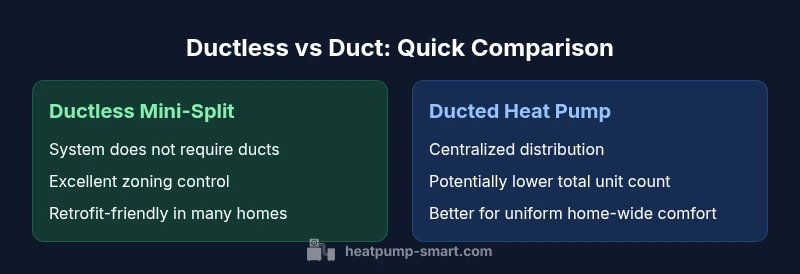
Ductless mini-splits excel in zoning and retrofit flexibility; ducted heat pumps excel in centralized comfort with fewer indoor units.
Choose ductless when room-by-room control and retrofit practicality are priorities. Choose ducted when you want uniform whole-home comfort and a centralized system, especially in homes with existing ductwork or when long-term maintenance patterns favor fewer indoor units.
Your Questions Answered
What is the core difference between ductless and ducted heat pumps?
Ductless systems operate with individual indoor units connected to the outdoor compressor, avoiding ducts. Ducted systems use a central air handler and an extensive duct network to deliver conditioned air to many zones. The choice influences zoning, installation disruption, and long-term maintenance.
Ductless uses separate indoor units with no ducts; ducted relies on ductwork for centralized air distribution.
Which option is better for large homes?
For very large homes, a ducted system often provides uniform distribution with a single centralized control. Ductless can cover large homes by adding multiple indoor units, but this can increase outdoor equipment and complicate zoning.
Ducted is typically favored for very large spaces, while multiple ductless units can work with careful planning.
Can a home convert from ducted to ductless?
Conversion is possible in some cases where retrofits are planned, but it can be invasive and costly. A professional assessment is essential to determine feasibility, especially regarding space for indoor units and refrigerant routing.
It’s possible but can be expensive and disruptive; a pro assessment is needed.
What maintenance differences exist?
Ductless systems require regular cleaning of multiple indoor unit filters and periodic checks for refrigerant balance. Ducted systems focus on maintaining the central unit and duct cleanliness; duct cleaning may be needed if ducts are dirty.
Ductless needs more frequent filter care; ducted relies on duct system upkeep.
How do energy savings compare?
Savings depend on usage and climate. Ductless systems offer beneficial zoning that can reduce energy waste by not heating or cooling unused zones, while well-sealed and balanced ducted systems can deliver efficient whole-home performance.
Savings depend on how you use the system and how well the ducts or units are balanced.
Top Takeaways
- Prioritize zoning when selecting a system
- Assess existing ductwork before retrofitting
- Balance upfront costs with long-term comfort and maintenance
- Consider space for indoor units in ductless setups