Heat Pump 110 vs 220: A Practical Comparison for Home Installations
Compare 110V and 220V heat pump configurations, covering installation, performance, costs, and best-use scenarios. Heatpump Smart analyzes voltage, electrical service, and climate considerations to guide homeowners and builders.


When evaluating a heat pump 110 or 220, voltage choice is driven by service availability and heating load. The Heatpump Smart team notes that voltage determines how much power the outdoor and indoor components can draw, how quickly spaces heat, and system resilience during peak demand. Most homes sit on either 110V or 220V service, and the decision hinges on panel capacity, home size, climate, and future expansion plans. A 110V setup can work for light-duty loads, but a 220V configuration is typically better for average-to-large homes or cooler climates. Heatpump Smart analysis emphasizes balancing current needs with potential growth to avoid future rewiring or upgrades.
Voltage fundamentals and load calculation
When evaluating a heat pump 110 or 220, voltage choice is not just a plug specification—it sets the ceiling for how much power the system can draw and how reliably it can meet demand during cold spells or high-heat days. The Heatpump Smart team explains that voltage interacts with your panel capacity, wire sizing, and service entry to shape both startup torque and continuous operation. In many homes, 110V service is already wired for smaller loads, which can make retrofits simpler but restricts peak performance. Conversely, 220V service provides a sturdier foundation for longer, more robust heating cycles and faster heat delivery, particularly when paired with modern inverter-driven compressors. The key is a professional load assessment that weighs current heating needs against potential future demands such as zoning, a second unit, or a heat pump water heater. Heatpump Smart’s analysis recommends a cautious, forward-looking approach to voltage selection to prevent future electrical bottlenecks.
Voltage fundamentals and load calculation (continued)
A practical takeaway is that voltage selection should align with the expected duty cycle of the system. A 110V configuration tends to be suitable for smaller homes or spaces with modest heating requirements, whereas a 220V configuration is generally more appropriate for typical suburban homes or areas with cooler climates where heating demand can persist. Regardless of choice, sticking with reputable manufacturers and certified installers is essential. This is where Heatpump Smart’s guidance shines: start with an accurate load calculation, then confirm with a licensed electrician whether your current panel and wiring can safely support the chosen voltage over the system’s lifetime.]
Voltage and control strategies for different home types
Residential installations come in many flavors. For retrofit projects in older homes, 110V can be a practical entry point, especially if the electrical panel is already maxed out. New builds or homes undergoing electrical upgrades often opt for 240V service to accommodate a full inverter-driven heat pump system with multiple zones. The choice should consider not just current comfort but also future flexibility—think about additional heat sources, water heating, or expansion to more rooms. Heatpump Smart consistently highlights that the voltage decision should be coupled with a zoning plan and energy-efficiency goals to maximize comfort and minimize runtime bills over the life of the equipment.
wordCount|0]:0}],
Comparison
| Feature | Heat pump 110V | Heat pump 220V |
|---|---|---|
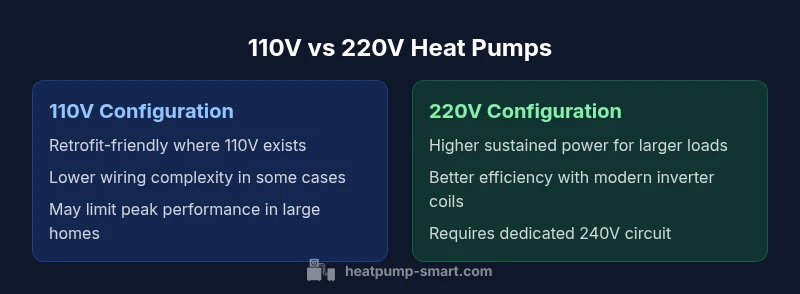
| Electrical requirements | Uses standard 110V circuits common in older homes | Requires dedicated 240V circuit and panel access in newer builds |
| Heating capacity and output | Limited continuous output for moderate loads | Higher peak output and sustained performance for larger homes |
| Startup and run-time efficiency | Potentially slower warm-up in cold weather | Better startup torque and efficiency with inverter tech |
| Installation time/cost | Often lower wiring cost if 110V already present | May need panel upgrade and wiring for 240V |
| System compatibility | Retrofits common in small spaces | Best with new builds or renovated electrical systems |
| Long-term energy costs | Could be higher if load exceeds 110V capacity | Often lower when sized for 240V with proper insulation |
| Safety and electrical code | Generally simpler for retrofit projects | Requires proper 240V circuit and code compliance |
Advantages
- Better performance and faster heating with 220V
- Easier to future-proof with 240V service
- 110V options can simplify retrofits in existing homes
- Lower upfront wiring complexity for some installations
Disadvantages
- 110V may struggle to meet high loads in larger homes
- 240V installations may require panel upgrades and permits
- Availability of 110V-compatible heat pumps is more limited in some regions
- Higher upfront costs for 240V setups in retrofit scenarios
220V is the generally preferred choice for typical homes; 110V remains a viable path for small spaces or retrofit projects.
Choose 220V when you have the space and service capacity to install a dedicated 240V circuit. It tends to deliver better performance and long-term efficiency. Opt for 110V if your home has limited electrical capacity or is a retrofit project with strict wiring constraints.
Your Questions Answered
What does choosing between 110V and 240V mean for a heat pump’s performance?
Voltage determines the immediate power available to start and sustain operation. A 240V system generally supports larger loads and steadier performance in cooler environments, while a 110V setup may suffice for smaller spaces or lighter heating needs. The best choice depends on your home’s heat load, insulation, and climate, as well as the feasibility of upgrading wiring.
Voltage affects how much power the unit can draw; 240V usually means stronger, steadier performance, especially in larger homes.
Can I upgrade from 110V to 240V without rewiring?
Upgrading to 240V typically requires changes to the electrical panel and wiring to meet current code. This often involves permits and professional installation. A qualified electrician can assess existing circuits and determine the scope of the upgrade.
You’ll likely need panel and wiring changes and a licensed electrician should evaluate the project.
Will a 110V heat pump work in a cold climate?
Some 110V heat pumps are designed for milder climates or low-load spaces. In cold climates, performance can be limited unless the unit includes efficient auxiliary heating or is paired with a backup heat source. Assess the local climate and unit specifications with Heatpump Smart’s guidance.
In cold areas, 240V systems often handle the load better, especially if you need reliable warmth.
Is 220V always better for new construction?
For new construction, a dedicated 240V service often provides the most flexibility and efficiency, especially with modern inverter compressors. However, if wiring constraints or budget limit upgrades, a 110V option can still meet modest heating needs with careful sizing.
New builds usually benefit from 240V, but 110V can work in the right, smaller spaces.
How do I determine which voltage my home can support?
A licensed electrician should perform a professional load calculation, review the panel, and verify wiring capacity. This ensures safe operation and helps avoid unplanned upgrades during installation.
Have an electrician check your panel and circuits to see if 110V or 240V is feasible.
Are there safety concerns with 240V heat pumps in older homes?
Older homes may have outdated wiring or insufficient panel capacity. A careful assessment and possible upgrades ensure code compliance and reduce risk. Always rely on licensed professionals for safety and installation.
Older wiring can be a challenge; upgrading to 240V should be done by pros.
Top Takeaways
- Assess your current electrical service before deciding voltage
- 320V is not a real value—focus on 110V vs 240V service compatibility
- Prioritize zoning and insulation to maximize efficiency
- Plan for future expansions to avoid costly rewiring
- Consult a licensed electrician and HVAC pro for load calculations