Heat pump vs split system: A practical comparison for home comfort
Compare heat pump vs split system to understand energy efficiency, climate fit, costs, and maintenance. Heatpump Smart analyzes performance, installation, and practical tips to help homeowners choose the right comfort solution.


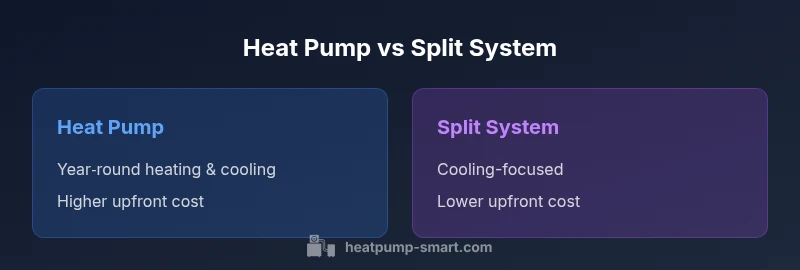
When deciding between a heat pump and a split system, consider climate, total cost of ownership, and year‑round comfort needs. In temperate regions, heat pumps often deliver superior energy efficiency and reliable heating, while a traditional split system can be cheaper upfront for cooling-focused homes. Heatpump Smart’s analysis emphasizes climate, incentives, and installation complexity as the deciding factors.
Defining the comparison: heat pump vs split system
In HVAC discussions, the phrase heat pump vs split system often surfaces. A heat pump is a single system designed to move heat in and out of a home, providing both heating and cooling. A traditional split system commonly refers to an air conditioner with separate indoor and outdoor units that primarily delivers cooling and relies on a separate heat source for warmth. For homeowners evaluating a new installation or an upgrade, the key distinction is year-round comfort and energy efficiency. According to Heatpump Smart, the decision hinges on climate, budget, and desired level of home comfort. The goal of this guide is to dissect those factors, translate them into real-world scenarios, and provide a clear framework for choosing the right approach for your property.
How a heat pump delivers heating and cooling
A heat pump uses a refrigerant cycle to transfer heat between indoors and outdoors. In heating mode, it extracts heat from outside air (even when it’s cold) and moves it inside. In cooling mode, the cycle reverses, removing indoor heat to the outside. Modern heat pumps come with variable-speed compressors and advanced reversing valves, enabling precise temperature control and better humidity management. The heat pump’s efficiency is often expressed as a combination of seasonal energy performance metrics and COP (coefficient of performance) ratings. When paired with a modern thermostat and proper airflow, a heat pump can deliver comfortable warmth without the high energy demands of electric resistance heating. For many homes, this unified heating and cooling capability translates into a simpler, more energy-efficient climate control strategy. In practice, homeowners notice more consistent temperatures and less temperature swing across rooms, particularly when the system is properly sized and installed.
How a traditional split system (cooling-focused) works
A conventional split system consists of an outdoor condenser/compressor connected to an indoor air handler or evaporator. It excels at cooling by extracting heat from the indoor air and venting it outside. Heating, if needed, typically relies on a separate furnace or boiler, or in some cases a heat pump can be added as a supplemental source. The split AC component is often compact, reliable, and cost-effective for cooling-heavy applications. However, when heating is required, homeowners may face higher operating costs if the auxiliary heating source is electric resistance-based. The simplicity of this arrangement can translate into easier service calls and shorter installation timelines, especially in homes with existing ductwork optimizations. For many property managers, the split system remains a practical cooling backbone, with heating handled elsewhere or via a dedicated system.
Efficiency and performance: beyond price tags
Efficiency for both options hinges on several metrics. Heat pumps shine in overall energy savings because moving heat uses less energy than generating it with resistance heating. In cooling-dominant seasons, heat pumps can leverage high SEER (seasonal energy efficiency ratio) and HSPF (heating seasonal performance factor) ratings to minimize runtime and energy usage. Split systems offer reliable cooling efficiency through high SEER models but may lack the integrated heating performance unless paired with a separate furnace. It’s essential to compare whole‑home performance, not just unit labels. Consider factors such as duct efficiency, insulation, and air sealing, because these can amplify or erode the equipment’s theoretical efficiency. Real-world results often reflect installation quality, climate, and thermostat strategy more than the brand of equipment alone. Heatpump Smart emphasizes that a well‑matched system with a smart thermostat will outperform a poorly configured alternative, regardless of whether you choose heat pump or split system.
Climate fit: where each option shines
Climate drives the decision. In moderate climates, heat pumps provide dependable year‑round comfort, effectively heating in cool weather and cooling in warm weather while delivering energy savings. In very cold climates, some heat pumps require auxiliary heat sources or cold-climate models, which can reduce overall efficiency and increase operating costs during extreme cold snaps. Split systems, when used for cooling with a separate heating source, can be simpler and cheaper upfront in regions where heating demand is low or brief. Energy managers and homeowners should assess typical winter temperatures, humidity levels, and occupancy patterns. Heatpump Smart notes that climate resiliency, duct design, and thermostat programming are often more influential on comfort and cost than the equipment choice alone.
Installation considerations and upfront costs
Installation is a key differentiator in the heat pump vs split system decision. A heat pump installation requires refrigerant lines, electrical capacity, proper outdoor clearances, and often enhanced insulation for efficiency. Depending on home layout, ductless mini-split configurations or traditional ducted setups may be chosen. A split system cooling installation can be simpler, especially if existing ductwork is in good condition. Upfront costs for a heat pump include equipment, refrigerant piping, and potential upgrades to electrical service, but incentives and rebates in many regions can offset a portion of these costs. For property managers, installation scheduling, access to skilled technicians, and long-term service plans should be part of the procurement process. Heatpump Smart encourages a phased approach: verify insulation, plan ductwork or conduit routing, and engage a licensed tech for a thorough load calculation before selecting equipment.
Maintenance, reliability, and service considerations
Routine maintenance for both options includes filter changes, coil cleaning, and system checks. Heat pumps often require annual refrigerant and electrical inspections to sustain efficiency, particularly in regions with seasonal temperature extremes. Split systems relying on a separate furnace or boiler may require servicing of multiple subsystems, which can complicate repairs but may simplify diagnostics for cooling components. Humidity control and indoor air quality are additional maintenance considerations. In both cases, investing in a service plan with an accredited technician helps catch issues early, reducing the risk of costly failures during peak demand periods. The key is to schedule proactive maintenance rather than reactive repairs, especially in properties with high occupancy or complex zoning.
Energy costs, incentives, and payback considerations
Energy costs are a function of usage, climate, and system efficiency. Heat pumps offer strong potential for long‑term savings where heating and cooling are used throughout the year, while split systems can be competitive for cooling‑focused properties with favorable electricity prices. Incentives, rebates, and tax credits can significantly affect the economics of either option. Homeowners should track available programs in their locality and consider the payback period for upgrading from older equipment. Heatpump Smart highlights that the most cost-effective choice often depends on the combined effect of climate, insulation quality, and system controls. A staged approach—starting with a professional load calculation, moving to high‑efficiency components, and then evaluating incentives—can maximize financial outcomes.
A practical decision framework: steps to choose
- Step 1: Assess climate and heating needs. Identify whether year‑round comfort or cooling focus dominates.
- Step 2: Perform a home energy assessment. Check insulation, duct leakage, and thermal zoning.
- Step 3: Run a total cost of ownership analysis. Include upfront costs, energy usage, maintenance, and incentives.
- Step 4: Consider installation constraints. Determine available space, electrical capacity, and ductwork condition.
- Step 5: Consult a qualified HVAC professional for a load calculation and equipment recommendations.
- Step 6: Review warranties and service plans. Favor systems with reputable coverage and accessible local technicians.
- Step 7: Decide with a clear preference: year‑round efficiency (heat pump) or lower upfront cost with cooling emphasis (split system).
Common myths and quick reality checks
Myth: Heat pumps can’t work in cold climates. Reality: Cold‑climate heat pumps exist, but extreme conditions may require supplemental heat. Myth: Split systems always cost less overall. Reality: Long‑term savings depend on efficiency, usage, and maintenance. Myth: All heat pumps require expensive refrigerant servicing. Reality: Regular professional servicing keeps refrigerant levels healthy and efficiency high.
Comparison
| Feature | Heat pump | Split system |
|---|---|---|
| Upfront price range | Higher upfront cost | Lower upfront cost |
| Energy efficiency | Typically higher overall efficiency with seasonal performance | Efficient for cooling, but heating depends on climate and model |
| Climate suitability | Best for moderate climates; cold-weather variants exist | Best for cooling-focused use in milder climates |
| Heating capability | Heating via refrigerant cycle; may require auxiliary heat in extreme cold | Heating depends on auxiliary source; often not integrated |
| Cooling capability | Yes, integrated heating and cooling in most models | Yes, cooling-focused but heating may require separate system |
| Maintenance needs | Annual service; outdoor unit care; refrigerant checks | Regular filter changes; mid-level maintenance |
| Noise | Outdoor unit noise can be noticeable; varies by model | Outdoor compressor noise can be noticeable, depending on placement |
| Best for | Year-round comfort, energy savings, space heating | Cooling-first homes, lower upfront investment |
Advantages
- Year-round heating and cooling in one system for most climates
- Strong potential for long-term energy savings with high efficiency
- Compact footprint with modern zoning and smart controls
- Possible rebates and incentives reducing payback time
Disadvantages
- Higher upfront costs and more complex installation
- Performance can drop in very cold conditions without supplemental heat
- Maintenance can require specialized technicians and refrigerant checks
- Noise and vibration from outdoor units in some configurations
Heat pumps win for all-season comfort and efficiency in temperate climates; split systems win on upfront cost for cooling-focused needs.
If you need year-round heating and energy savings in a moderate climate, choose a heat pump. If upfront cost and cooling-only performance are your priorities, a traditional split system may be the better fit, especially in milder areas.
Your Questions Answered
What is the key difference between a heat pump and a split system?
The core difference is heating capability. A heat pump provides both heating and cooling by moving heat, whereas a traditional split system primarily cools and relies on a separate heating source. The choice depends on climate, energy goals, and upfront costs.
A heat pump handles both heating and cooling by moving heat, while a split system mainly cools and needs a separate heater. Your climate and budget should guide the choice.
Can a heat pump replace a furnace entirely?
In many moderate climates, a heat pump can replace a furnace as the primary heating source, especially when paired with efficient insulation and radiant or supplemental electric heat for very cold days. In harsher climates, a hybrid approach may be preferred.
In many moderate climates, yes, a heat pump can replace a furnace, but in very cold areas you might need extra heat.
Are heat pumps effective in cold climates?
Cold‑climate heat pumps perform well down to moderate winter temperatures and can include auxiliary heating for extreme cold. Efficiency declines as outdoor temperatures fall, so sizing, insulation, and backup heat are important considerations.
They work well in moderate winters and can use backup heat in very cold periods. Proper sizing and insulation matter.
Which is cheaper upfront, heat pump or split system?
Upfront costs for a heat pump are typically higher due to equipment, refrigerant lines, and potential electrical upgrades. A split system often costs less initially, especially if existing ductwork is in good condition.
Heat pumps usually cost more upfront, while split systems are cheaper to install, especially with existing ducts.
Do both provide cooling?
Yes. Both heat pumps and traditional split systems provide cooling. The heat pump combines heating and cooling in one unit, while a split system can deliver cooling with or without supplemental heating.
Both can cool your home; heat pumps do heating too, while split systems focus on cooling unless paired with another heater.
What maintenance do these systems require?
Regular maintenance includes filter changes, coil cleaning, and annual inspections. Heat pumps may require refrigerant checks and electrical testing, while split systems may need furnace or boiler servicing alongside cooling components.
Keep filters clean and schedule annual checks. Heat pumps may need refrigerant and electrical checks, while split systems require service for cooling plus any heating system involved.
Top Takeaways
- Evaluate climate and heating needs before choosing
- Compare total ownership costs, not just price
- Check available incentives and rebates in your area
- Ensure proper sizing and ductwork or conduit planning
- Schedule professional load calculations for accuracy