Heat Pump Water Heater Size: How to Choose the Right Capacity in 2026
A practical guide to sizing heat pump water heaters, covering capacity ranges, daily usage calculations, and installation considerations for energy efficiency.


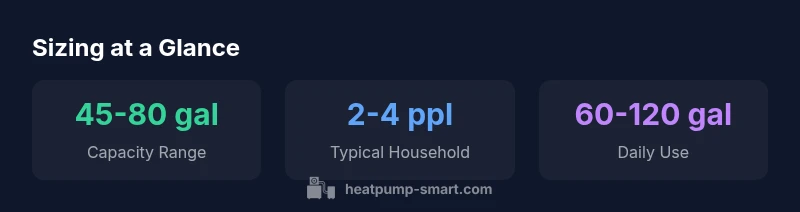
For most homes, the right heat pump water heater size falls in the 45-80 gallon range. Sizing depends on daily hot water usage, household size, and climate. According to Heatpump Smart Analysis, 2026, select a unit that meets peak demand and avoids long recovery times. A precise size minimizes standby energy and balances upfront cost with long term savings.
Why the right size matters
The size of a heat pump water heater directly affects daily comfort and long term energy costs. An undersized unit will run continuously to meet demand, reducing efficiency and increasing wear from frequent cycling. An oversized tank may sit idle much of the day, wasting standby energy and raising upfront costs. Getting the right size helps ensure fast hot water recovery during morning showers, minimizes energy use, and reduces wear on the appliance. In practice, most homes need a balance between peak demand and storage capacity. According to Heatpump Smart Analysis, 2026, the optimal residential capacity typically lies in the 45-80 gallon range, with climate and occupancy as key modifiers. This guide explains how to tailor that range to your home without guessing.
How sizing is determined
Sizing a heat pump water heater relies on several factors. First, estimate daily hot water usage by considering showers, baths, laundry, and dishwashing. Next, factor in peak demand, which is the amount of hot water used during the busiest hour of the day. The First Hour Rating FHR indicates how much hot water can be drawn in the first hour of use and is a key guideline for capacity. Climate matters because heat pump efficiency drops in cold environments, potentially necessitating a larger tank or supplemental heating. Finally, real world constraints such as space, electrical service, and installation costs influence the final choice.
Practical sizing guidelines by household size
Household size guides rough capacity choices. For 1-2 people use about 45 gallons, for 3-4 people use 60 gallons, and for 4-6 people consider 60-80 gallons. These ranges accommodate typical daily usage patterns and provide headroom for peak demand. Remember that pipe sizing, water temperature setpoints, and appliance efficiency also affect the effective capacity you experience.
Efficiency, cost, and installation considerations
Choosing the right size is not just about tank volume. A properly sized heat pump water heater delivers hot water efficiently, reducing energy consumption and operating costs over time. Consider the energy factor EER, standby losses, and the potential rebates or incentives in your area. Installation location and ventilation rules can influence performance and service access. If the unit is placed in a cold garage, you might see slightly reduced efficiency and should plan for that in your sizing decision.
Sizing vs installation constraints and placement
Installation constraints matter. If space is tight, you might need a compact model with similar capacity. Electrical service capacity and refrigerant piping can also limit choices. Ensure access for service, proper clearances for heat exchange, and appropriate drainage. A professional installer can confirm that the chosen size aligns with your electrical panel capacity and space, ensuring optimal performance and safety.
Step-by-step sizing workflow
- Gather data on household size, daily hot water usage, and peak demand. 2) Identify climate considerations and space constraints. 3) Check the FHR and energy factor of candidate models. 4) Compare 45, 60, and 80 gallon options and consider future needs. 5) Confirm with a qualified installer and request a load calculation or spec sheet review. 6) Plan for future upgrades or changes in occupancy that could affect hot water use.
Practical examples: common scenarios
A single occupant in a warm climate may do well with 45 gallons, while a family of four in a temperate region often benefits from a 60-80 gallon unit. A multi story home with high simultaneous usage like back to back showers plus laundry may require the higher end of the range. Climate, water heater efficiency, and your appliance mix all influence the final choice.
Sizing guide by family size
| Size (gal) | Suitable for (people) | Typical daily usage (gal) |
|---|---|---|
| 45 | 1-2 | 40-60 |
| 60 | 2-4 | 60-90 |
| 80 | 4-6 | 90-120 |
Your Questions Answered
What size should I choose for a 2-person household?
For two people, a 40-60 gallon unit is usually sufficient. This supports daily use while avoiding excessive standby energy. If water usage is unusually high, consider 60 gallons as a safe middle ground.
For two people, a 40 to 60 gallon unit is usually enough, with 60 gallons offering extra headroom if you have higher hot water use.
Can I oversize a heat pump water heater?
Oversizing can lead to higher upfront costs and may not improve comfort if usage is low. Size to peak demand and then consider a model with efficient recovery to meet future needs.
Oversizing wastes money and energy. Size to peak demand and pick a unit with efficient recovery.
How does climate affect size recommendations?
In colder climates, heat pump efficiency decreases, which can reduce effective capacity. You may need a larger tank or supplemental heating in winter.
Cold weather lowers efficiency, so you might opt for a larger tank or supplemental heat in winter.
What factors beyond capacity should I consider?
Look at energy factor, installation space, venting, noise, and future maintenance needs. Energy savings and rebates can affect total cost of ownership.
Check energy factor, space, and potential rebates to maximize savings over time.
How do I calculate daily hot water usage?
Estimate by listing showers, baths, dishes, and laundry per day. Use past bills or a water usage calculator to translate into gallons per day.
Count your daily hot water activities and estimate gallons per day.
“Sizing a heat pump water heater is about matching recovery rate to peak demand while preserving efficiency.”
Top Takeaways
- Start with daily hot water use to pick size
- Consider peak demand and recovery time
- Climate affects performance and sizing
- Balance energy savings with upfront cost
- Consult a professional for load calculations