Install Ground-Source Heat Pump: A Homeowner's Step-by-Step Guide
Step-by-step guide to install a ground-source heat pump: assess site, plan the loop, install the system, integrate with home comfort, and optimize performance.


This guide shows you how to install a ground-source heat pump (GSHP) in a residential setting, covering site assessment, loop field installation, indoor unit hookup, electrical and control integration, and commissioning. You’ll learn how to choose loop type, plan permits, coordinate with professionals, and optimize long-term performance.
Why install a ground-source heat pump
Ground-source heat pumps (GSHPs) offer a reliable, energy-efficient way to heat and cool homes by exchanging heat with the earth. Unlike air-source systems, GSHPs leverage the earth’s relatively stable underground temperatures to deliver consistent comfort year-round. The Heatpump Smart team notes that properly designed and installed GSHPs can provide high seasonal efficiency, quiet operation, and long service life, making them a compelling option for homeowners, builders, and property managers who want durable performance and predictable energy costs. Before you start, ensure you have adequate outdoor space for the loop field, a sensible electrical supply, and a budget that accommodates professional design and permitting. This section underscores why GSHPs are worth considering as a long-term climate solution for residential buildings, especially in areas with varying outdoor temperatures and growing energy costs.
How a ground-source heat pump works
A GSHP uses a closed-loop network buried underground or submerged in water to absorb heat from the earth in winter and reject heat back into the ground in summer. Inside the home, a geothermal heat pump extracts or rejects heat to the refrigerant loop and then transfers it to the building’s distribution system (radiant floors, forced-air, or hydronic radiators). There are several loop configurations:
- Closed-loop vertical boreholes: Deep holes drilled for loop piping, ideal where space is limited.
- Closed-loop horizontal trenches: Shallow trenches laid out in a field, suitable for larger lots.
- Open-loop systems: Use groundwater directly, though this option is climate- and site-dependent and subject to water rights.
Key performance concepts include the COP (coefficient of performance) and the seasonal efficiency of the system. A GSHP’s efficiency hinges on loop design, soil/groundwater conditions, and how well the indoor system matches the building’s load. A well-designed GSHP can deliver consistent comfort with lower operating costs over time, especially when paired with high-performance insulation and efficient distribution. For homeowners, this is where good planning and professional design matter most.
Site assessment and sizing considerations
Proper site assessment is essential before you purchase equipment or start digging. The assessment should determine loop type (vertical, horizontal, or open-loop) based on site constraints, soil type, groundwater availability, and space. A professional assessment includes:
- Load calculation: Estimating the building’s peak heating and cooling demand helps size the GSHP and loop field appropriately.
- Ground conditions: Soil conductivity, moisture, and temperature influence loop length and loop layout.
- Local codes and permits: Many regions require permits and inspections for drilling, trenching, and electrical work.
- Budget and space planning: A robust plan considers long-term energy savings, equipment efficiency, and the footprint of the loop field.
Based on Heatpump Smart analysis, the best outcomes come from pairing accurate load calculations with a loop layout that minimizes energy losses and supports efficient heat transfer. Keep a contingency budget for unexpected site conditions, and engage a licensed installer to confirm feasibility and code compliance. If you’re upgrading an existing home, consider how your current distribution system (radiant, hydronic, or forced air) will interface with a GSHP.
Installation design and system integration
A successful GSHP installation requires coordinating the outdoor loop field with an indoor heat pump and your preferred distribution system. Key design considerations include:
- Indoor unit selection: Choose a GSHP with a suitable capacity and compatible refrigerant options for your climate and home design.
- Distribution strategy: Radiant floor systems deliver even heat; high-efficiency air handlers may be used with ducted layouts; hydronic radiators are another option.
- Controls and zoning: Smart thermostats and zoning strategies help maximize comfort and efficiency by aligning heat delivery with actual occupancy and space use.
- Domestic hot water integration: Some GSHPs can deliver DHW via a dedicated coil or tank, reducing peak load if sized correctly.
- System balance: Proper refrigerant charge, loop fill, and pump sizing are essential to prevent short cycling and ensure consistent performance.
During design, anticipate seasonal performance needs and plan for potential upgrades, such as enhanced insulation or air sealing, to maximize the GSHP’s efficiency. A well-integrated system minimizes energy waste and enhances occupant comfort over the long term.
Operation, maintenance, and performance optimization
GSHPs are typically low-maintenance compared with combustion-based systems, but they still require regular care to sustain performance. Best practices include:
- Routine inspections: Schedule professional checks for refrigerant levels, electrical connections, and pump operation.
- Loop field integrity: Periodic testing for leaks and pressure stability protects the loop from slow performance degradation.
- Indoor distribution upkeep: Clean or replace filters as needed; ensure ducts or radiant panels are unobstructed and properly balanced.
- Freeze protection and antifreeze: Many loops use glycol or antifreeze to prevent freezing; ensure proper mixture and seasonal checks.
- Insulation and airtightness: Maintain building envelope efficiency to reduce system load and keep energy savings on track.
Seasonal performance optimization often hinges on thermostat programming, setpoint management, and proper defrost strategies. Heatpump Smart guidance emphasizes that homeowner education and routine professional maintenance together preserve efficiency and comfort over time.
Cost considerations and long-term value
A GSHP is an investment with ongoing energy savings and a longer service life than many traditional systems. Costs are driven by loop field type, drilling or trenching challenges, equipment efficiency, and installation complexity. While upfront expenses can be substantial, long-term energy savings, reduced maintenance, and potential incentives can improve total cost of ownership. When evaluating the economics, consider:
- System life expectancy and warranty terms.
- Expected energy savings relative to baseline systems in your climate.
- Available incentives, rebates, and tax credits.
- Potential value gains for occupants in terms of comfort and reliability.
Heatpump Smart analysis shows that the actual payback period varies with climate, occupancy patterns, and how well the home is insulated. In practice, homeowners should perform a thorough financial assessment with a licensed contractor and check local programs before committing. This section helps you weigh initial costs against long-term value and comfort.
Common pitfalls and troubleshooting
Even a well-planned GSHP project can encounter hurdles. Awareness of common pitfalls helps you avoid costly delays and suboptimal performance. Watch for:
- Inadequate load calculation leading to undersized or oversized loops.
- Poor loop layout or difficult access for future maintenance.
- Insufficient insulation and air sealing that increases system load.
- Noncompliance with local codes or permitting requirements.
- Delayed commissioning due to incomplete electrical or controls work.
If a problem arises, start with a professional assessment to differentiate between installation issues and equipment faults. Scheduling routine maintenance with a licensed technician, keeping a service log, and using manufacturer-recommended settings for controls will reduce troubleshooting time and prolong system life.
Tools & Materials
- Drilling equipment for boreholes(Vertical boreholes or horizontal trenching equipment as needed by site)
- HDPE loop piping(Closed-loop tubing for the ground loop field)
- Antifreeze coolant and additives(Compatible with loop material and local codes)
- Manifold and fittings(For loop field connections and distribution)
- Thermostat, sensors, and control wiring(Integrated with indoor distribution and outdoor unit)
- Electrical disconnect, conduit, and grounding gear(Professional electrical work required; follow local codes)
- Pressure testing gauge and leak detector(Used to verify loop integrity after filling)
- Personal protective equipment (PPE)(Hard hat, gloves, eye protection, and steel-toed boots as needed)
- Permits and inspection approvals(Obtain from local authority prior to drilling or trenching)
Steps
Estimated time: 2-7 days
- 1
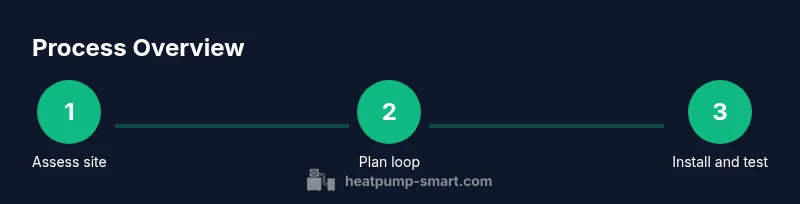
Assess loop type and site
Perform a site survey to determine vertical boreholes or horizontal trenches based on space and soil. Confirm load requirements with a professional to guide loop length and configuration. This decision shapes cost, duration, and future maintenance.
Tip: Document soil conditions and groundwater availability for reference during design. - 2
Obtain permits and design with a pro
Submit plans for drilling or trenching to the local authority and coordinate with a licensed installer for system design. Ensure electrical and indoor distribution plans are aligned with outdoor loop work.
Tip: Start permit checks early to avoid project delays. - 3
Install loop field
Drill vertical boreholes or lay horizontal loops and connect to the manifold. Fill with loop fluid and perform an initial pressure test. Allow time for any grout or backfill to cure as required by local codes.
Tip: Maintain clear access for future maintenance and inspections. - 4
Mount and connect the indoor unit
Position the geothermal heat pump in a ventilated area, connect refrigerant lines, controls, and distribution to the home system. Verify compatibility with existing radiators, underfloor heating, or air handlers.
Tip: Double-check refrigerant charge and ensure leak-free connections. - 5
Integrate controls and hydronic loops
Install sensors, zone controls, and thermostats. If using DHW, add the dedicated coil or tank and balance heating vs. hot-water demand. Ensure proper sequencing for efficient operation.
Tip: Program zoning to maximize comfort in occupied areas. - 6
Commission and test
Perform a full system balance test, verify pressures, and confirm heating and cooling output matches design. Commissioning confirms safe operation and validates performance in real conditions.
Tip: Keep a commissioning checklist and service log for future reference. - 7
Educate and document maintenance
Provide occupants with operating instructions and schedule routine maintenance with a licensed tech. Record system settings, warranty details, and any special considerations for future upgrades.
Tip: Set reminders for annual inspections and filter changes.
Your Questions Answered
What is a ground-source heat pump and how does it work?
A ground-source heat pump uses loops buried in the ground to exchange heat with the earth, providing efficient heating in winter and cooling in summer. It transfers heat to or from the home via a refrigerant cycle and indoor distribution system.
A ground-source heat pump uses underground loops to heat in winter and cool in summer, moving heat with a refrigerant system to your home.
Do I need planning permission for a GSHP installation?
Requirements vary by location, but most regions require permits for drilling, trenching, and electrical work. A licensed installer can guide you through the permitting process and inspections.
Permits vary by location, but a licensed installer will help you navigate drilling, trenching, and electrical permits.
Can I install a GSHP myself?
GSHP installations involve refrigerant handling, drilling or trenching, and electrical work that typically require licensed professionals to ensure safety and code compliance.
Installing a GSHP usually needs licensed professionals for safety and to meet codes.
How long does installation take?
Timeline depends on site complexity, loop field type, and weather. Expect several days to complete drilling or trenching, equipment hookup, and commissioning with inspections.
It typically takes several days, depending on site complexity and permitting.
What maintenance is required for a GSHP?
Schedule annual professional checks for refrigerant, electrical connections, and loop integrity. Regular indoor system upkeep, air-sealing, and filter changes support sustained efficiency.
Annual professional checks plus routine indoor maintenance keep a GSHP running well.
Will a GSHP work with my existing heating system?
Yes, GSHPs can be integrated with radiant floors, hydro- or air-based distribution, and domestic hot water systems, though some incompatibilities may require upgrades or controls adjustments.
It can work with radiant floors or other distribution systems, but you may need some upgrades.
Watch Video
Top Takeaways
- Assess site and load early to guide loop choice.
- Choose loop type based on space, soil, and groundwater.
- Coordinate permits, design, and commissioning with professionals.
- Integrate controls for optimal comfort and efficiency.
- Maintain paperwork and schedule regular professional checkups.