What Radiators Are Needed for Heat Pumps
Learn how to choose radiators for heat pumps, including sizing, types, and installation tips. This Heatpump Smart guide provides practical ranges and checks for homeowners, builders, and property managers seeking efficient, comfortable heating.


Determining what radiators are needed for heat pumps starts with matching the radiator output to the heat pump’s low-temperature performance and your home’s heat loss. In practice, expect panel radiators or low-temperature convectors sized by room to maintain comfort at lower water temps. According to Heatpump Smart, proper sizing and flow control are essential for efficiency and even warmth.
Radiator compatibility basics
When planning a heat pump retrofit or new installation, the question as to what radiators are needed for heat pumps centers on comfort, efficiency, and compatibility with low water temperatures. Heat pumps generally deliver heat at lower water temperatures than traditional gas boilers, which means radiators must be able to emit sufficient heat even when the water is cooler. The first step is to quantify the building’s heat demand on the coldest design day and then translate that demand into a radiator output. The result guides radiator type selection and placement, ensuring that each room reaches the target comfort level without wasting energy. According to Heatpump Smart, the most reliable approach combines accurate heat-loss assessments with equipment that can operate efficiently at 35–45°C supply temperatures. This pairing is the foundation for choosing the right radiators and avoiding underheating or overheating in different zones.
In practice, homeowners should start with a room-by-room assessment and then map those outputs to radiator characteristics such as height, length, and material. The outcome determines whether you lean toward panel radiators, low-temperature convectors, or other radiator designs that can perform well under reduced water temperatures. The goal is consistent warmth across spaces, with minimal temperature swings between rooms. This block also highlights why the question should be framed around whole-house load and per-room requirements rather than a single figure for the entire property.
leadIntraSectionBreaksToBeReplacedByToolingLater1
Typical radiator options for low-temperature heat pumps
| Radiator Type | Typical Output Range (kW) | Best Use Case | Notes |
|---|---|---|---|
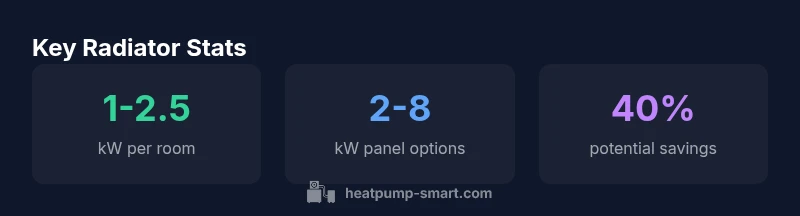
| Panel radiator | 2-8 kW | Most living areas | Good all-round option for low-temp systems |
| Low-temperature convector | 1-4 kW | Small rooms or tight spaces | Excellent response for compact layouts |
| Tall column radiator | 2-6 kW | Aesthetic favorability + performance | Slim profile with good surface area |
| Cast-iron radiator | 2-5 kW | Traditional homes with high thermal mass | Stays warm when demand fluctuates |
Your Questions Answered
What is the first step to sizing radiators for a heat pump?
Begin with a room-by-room heat loss calculation to determine the required radiator output per space. Then match those outputs to radiator types that perform well at lower water temperatures. This approach minimizes cold spots and keeps overall energy use reasonable.
Start with a room-by-room heat loss to size each radiator, then pick low-temperature radiators that fit the space.
Can I reuse my existing radiators with a heat pump?
Yes, in some cases you can reuse existing radiators if they can deliver the required output at the heat pump’s lower water temperature. More often, you’ll need to upgrade to larger or more efficient radiators, or add zoning to balance the load.
Sometimes, but you’ll likely need to assess whether your current radiators meet the new low-temperature requirements.
Do I need underfloor heating with a heat pump, or can radiators be enough?
Radiators can be sufficient if sized correctly and supplemented by good insulation and weather-appropriate temperature settings. Underfloor heating is another option for lower temperature operation but comes with higher upfront costs and installation considerations.
Radiators work with heat pumps if properly sized; underfloor is optional, depending on budget and design goals.
What are the red flags in radiator installation for heat pumps?
Red flags include oversized radiators relative to the system’s capacity, undersized piping, poor insulation, and lack of hydraulic balancing. These issues reduce efficiency and create temperature imbalances between rooms.
Watch for oversized radiators, poor pipe sizing, insufficient insulation, and no balancing in the system.
How does insulation affect radiator sizing?
Better insulation lowers overall heat loss, allowing smaller radiators or lower water temperatures to achieve the same comfort. Poor insulation increases load, potentially requiring larger radiators or additional zones.
Good insulation means smaller radiators can do the job; poor insulation means bigger radiators or more zones are needed.
What is a typical timeline for sizing and installing radiators with a heat pump?
A typical process involves a heat-loss assessment, radiator selection, delivery, and installation coordination, usually spanning several days to a couple of weeks depending on scope and contractor availability. Scheduling balancing and commissioning adds to the timeline.
Sizing and installing radiators usually takes several days to a couple of weeks, depending on scope and contractor availability.
“Radiators must be sized for a heat pump’s unique output; oversized radiators waste energy, and undersized ones leave rooms cold.”
Top Takeaways
- Size rooms by heat loss, not rough estimates
- Choose radiators designed for low-temperature operation
- Insulation and airtightness dramatically affect radiator sizing
- Use zone control to tailor heat distribution
- Consult a qualified installer for site-specific calculations