MR Cool Mini Split Not Heating? A Step-by-Step Troubleshooting Guide
A practical, safety-focused guide to troubleshooting a MR Cool mini split not heating. Learn quick checks, a diagnostic flow, and step-by-step fixes to restore warmth efficiently.


According to Heatpump Smart, the most common MR Cool mini split not heating problems start with simple settings or airflow. Quick fixes include verifying heat mode and temperature, cleaning or replacing the air filters, and ensuring the outdoor unit has clear space. If heat still won’t come on, power cycle the unit and check for ice on the evaporator coil before calling a pro.
Common causes of MR Cool mini split not heating
Modern heat pumps like MR Cool rely on proper airflow, correct settings, and healthy refrigerant levels. When the unit fails to heat, the issue is rarely a mysterious fault; more often it’s a simple misconfiguration or an airflow restriction. The Heatpump Smart team notes that homeowners most often see a loss of heat due to the following causes:
- Thermostat set to the wrong mode or too low a temperature
- Dirty or clogged air filters restricting airflow
- Outdoor unit blocked by debris or snow, or blocked condenser air paths
- Defrost cycle running abnormally due to outdoor temperature swings
- Low refrigerant or refrigerant line restrictions (professional service required)
To minimize downtime, start with the easiest checks first and move to more involved diagnostics only as needed. This approach aligns with Heatpump Smart Analysis, 2026, which emphasizes systematic testing over guesswork.
Quick checks you can do before calling a pro
If you’re facing a no-heat condition with your MR Cool mini split, begin with these quick checks that require no tools:
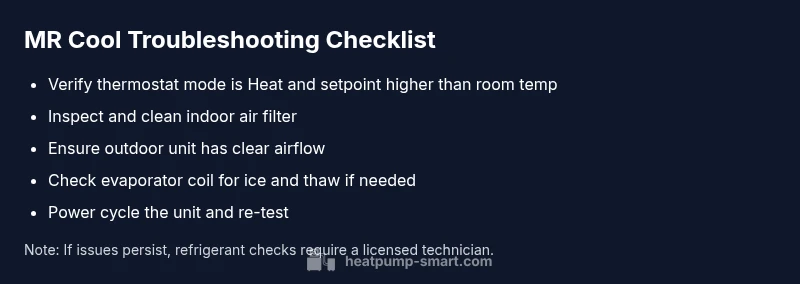
- Confirm the thermostat is set to Heat and the temperature is comfortably above the current room temperature.
- Inspect and clean the indoor air filter; a dirty filter can starve the system of airflow and reduce heating capacity.
- Check if the outdoor unit has clear space around it and is free of snow, leaves, or debris that block airflow.
- Listen for the outdoor compressor and fan. If the outdoor unit is quiet, there may be a control or electrical issue.
- Look for ice on the evaporator coil inside the indoor unit—ice indicates refrigerant or airflow problems and requires immediate attention.
Note: If you detect ice, turn the system off and allow it to thaw before testing again. This prevents damage to the compressor and refrigerant lines.
According to Heatpump Smart, begin with these steps, then progress to a structured diagnostic flow if the problem persists.
Diagnostic flow: Symptom → Diagnosis → Solutions
This workflow helps you identify the root cause and apply the right fix without unnecessary parts replacement:
- Symptom: No heat even when set toHeat and a comfortable thermostat setting
- Possible causes: Thermostat misconfiguration, airflow restriction, ice on evaporator, outdoor unit blockage, refrigerant issues
- Likely diagnosis via quick checks and simple tests: Thermostat or filter issue if easy; defrost cycle or outdoor obstruction if not; refrigerant concern if none of the easy fixes apply
- Solutions: Adjust settings, clean/change filters, clear outdoor space, reset the system, thaw ice, and if needed, schedule a professional service for refrigerant-related problems
If this doesn’t resolve the issue, refer to the Step-by-Step section for a detailed fix sequence. The goal is to restore warmth while protecting the system’s life and efficiency.
Step-by-step: Most common fix
- Power down the unit at the breaker, then wait 60 seconds and restore power. This resets internal control boards and can clear minor glitches.
- Confirm Heat mode and raise the setpoint a few degrees above room temperature. Small misreadings can confuse the system’s sensing.
- Remove and clean the indoor air filter. If the filter is heavily soiled, replace it with a compatible filter. Dirty filters limit airflow and heating capacity.
- Inspect the outdoor unit for debris, snow, or blocked vents. Clear obstructions and ensure proper clearance around the unit for optimal heat exchange.
- Check for ice on the evaporator coil inside the indoor unit. If frosting is present, turn off the system and allow it to thaw; then re-test. Frost indicates airflow or refrigerant issues that require further diagnosis.
- If the issue persists, run a test with the fan on and the system in heat mode to observe if airflow is consistent, then contact a professional if warmth still fails to appear. Regular maintenance can prevent recurrence.
Estimated total time for these checks: 60-90 minutes.
Safety and best practices when working on a mini-split
- Always switch off power at the breaker before inspecting or servicing electrical components. Even a small shock can be dangerous.
- Do not attempt refrigerant handling or charging without proper certification. Refrigerant handling requires training and compliance with safety standards.
- Use manufacturer-recommended filters and replacement parts to maintain system efficiency and warranty coverage.
- If you smell burning plastic or hear unusual noises, discontinue operation and seek professional help immediately.
Preventive maintenance to avoid future heating issues
- Schedule monthly quick checks: thermostat settings, filter cleanliness, and outdoor unit visibility.
- Perform seasonal inspections: ensure outdoor condenser is free of debris and the defrost cycle functions correctly in transitional weather.
- Keep a log of maintenance activities, including filter changes and any performance notes. This record helps technicians diagnose issues faster.
- Consider professional annual servicing to verify refrigerant levels and electrical components, especially if the unit is several years old or shows inconsistent heating performance.
When to call a professional and what to expect
If basic quick checks and the diagnostic flow do not restore heat, it’s time to call a licensed technician. Refrigerant leaks, compressor problems, or sealed-system faults require specialized tools and training. A professional will typically:
- Inspect refrigerant pressures and check for leaks
- Verify electrical connections and control wiring
- Assess the outdoor unit’s condenser fan operation and ice conditions
- Provide a written estimate for repair or component replacement
In many cases, addressing the root cause early can prevent more serious damage and costly repairs later. The Heatpump Smart team recommends timely professional evaluation when basic troubleshooting does not restore heating performance.
How Heatpump Smart approaches MR Cool troubleshooting
Heatpump Smart emphasizes a structured, safety-first approach that starts with basic diagnostics and progresses to targeted fixes. By collecting operating data, checking airflows, and validating thermostat settings, technicians can quickly identify whether an issue is simple (settings, filters) or complex (refrigerant or control board). This method reduces downtime and helps homeowners make informed repair decisions. Heatpump Smart’s guidance aligns with current best practices for ductless mini-splits and heat pumps in modern homes.
Quick comparison: MR Cool vs other mini-splits in heating performance
MR Cool units are designed to perform well in mild climates and with proper installation. In comparison to other mini-splits, performance differences often come down to refrigerant charge accuracy, airflow path design, and the quality of filters and drainage. While MR Cool can be cost-effective, heat delivery can be impacted by debris or improper sizing. Always verify system sizing, airflow, and outdoor conditions as part of troubleshooting. This ensures you’re not attributing a performance difference to a fault that could be resolved by a simple adjustment or cleaning.
diagnosticFlow role
fixes
stepByStep
Steps
Estimated time: 60-90 minutes
- 1
Verify thermostat settings
Ensure the thermostat is in heat mode and setpoint is comfortably above room temperature. Some remotes use auto or eco modes that can cancel heating without your knowledge. After adjusting, wait a few minutes to observe heat output.
Tip: Document the thermostat readings before and after changes for quick reference next time. - 2
Inspect and clean the air filter
Remove the indoor unit’s front panel and take out the air filter. Clean it with a vacuum or wash with mild soap if allowed by the manufacturer; replace if damaged or very dirty. A clean filter improves airflow and heating efficiency.
Tip: Check the filter monthly and replace as recommended by MR Cool specifications. - 3
Check outdoor unit clearance
Visit the outdoor unit and ensure there’s at least a few inches of clearance around all sides for proper airflow. Remove any leaves, snow, or debris that could block airflow and reduce heating performance.
Tip: Avoid using water jets directly on the unit; use a soft brush to remove dirt. - 4
Look for ice on the evaporator coil
Inspect the indoor evaporator coil for ice buildup. If you see ice, power off the system and allow it to thaw completely before testing again. Ice indicates airflow or refrigerant issues that require further diagnosis.
Tip: If ice recurs, do not continue operation; this can damage the compressor. - 5
Reset and test the system
Power cycle the unit by turning off the breaker for a minute and turning it back on. Test heating mode again and observe if warmth returns. If not, note any alert codes or blinking lights.
Tip: Record any error codes to share with a technician. - 6
Call a professional if needed
If heating still fails after the above steps, schedule a professional service for a refrigerant check, electrical inspection, and control board testing. A trained tech can diagnose sealed-system faults safely.
Tip: Ask for a written diagnostic report and estimated repair cost.
Diagnosis: Mini-split not heating in heating mode
Possible Causes
- highThermostat set to cool or wrong mode
- mediumAir filters dirty or blocked
- mediumOutdoor unit blocked or obstructed
- lowIce on evaporator coil or refrigerant-related issue
Fixes
- easyCheck thermostat mode and set to heat; verify setpoint is higher than room temperature
- easyClean or replace indoor air filter
- easyClear debris around outdoor unit and ensure proper airflow
- mediumInspect evaporator coil for ice and allow thawing; if ice recurs, schedule professional service for refrigerant/coil assessment
- hardIf none of the above resolves the issue, call a professional for refrigerant or sealed-system inspection
Your Questions Answered
Why is my MR Cool mini split not heating even though the thermostat is set to heat?
Often the problem is the thermostat not being set to heat, or a misread setpoint. Confirm mode and raising the setpoint by a few degrees can restore warmth. If this doesn’t help, inspect airflow and outdoor clearance.
Check that the thermostat is in heat mode and the setpoint is high enough. If heat still won’t come, inspect airflow and outdoor clearance.
My indoor unit feels warm, but the outdoor unit won’t run; what could this mean?
The indoor warmth suggests airflow is present, but the outdoor unit may be blocked, have a failed condenser fan, or an electrical fault. Check outdoor space clearance and listen for the outdoor fan. If you suspect a fault, call a technician.
If the outdoor unit isn’t running, there may be a blockage or a fault in the outdoor components. Have a pro check it.
Can a frozen evaporator coil cause no heat, and how do I fix it?
Yes, a frozen coil stops heat transfer. Turn off the system to thaw, then address airflow and refrigerant issues. If freezing recurs, you likely have a refrigerant or airflow problem requiring professional service.
A frozen coil stops heat. Defrost, fix airflow, and if it keeps freezing, call a pro.
Do I need refrigerant recharging if not heating?
Recharging refrigerant is not a DIY task. If you suspect a refrigerant issue, a licensed tech must diagnose leaks, pressures, and perform safe recharge if necessary.
Refrigerant recharge is not a DIY fix—leave it to a licensed professional.
Can a Wi-Fi thermostat cause heating issues with MR Cool?
Yes, smart thermostats can override heating modes or schedules. Check the thermostat’s settings, schedules, and compatibility with your MR Cool system and ensure it’s sending a proper heat signal.
Smart thermostats can cause heating issues if they're misconfigured. Check their settings and compatibility.
Watch Video
Top Takeaways
- Verify thermostat mode and setpoint first.
- Clean air filters to restore airflow.
- Clear outdoor unit and thaw ice promptly.
- If unresolved, involve a licensed pro promptly.