bosch heat pump vs trane: An Objective Side-by-Side Guide
Explore a comprehensive bosch heat pump vs trane comparison covering efficiency, reliability, installation, warranties, and ownership costs to help homeowners decide.


bosch heat pump vs trane: A quick, evidence-based comparison for homeowners. Both brands offer energy-efficient air-source heat pumps with different strengths: Bosch focuses on compact design and steady efficiency, while Trane emphasizes reliability and robust performance in varied climates. Read on for depth on specs, costs, and installation considerations.
Bosch vs Trane: Core design philosophies and what they mean for you
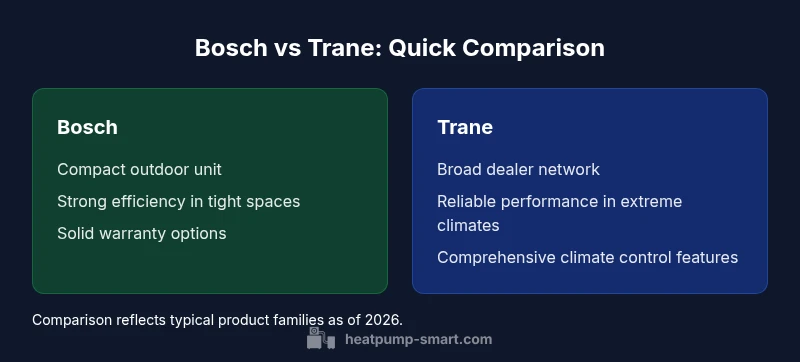
According to Heatpump Smart, the bosch heat pump vs trane comparison begins with design philosophy and product ecosystems. Bosch tends to emphasize compact outdoor units, modular installation, and steady efficiency across a wide range of home sizes. Trane, by contrast, leans into proven reliability, a broad dealer network, and software driven climate control that aims to optimize performance in varied weather. For homeowners, builders, and property managers evaluating bosch heat pump vs trane, understanding these differences is essential before you compare performance, warranties, and long term costs. In practice this means Bosch models may offer more flexible installation in tight spaces, while Trane systems may deliver more consistent performance in extreme temperatures. Both brands now include outdoor units, indoor air handlers, and smart controls, but the value proposition differs with each model family. This first section sets the stage for deeper analysis of efficiency, reliability, and total cost of ownership across climates, so you can make a decision aligned with your home and budget. As you read, keep in mind the 2026 context that guides product development and service support.
Efficiency and performance across climates
Efficiency is a central axis in any bosch heat pump vs trane comparison, but it matters much more when you map it to your climate, home size, and comfort expectations. Bosch tends to prioritize compact footprints with energy management that minimizes losses in small-to-midsize homes, often delivering strong heat pump performance without large equipment footprints. Trane emphasizes robust performance across a wider range of ambient conditions, including both very warm summers and cold snaps. In practice, homeowners may notice Bosch models running more quietly and using less space, while Trane units may maintain steadier heating or cooling output during seasonal transitions. When evaluating efficiency, look beyond a single SEER number and consider how the system responds to changing loads, defrost cycles, and thermostat control. Heatpump Smart analysis shows that real world efficiency is shaped by duct design, insulation, and how aggressively the controls modulate the compressor. As of 2026, both brands offer high efficiency options that pair well with modern smart thermostats and home automation, enabling better energy savings over the life of the system.
Reliability, warranties, and service networks
Reliability is a cornerstone of any long term heat pump investment. Bosch and Trane both claim durable components and long warranty coverage, but the specifics vary by model line, region, and installation. In general, Trane has built a broad service network with many authorized dealers and a long track record in residential and commercial settings, which can translate to easier service scheduling and quicker parts availability in many areas. Bosch, while often smaller in footprint, has increasingly expanded its service footprint and provides solid warranties on core components when installed by approved contractors. When you plan bosch heat pump vs trane, ask for the exact warranty terms on compressor, outdoor condenser, and indoor air handler, and confirm what is covered in your climate and local regulations. The Heatpump Smart team notes that regional service capacity can affect uptime, so check lead times for labor in your area and whether local technicians have experience with the brand you choose. A thoughtful warranty combined with a strong service network reduces risk for property managers overseeing multi-unit buildings as well as homeowners with busy schedules.
System compatibility and installation considerations
Selecting bosch heat pump vs trane also means evaluating how the system will fit with your existing infrastructure. Both brands publish compatibility guidelines, but real world installation often hinges on the efficiency class of the outdoor unit, the capacity of the indoor air handler, and the available electrical supply. Bosch units are frequently praised for their compact outdoor footprints, which can make retrofits easier where outdoor space is limited or where a contractor needs to maximize yard real estate. Trane systems typically emphasize broader compatibility with a wide range of indoor air handlers and zone control options, which can be advantageous in larger homes or retrofit projects. In all cases, hire a licensed contractor who follows local codes and uses approved refrigerants and charging procedures. The choice between bosch heat pump vs trane can also hinge on ductwork quality and insulation; poor ducts can undermine efficiency in both brands, making an upgrade worth considering in tandem with the heat pump selection. As you plan, verify electrical service capacity, wire sizing, and whether a dedicated outdoor disconnect is required by code.
Noise, comfort features, and controllability
Noise levels and comfort features are often deciding factors in residential installations. Bosch equipment frequently earns praise for compact form factors and quiet operation, which helps when the unit sits near patios or bedrooms. Trane products focus on robust climate control and a broad array of comfort features that optimize temperature and humidity with smart controls and occupancy-aware mode settings. Both brands offer variable-speed compressors where available and smart thermostats compatibility to enhance comfort without compromising efficiency. When you compare bosch heat pump vs trane, consider pipeline noise from the outdoor unit at typical operating ranges and the potential audible differences between single-stage versus multi-stage models. For households sensitive to sound, ask for dB ratings from the installer and request a model that emphasizes low-noise operation. Also evaluate comfort features like adaptive defrost, zone controls, and fan speed options that influence perceived temperature stability and energy use over a full season.
Cost of ownership: upfront, operating, and maintenance
Upfront cost is a major consideration in bosch heat pump vs trane decisions, and price can vary widely by model, features, and regional incentives. Bosch compact models may offer attractive price points for retrofit projects where space is tight, while Trane equipment can carry a premium due to dealer support and long standing familiarity with contractors. Beyond sticker price, think about operating costs, as efficiency and part quality influence energy bills over years of service. In addition, ongoing maintenance costs depend on filter replacements, refrigerant handling, and technician visits for seasonal checks. Both brands provide maintenance schedules through the installing contractor, and many programs offer rebates or tax incentives that can alter the total cost of ownership over a typical 10 to 15 year period. Heatpump Smart analysis emphasizes the importance of regular professional checkups to maintain efficiency and avoid unexpected failures. Plan for a service plan that aligns with your occupancy patterns and the expected climate stress on the system.
Real-world scenarios: which brand for which home?
Choosing between bosch heat pump vs trane depends on your property profile and priorities. For compact new builds or renovations where outdoor space is at a premium, Bosch can offer easier installation and cleaner sightlines without sacrificing modern performance. For larger homes, multi-zone setups, or properties in regions with more dramatic temperature swings, Trane often delivers robust climate control, strong warranty coverage, and a broader network of service technicians. Property managers with multi-unit dwellings may prefer Trane for its established dealer presence and simplified maintenance planning, while homeowners who value space-savings and quiet operation may lean toward Bosch. Climate considerations matter: hot climates, cold climates, and mixed climates all have different requirements for compressor staging and defrost strategies. In all cases, involve a qualified installer who can map your ductwork, electrical load, and refrigerant logistics to the specific model families you are considering. The right choice should align with your usage patterns, future plans, and willingness to invest in service coverage.
Comparison
| Feature | bosch heat pump | trane heat pump |
|---|---|---|
| Key differentiator | Compact design and modular installation focus | Proven reliability and climate versatility across models |
| Efficiency emphasis | Space-saving efficiency and simplified control | Weather-robust efficiency with broad climate optimization |
| Climate versatility | Best for tight spaces and moderate climates | Strong performance in extreme heat/cold conditions |
| Warranty and service network | Warranty terms vary by model; growing but selective service coverage | Broad dealer network and long-standing service footprint |
| Installation considerations | Requires compatible outdoor unit size; easy retrofits in tight spaces | Wide compatibility with indoor units and zone controls |
| Noise levels | Typically compact units with quiet operation | Engineered for lower noise in residential deployments |
| Price Range | Mid-range to premium depending on model | Mid-to-high depending on features and SEER |
| Best For | Space-constrained homes seeking efficiency | Homes needing climate resilience and dealer support |
Advantages
- Compact design can simplify retrofit in tight spaces
- Potentially lower upfront cost on certain Bosch models
- Broad dealer networks and service options for Trane
- Modern models offer strong energy management and smart controls
Disadvantages
- Upfront cost can be higher for premium models in both brands
- Availability of specific models may vary by region
- Installation quality and ductwork remain critical for performance
- Warranty terms vary by model and region
Bosch and Trane each win in different situations; pick based on climate, space, and service availability.
Choose Bosch for compact, space-saving efficiency. Choose Trane for reliability and broader dealer support, especially in regions with extreme weather.
Your Questions Answered
Which brand tends to be more energy efficient overall?
Both Bosch and Trane offer high efficiency heat pumps, with different strengths depending on the model. Bosch focuses on compact efficiency and reduced footprint, while Trane emphasizes robust performance and consistent output in varied climates. Your actual efficiency will depend on system sizing, ductwork, and how you use your thermostat.
Both brands offer high efficiency options; the best pick depends on climate and system design.
Are Bosch and Trane compatible with smart thermostats?
Yes, most models support popular smart thermostats; check model-specific compatibility and professional installation. Compatibility can vary by model and region, so confirm with your installer before purchase.
Yes, both support common smart thermostats; verify compatibility with the installer.
Which has lower upfront cost?
Costs vary by model and region; Bosch compact options can be affordable, while Trane often carries premium options with broader dealer coverage. Ask for a detailed quote that itemizes equipment, installation, and any add-ons.
Costs vary; Bosch might be cheaper for compact models, but region matters.
What installation considerations should I plan for?
Electrical loads, ductwork integrity, and outdoor space all affect both brands. Use a qualified installer, and ensure local codes, refrigerants, and charging procedures are followed. A thorough site assessment helps avoid post-installation surprises.
Plan for ductwork, electrical, and space; hire a qualified installer.
Which brand performs better in cold climates?
Both brands offer cold climate capable options, but performance depends on the specific model and defrost strategies. Review the climate ratings for your chosen model and consult with a local installer to match a unit to your winters.
In very cold climates, check model ratings and defrost strategies; a pro can match you.
Do warranties vary by region or model?
Yes, warranty terms differ by model and region; confirm coverage with the installer and local distributor. Regional conditions and regulatory requirements can influence warranty terms.
Warranties can vary by model and location; verify with the dealer.
Top Takeaways
- Define climate and space constraints before choosing
- Assess installation readiness and ductwork quality
- Verify warranty terms and regional service access
- Compare upfront price against long-term energy savings
- Consider smart thermostat compatibility and maintenance plans