Bosch heat pump vs Carrier: An Objective Comparison for Homes
A detailed, objective comparison of Bosch and Carrier heat pumps, covering efficiency, installation, costs, service networks, and practical guidance for homeowners, builders, and managers deciding between Bosch heat pumps and Carrier systems.


bosch heat pump vs carrier presents a clear two-brand decision: both brands deliver high-efficiency heat pumps, but the best pick depends on installation access and space. Carrier generally excels in dealer networks and service coverage, while Bosch often offers compact footprints and strong efficiency. For most homes, weigh dealer availability, room for installation, and total cost of ownership when choosing between these two proven options.
Introduction to the Bosch heat pump vs Carrier decision for modern homes
Choosing between a Bosch heat pump and a Carrier heat pump is a common dilemma for homeowners who want reliable comfort and energy savings. Both brands offer models that are highly efficient and well-supported by installers. The fundamental question isn’t a simple right-or-wrong answer; it’s a trade-off between space, service access, and long-term operating costs. According to Heatpump Smart, the decision hinges on local installer availability, the footprint you can accommodate, and how you value warranty terms and smart controls. In many regions, the Heatpump Smart team observes that Carrier systems dominate in service coverage, while Bosch models shine in compactness and efficiency for tight mechanical spaces. Your climate, home design, and budgeting constraints will steer you toward one approach or the other, even though both brands can meet high-performance standards when matched to the right model.
Key differentiators in the Bosch heat pump vs Carrier comparison
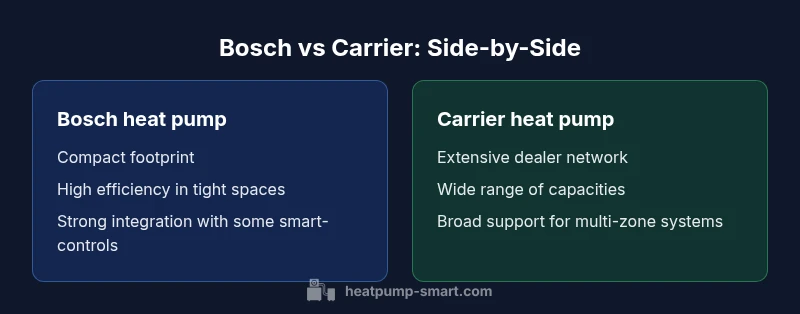
When you compare Bosch and Carrier head-to-head, the most impactful differences usually relate to installation footprint, dealer network, and model breadth. Bosch often emphasizes compact outdoor units and simpler ductless or mini-split options, which can be advantageous in retrofit projects or homes with limited outdoor space. Carrier tends to offer a wider dealer footprint and broader model options for various home sizes, climates, and existing HVAC configurations. This difference matters most if you live in an area with fewer installers, or if you plan a multi-zone system that requires robust service support. Heatpump Smart's analysis shows that neither brand is universally superior; instead, the best choice depends on your specific installation context and comfort priorities.
Efficiency and performance explained
Efficiency in heat pumps is typically expressed through SEER, HSPF, and COP ratings, with higher numbers indicating lower operating costs. Bosch and Carrier both provide models that meet or exceed ENERGY STAR criteria, but actual performance depends on the exact model, climate, and system configuration. In theory, Bosch can deliver excellent efficiency in compact package designs, particularly where ductwork is constrained or where newer refrigerant approaches are used. Carrier models may offer strong efficiency across a broader range of sizes and configurations, including traditional forced-air and heat-pump-with-water-heating hybrids. When evaluating efficiency, compare the same climate data and the seasonal performance metrics (like SEER2 and HSPF) specified for the model you’re considering. Heatpump Smart recommends checking the rated performance at your expected outdoor temperatures and ensuring proper charging and configuration.
Sizing, installation, and compatibility considerations
Sizing a heat pump correctly is critical to performance and comfort. Bosch’s lineup often targets compact footprints and easier installation in tight spaces, which can simplify retrofits or multi-family setups. Carrier provides a broader range of capacities and system types, including air-to-air and air-to-water configurations, giving installers more flexibility in matching your home size and climate. The installation process—ductwork, electrical service upgrades, refrigerant piping, and outdoor unit placement—affects both upfront cost and long-term reliability. Heatpump Smart emphasizes working with a qualified installer who can perform accurate load calculations (Manual J) and confirm that the chosen unit aligns with your home’s insulation, air sealing, and ventilation needs.
Noise, comfort, and control interfaces
Noise levels are a common purchase criterion, especially for homes near living spaces or neighbors. Both Bosch and Carrier offer low-noise options, but actual quiet operation depends on the model, mounting, and refrigerant charge. Comfort features such as variable-speed compressors, zoning capabilities, and smart thermostats influence daily experience more than a brand name alone. The two brands support a range of control interfaces, mobile apps, and third-party smart home platforms, allowing you to integrate the system with existing home automation. For quiet, consistent performance, ensure your outdoor unit is installed with appropriate clearances and vibration isolation and that the indoor air handler is well matched to the ductwork or hydronic interface.
Warranty, service networks, and reliability
Warranty terms and service networks are a crucial part of total cost of ownership. Carrier often benefits from a broad installer network, which can lead to faster service and simpler parts sourcing in many regions. Bosch tends to emphasize high manufacturing quality and efficient engineering, with solid warranties on many models; however, local dealer coverage can vary by region. In practice, your warranty experience depends on the specific model, seller, and service provider. Heatpump Smart notes that regional availability, technician expertise, and authorized service centers influence reliability as much as the brand name.
Cost considerations: upfront and lifecycle costs
Upfront costs for Bosch and Carrier heat pumps depend heavily on model choice, installed capacity, and any required electrical or ductwork upgrades. Across markets, brands may price similarly for comparable specs, though certain compact Bosch models can reduce outdoor footprint costs and installation complexity. When evaluating lifecycle costs, consider energy savings, maintenance requirements, refrigerant replacement likelihood, and potential rebates or incentives. Heatpump Smart analysis shows that total cost of ownership often hinges more on installer quality and system sizing than on the brand itself.
Smart features and home integration
Today’s heat pumps often include smart features such as learning thermostats, zoning, weather-aware controls, and integration with voice assistants. Both Bosch and Carrier offer compatible apps and smart home integration, but the depth of features may vary by model and firmware. When selecting a model, consider how well the interface fits your routines, whether you value remote diagnostics, and if the system supports energy management features that optimize performance during peak demand periods. A well-integrated system can reduce both energy waste and comfort complaints.
Environmental impact and refrigerants
Environmental considerations matter for many homeowners. Modern heat pumps use refrigerants with lower global warming potential in many regions, and both brands have updated lines to comply with evolving standards. If refrigerant type matters to you (for example, R-410A vs newer blends), verify the specific model’s refrigerant charge and any potential phaseout timelines in your jurisdiction. Heatpump Smart encourages choosing models that align with local regulations and long-term availability of refrigerants, while also considering the overall efficiency gains that translate to lower environmental impact.
Real-world installation scenarios and case studies
In retrofit projects with limited outdoor space, Bosch’s compact units can reduce the footprint and simplify mounting, sometimes avoiding significant exterior modifications. In new construction or larger homes, Carrier’s expansive product lines can provide flexible zoning and plenty of capacity, reducing the risk of undersized systems. A balanced approach is to perform a careful load calculation, discuss installation options with multiple qualified installers, and compare the predicted energy savings under typical weather patterns for your area. Real-world installations demonstrate that the best choice is often the one that matches your home’s physical constraints and seasonal needs.
What to ask your installer: a practical checklist
Before you buy, prepare a checklist for your installer: confirm the model’s rated efficiency, verify the expected noise levels, ask about warranty terms and service coverage in your region, request a step-by-step installation plan, and discuss any needed electrical upgrades. Also inquire about refrigerant types, potential compatibility with existing ducts or hydronic loops, and the expected maintenance schedule. This practical approach helps ensure that your Bosch heat pump vs Carrier decision is based on actionable details rather than marketing claims.
Decision framework: a practical, step-by-step checklist
To decide between Bosch and Carrier, follow a structured framework: (1) define your installation constraints (space, ducting, outdoor location); (2) compare efficiency ratings for models that fit your climate; (3) evaluate dealer availability and local service quality; (4) assess warranty terms and post-installation support; (5) consider total cost of ownership and potential rebates. By grounding your choice in concrete criteria and local realities, you’ll arrive at a decision that balances performance, cost, and convenience.
Authority sources
- Energy.gov: Heat Pumps overview and energy-saving guidance
- Energy Star: Heating and cooling products information
- EIA: How heat pumps fit into the U.S. energy landscape
Comparison
| Feature | bosch heat pump | carrier heat pump |
|---|---|---|
| Energy efficiency (model-dependent) | high/very competitive across compact models | high/very competitive across a wide range of sizes |
| Compactness and footprint | often optimized for small outdoor spaces | broader footprint options for larger installations |
| Dealer network and service coverage | installers may vary by region; look for Bosch-certified techs | extensive Carrier dealer network with nationwide coverage |
| Smart home integration | supports common ecosystems via apps and thermostats | strong compatibility with popular smart-home setups |
| Warranty options | standard warranties with optional extensions | competitive warranties with optional extended coverage |
| Typical installation complexity | depends on model and location; easier in tight spaces | depends on existing ductwork and electrical upgrades |
| Price range (pre-installation) | mid-to-high depending on model and region | mid-to-high depending on model and region |
| Best for | space-constrained homes or retrofit projects | markets with broad installer coverage and customization needs |
Advantages
- Provides a balanced view of two major brands
- Helps plan budgeting across Bosch and Carrier options
- Highlights installation and service network considerations
- Supports informed conversations with installers and builders
- Encourages model-specific comparisons rather than brand myths
Disadvantages
- Cannot guarantee model-level performance in every climate
- Does not replace professional load calculations and site surveys
- Brand popularity varies by region, affecting dealer availability
- Some claims require model-specific validation
Carrier often wins on service reach while Bosch shines in compact design and efficiency
Choose Carrier if you need widespread service support and easy access to installers. Choose Bosch if space is tight and you prioritize compact design and high efficiency, then validate with a local installer.
Your Questions Answered
Which brand typically has better dealer coverage for heat pumps?
Carrier generally has a broader installer network in many regions, which can simplify maintenance and service scheduling. Bosch relies on local partners and certified technicians, so coverage can vary by area. Always verify installer availability before purchasing.
Carrier usually has broader dealer coverage, but check with local installers for Bosch in your area before deciding.
Are Bosch heat pumps more compact than Carrier?
Bosch models are often designed to fit in tighter spaces, making them attractive for retrofits and limited outdoor areas. Carrier offers a wider range of sizes, including larger units for bigger homes. The best choice depends on your space and capacity needs.
Bosch often offers compact units; Carrier has more size options—choose based on space and required capacity.
Which is more affordable upfront, Bosch or Carrier?
Upfront costs depend on the exact model, capacity, and installation requirements. Both brands can be similar in price for comparable specs, but local labor and ductwork needs can tilt the initial quote. It’s best to obtain multiple estimates.
Upfront costs vary by model and installation; get several quotes to compare.
Do both brands offer ENERGY STAR models?
Yes, both Bosch and Carrier offer ENERGY STAR-qualified heat pumps in many product lines. When shopping, compare ENERGY STAR-rated models and their expected operating costs in your climate zone.
Both brands offer ENERGY STAR options; compare ratings for your climate.
Which should I choose if I want strong smart home compatibility?
Both brands provide smart controls and integration with common platforms, but availability of features can vary by model. Review the exact app capabilities and compatibility with your preferred ecosystem before buying.
Both offer smart controls; verify app features for your ecosystem.
What questions should I ask installers when comparing Bosch vs Carrier?
Ask about load calculations, refrigerant type, warranty terms, service availability, and whether the installer recommends a single-zone vs multi-zone configuration. Get a written proposal with model numbers and expected efficiency ratings.
Ask for load calculations, refrigerant details, and a clear proposal with model specs.
Top Takeaways
- Assess installation space and footprint before choosing.
- Check local dealer networks for both brands.
- Compare model-specific efficiency ratings and features.
- Consider total cost of ownership and available rebates.
- Ask installers about refrigerant types and warranty terms.