Kerr vs Daikin Heat Pump: An Objective Comparison
A rigorous, data-driven comparison of Kerr versus Daikin heat pumps, covering efficiency, installation, cost, and reliability to guide homeowners and professionals.


For homeowners weighing Kerr vs Daikin heat pumps, the best choice hinges on climate, efficiency goals, and service availability. Kerr models can offer competitive upfront costs and simpler control layouts in certain markets, while Daikin models emphasize high efficiency, extensive model variety, and a broad dealer network. When evaluating kerr vs daikin heat pump, consider long-term energy savings, installation needs, and warranty terms to pick the option that aligns with your home and budget.
Kerr vs Daikin heat pump: Context and scope
Choosing between Kerr and Daikin heat pumps requires a clear view of how you use heating and cooling, your climate, and the service support available in your area. This section sets the stage for a rigorous, model-agnostic comparison. According to Heatpump Smart, the decision should start with climate zone, home size, ductwork status, and compatibility with existing thermostats and controls. When addressing the topic of kerr vs daikin heat pump, it's essential to distinguish differences in design philosophy, warranty structure, and dealer network, rather than focusing solely on headline efficiency numbers. The Heatpump Smart team emphasizes that real-world performance depends on proper sizing, correct installation, and ongoing maintenance. In 2026, homeowners increasingly prioritize long-term energy savings, quieter operation, and smart integration, which can influence the perceived value of either brand.
This context helps frame the comparison as a practical decision supported by real-world considerations rather than marketing claims. Heatpump Smart analyses emphasize that outcomes hinge on installation quality, local climate nuances, and how households use the system over time. By starting with these factors, you can avoid over-reliance on single metrics like efficiency ratings and instead build a holistic view of total cost of ownership.
In this section, we outline the guiding criteria used to evaluate Kerr and Daikin heat pumps in a way that homeowners, builders, and property managers can apply to their projects. The review focuses on climate adaptability, system integration, service networks, and long-term value. Heatpump Smart analysis suggests that the most meaningful comparisons occur when models are matched to load calculations, insulation quality, and planned usage patterns, rather than judging brands by advertisement claims alone.
Kerr vs Daikin heat pump: Market positioning and product philosophy
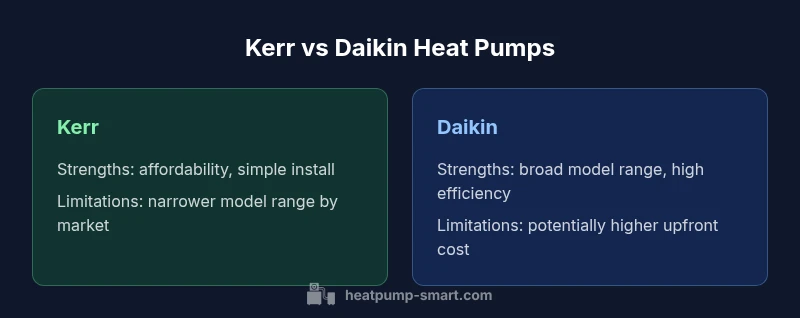
This subsection compares the two brands from a design and market strategy perspective. Kerr often positions itself around affordability and straightforward installation, appealing to retrofit projects and cost-conscious buyers in select regions. Daikin emphasizes breadth—offering a wider range of model families, higher-end efficiency options, and an established global dealer network aimed at supporting complex installations. The result is a trade-off: Kerr can win on price and simplicity in certain markets, while Daikin can win on choice, advanced features, and long-term efficiency in many others. Heatpump Smart notes that the value of each approach depends on local labor markets, climate challenges, and homeowner goals beyond the sticker price.
A practical takeaway from Heatpump Smart's 2026 assessment is that the best choice is customer-specific: model alignment with climate, equipment sizing accuracy, and a dealer-enabled maintenance plan often overshadow brand-wide generalizations.
Real-world performance drivers for Kerr and Daikin heat pumps
In the real world, performance is driven by more than the unit’s nameplate efficiency. Proper sizing, ductwork integrity, refrigerant line routing, and credible commissioning are essential for achieving the projected SEER/SCOP and reliability. Kerr models may show strong performance in moderate climates where load requirements are predictable, provided installation quality is high. Daikin models frequently excel in a wider array of climates, particularly when paired with their higher-efficiency compressors and well-matched air handlers. Heatpump Smart’s field observations indicate that users who optimize insulation, seal ducts thoroughly, and maintain equipment consistently see the largest gains in energy savings—regardless of brand. When evaluating kerr vs daikin heat pump options, lean toward the model families that match your actual climate profile and usage patterns rather than the brand name alone.
Comparison
| Feature | Kerr heat pump | Daikin heat pump |
|---|---|---|
| Recommended climates | Best for moderate climates with model-dependent performance | Strong performance across diverse climates; cold-climate options common |
| Efficiency metrics | Model-dependent SEER/SCOP; verify per-unit ratings | Broad range of high-efficiency models with inverter-driven compressors |
| Warranty and service network | Terms vary by model and region; local dealer involvement key | Extensive global dealer network; regional variations apply |
| Installation flexibility | Good fit for straightforward retrofit with existing ducts | Wide installation options (ducted/ductless) for complex homes |
| Upfront cost | Potentially lower upfront in market-specific Kerr models | Often higher upfront for advanced Daikin efficiency lines |
| Smart features and controls | Reliable basic controls; fewer premium smart features | Strong smart-home integration and advanced control options |
| Noise and space requirements | Outdoor unit size and noise depend on model; check dB ratings | competitive sound reduction across Daikin lineups |
| Long-term value and maintenance | Maintenance impact varies with usage and servicing | Higher efficiency can reduce operating costs; maintenance matters |
Advantages
- Potentially lower upfront costs in certain Kerr markets
- Simpler control interfaces may ease initial setup
- Wide Daikin model range offers more customization options
- Strong efficiency potential with Daikin in many markets
Disadvantages
- Upfront costs can be higher for Daikin in some regions
- Complexity of installation can increase with broader product lines
- Warranty terms and service availability vary by model/region
Daikin generally offers broader model availability and higher long-term efficiency potential, while Kerr can be cost-competitive and simpler to install in select markets.
If your priority is maximum efficiency and dealer support in a broad climate range, Daikin is likely the better fit. If upfront cost and simple installation are paramount, Kerr may be preferable where a strong local network supports it.
Your Questions Answered
What should I consider when comparing Kerr vs Daikin heat pumps?
Focus on climate compatibility, efficiency ratings (SEER/SCOP), warranty terms, installation options, and the local service network. Don’t rely on a single metric—balance upfront cost with long-term savings.
Look at climate, efficiency, warranty, and installer support to choose the right model.
Are Kerr heat pumps generally cheaper upfront than Daikin?
Costs vary widely by model and region. Kerr offerings can appear cheaper near the point of sale, but total ownership costs depend on efficiency, maintenance, and incentives.
Prices depend on the exact model and local market, so compare total cost of ownership.
Which brand has better efficiency or SEER/SCOP ratings?
Both brands offer high-efficiency options; Daikin often emphasizes advanced inverter technology across more lines, while Kerr’s efficiency varies by model and market.
Daikin generally provides many high-efficiency choices; always check the per-model SEER/SCOP.
What about warranty and service coverage?
Warranty terms depend on the model and region. Ensure installation is performed by an authorized technician and verify what the warranty covers and for how long.
Warranty depends on model and location; use an authorized installer.
How should climate influence my choice?
In cold climates, choose models with proven low-temperature performance; in milder regions, energy efficiency and comfort features may be more important.
Climate should drive brand/model selection for reliable comfort.
Is installation difficulty a deciding factor?
Yes. Installation complexity depends on your existing ductwork, zoning, and system design. Daikin’s broader lineup can offer more options, but local installer expertise matters most.
Installation quality and installer experience matter more than brand.
Top Takeaways
- Prioritize climate-specific model choices over brand name
- Verify installer qualifications and local dealer support
- Balance upfront cost against long-term energy savings
- Check SEER/SCOP ratings for each model, not only the brand
- Consider warranty terms and maintenance needs before purchase