LG Heat Pump vs Daikin: A Comprehensive Side-by-Side Analysis
A detailed, objective comparison of LG heat pumps and Daikin units, covering efficiency, installation, costs, service, and real-world performance to help homeowners choose the right system.


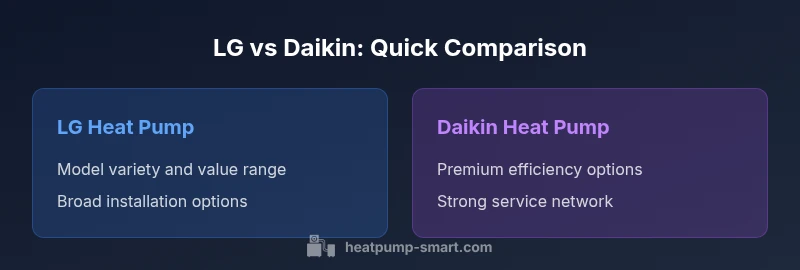
LG heat pumps and Daikin units both deliver strong energy efficiency and flexible installation options. In practice, Daikin often edges ahead in service coverage and premium performance, while LG tends to offer broader model availability and more price points for budget-minded buyers. Your best choice depends on climate, local support, and long-term operating costs.
Overview of LG vs Daikin in the Heat Pump Market
The heated debate between LG heat pump vs Daikin is less about one brand being universally superior and more about how each brand aligns with your climate, home size, and service ecosystem. LG positions itself with a wide selection of residential heat pumps, often emphasizing cost competitiveness and modern inverter technology. Daikin, by contrast, tends to emphasize premium performance, deep energy efficiency, and a robust global service network. For homeowners, builders, and property managers, the right choice hinges on three practical lenses: climate suitability, system compatibility with existing ductwork or ductless configurations, and the reliability of local installation and support. According to Heatpump Smart, understanding the core differences in efficiency strategy, installation options, and warranty coverage will help you translate product specs into real-world comfort and savings. The goal is to identify a model family that can meet your winter warming demands, summer cooling loads, and ongoing maintenance commitments while staying within your budget. This article uses the lg heat pump vs daikin comparison to map the decision factors, translate model ranges into actionable criteria, and provide a structured way to evaluate options side by side.
Key Differentiators: Efficiency, Range, and Warranty
Efficiency is the cornerstone of any heat pump decision. LG typically offers a broad spectrum of models across entry-level to advanced systems, with inverter-driven compressors designed to optimize seasonal performance. Daikin emphasizes high-efficiency options in its premium lines, often with advanced heat exchange technologies and extended warranty terms on select models. When you compare lg heat pump vs daikin, note that efficiency is not a single number; it depends on the SEER, HSPF, and COP ratings of a given model, the outdoor temperature rating, and how the system is sized for your home. Warranties can differ by model and region, so always verify the specific terms tied to the installer and location. A key takeaway from Heatpump Smart analysis is that the real-world efficiency also hinges on proper installation, refrigerant charge, and the building envelope. A good install can unlock efficiency that even the best model cannot achieve if the house leaks air or uses undersized ductwork.
Climate, Comfort, and Noise: Where the Brands Shine Differently
Climate response and occupant comfort are major decision drivers when evaluating lg heat pump vs daikin. Daikin often targets high-performance cooling and heating in varied climates, with some models optimized for colder environments, which can translate into more consistent comfort during shoulder seasons. LG tends to offer a broad lineup that supports a range of noise levels and operating modes, which can be advantageous for homes near bedrooms or living spaces where sound matters. Noise performance is not universal; it varies by outdoor unit size, refrigerant circuit design, and fan configuration. For homes sensitive to sound, review the specific decibel rating for the exact model and installation location. Remember that real-world noise is also shaped by mounting, vibration isolation, and outdoor unit clearances.
Installation Realities: Ducted, Ductless, and Compatibility Considerations
Installation compatibility is often the deciding factor in lg heat pump vs daikin choices. Both brands offer ducted and ductless systems, including mini-split configurations, which are ideal for room additions or zones without existing ductwork. The installer’s expertise matters as much as the brand: proper refrigerant charging, airflow balancing, and thermostat integration are critical for achieving advertised efficiency. If your home uses older ductwork, you may need air sealing or duct improvements to avoid energy losses that erode savings. For new builds, ensure the chosen model supports the planned zoning strategy and that the electrical service can accommodate the unit’s amperage requirements. In many regions, Daikin’s installation network is robust, while LG packs a wide dealer footprint that offers competitive lead times. The key is to align the model family with your home’s architectural layout and seasonal load profile.
Price and Total Cost of Ownership: Upfront vs Long-Term Value
Pricing for lg heat pump vs daikin varies widely by model, region, and installer, making apples-to-apples comparisons challenging. LG often provides a broad price spectrum across entry-level to mid-range systems, which can translate to lower upfront costs for basic comfort needs. Daikin’s premium lines generally command higher sticker prices but may deliver superior efficiency at peak operating loads and longer warranty protections. Total cost of ownership should account for initial price, installation labor, refrigerant management, electricity rates, and expected maintenance intervals. Over the life of the system, higher efficiency and better component durability can offset a higher upfront investment, particularly in hotter or colder climates where seasonal energy use is a major expense. Heatpump Smart’s guidance is to run a modeled estimate based on your local energy rates, climate zone, and expected run hours to compare projected savings between lg heat pump vs daikin.
Service Availability and Local Support Networks
A critical factor in the lg heat pump vs daikin decision is service coverage. Daikin has built a broad, often globally available service network that can reduce downtime and simplify maintenance scheduling in many markets. LG also maintains extensive distribution and service channels, but coverage can vary by region. When evaluating options, verify the availability of qualified technicians in your area, the ease of obtaining replacement parts, and the typical response times for service calls. A strong service network can translate into shorter outages and more consistent comfort, especially during peak cooling or heating seasons. Heatpump Smart notes that a local, responsive vendor partnership often matters as much as the unit’s efficiency label.
Model Availability and System Types: Split, Multi-Split, and Hybrid Options
LG and Daikin both offer a range of system types, including single-split, multi-split, and hybrid configurations that can pair with existing furnaces or serve as standalone cooling and heating solutions. The breadth of options means you can tailor capacity to a zone-by-zone load profile and optimize comfort throughout the home. When comparing lg heat pump vs daikin, examine the maximum allowable capacity per outdoor unit, compatibility with existing indoor air handlers, and the control options (smart thermostats, zoning capabilities, and app integration). Daikin’s catalog often emphasizes modularity and heat pump performance under variable outdoor conditions, while LG commonly highlights versatile mounting configurations and quick adaptability to retrofit projects.
Efficiency Metrics and Real-World Performance: Reading the Labels
Understanding SEER (Seasonal Energy Efficiency Ratio), HSPF (Heating Seasonal Performance Factor), and COP (Coefficient of Performance) is essential for a fair lg heat pump vs daikin comparison. Models from both brands display a range of efficiency, and the best performers deliver meaningful energy savings in daily use. Real-world metrics depend on installation quality, insulation, thermostat programming, and how aggressively the system is commanded during peak periods. A model with high theoretical efficiency may underperform if it is oversized for the space or if duct losses are significant. Heatpump Smart emphasizes reviewing third-party installation guides and performing a site-specific load calculation to anchor expectations in reality.
Maintenance and Care: Keeping Your System in Peak Form
Maintenance schedules for LG and Daikin systems center on filter cleaning, coil inspection, refrigerant checks, and thermostat calibration. Regular checks help sustain efficiency and avoid wasted energy. Some brands promote longer-life components or service-friendly designs, but the actual longevity depends heavily on maintenance discipline and environmental conditions. Seasonal checks before peak heating or cooling periods are recommended, including refrigerant integrity and electrical connections. A proactive maintenance plan can prevent costly breakdowns and maintain comfort levels across seasons.
Decision Framework: How to Choose Between LG and Daikin
To decide lg heat pump vs daikin, start with a climate profile and seasonal load. Identify your priorities: total cost of ownership, noise sensitivity, warranty protection, or the breadth of service coverage in your area. Shortlist models that match your predicted loads and verify compatibility with existing ductwork or zoning strategies. Seek multiple bids from qualified installers and request performance-based quotes that reflect your home’s energy context. Finally, consider a trial period or a trusted contractor’s post-installation performance guarantee to ensure the system meets your comfort and cost expectations. Heatpump Smart recommends documenting your criteria and scoring each model against your priorities to make an evidence-based choice.
Common Pitfalls and Myths About LG vs Daikin
Myths persist that one brand is always superior in every climate. Reality is more nuanced: performance depends on model selection, installation quality, and your home’s envelope. A frequent mistake is ignoring duct losses or oversizing the unit, which undermines efficiency regardless of brand. Another pitfall is underestimating the value of service networks; a technically excellent unit can lose down time if local support is slow. By focusing on climate-appropriate models, verified contractor expertise, and transparent pricing, you can avoid these missteps and achieve reliable year-round comfort.
Comparison
| Feature | LG Heat Pump | Daikin Heat Pump |
|---|---|---|
| Efficiency Range (model varies) | Wide variety across LG lineup | Wide variety across Daikin lineup |
| Operating Temperature Range | Broad range depending on model | Broad range depending on model |
| Noise Level | Moderate to low in many models | Moderate to low in many models |
| Price Range | Broad price points from entry to mid-range | Often higher upfront for premium lines |
| Best For | Budget-conscious buyers and broad dealer network | Premium performance with strong service coverage |
| Warranty Length | Varies by model and region | Varies by model and region, often strong in premium lines |
Advantages
- Broad model range, increasing chances of finding a fit
- Competitive pricing in entry-to-mid-range models
- Strong inverter-driven performance for variable loads
- Flexible installation options across ducted and ductless configurations
Disadvantages
- Warranty terms vary by region and model; confirm specifics
- Service coverage can differ by locale, affecting response times
- Real-world performance depends heavily on installation quality
- Premium features may come with higher upfront costs
Neither brand dominates; choose LG for breadth and value, Daikin for premium performance and service depth
LG is typically better for budget-conscious buyers with broad availability, while Daikin appeals to users prioritizing high efficiency and robust service networks. Base your choice on climate, installation quality, and local support rather than brand alone.
Your Questions Answered
Which is more energy-efficient, LG heat pumps or Daikin models?
Both brands offer highly efficient options, but efficiency is model-specific. Compare SEER/HSPF ratings and ensure proper installation to realize the labeled performance.
Both brands have efficient options, but check the model's SEER and HSPF ratings and ensure proper installation to achieve those numbers.
Do LG or Daikin offer better warranty terms?
Warranty terms vary by model and region. Review the exact coverage, including parts and labor, for the specific unit you’re considering.
Warranty depends on the model and location; read the terms for your chosen unit.
Is Daikin better for cold climates than LG?
Both brands provide models designed for cold climates, but performance depends on the exact model and sizing. Check cold-weather ratings for the unit you’re considering.
It depends on the model; some Daikin units perform well in cold weather, but verify the spec.
Which brand is easier to service locally?
Local service availability varies by region. Verify nearby technicians and expected response times for the specific brand in your area.
Service availability depends on your region; confirm local technicians for the brand you pick.
Should I buy LG heat pump to save costs?
Cost is multi-faceted: upfront price, installation, and running costs all matter. Compare total cost of ownership using local energy rates and your load.
Cost is about more than upfront price—consider installation and running costs too.
What should I ask an installer when choosing between these brands?
Ask about model suitability for your climate, expected energy savings, warranty terms, and the installer’s experience with the brand.
Ask about climate suitability, expected savings, and installer experience with the brand.
Are there rebates or incentives for LG vs Daikin systems?
Rebates depend on local programs and the system’s efficiency. Check regional energy programs and tax credits that apply to heat pumps.
Rebates vary by location and model; check local programs for eligible units.
Top Takeaways
- Assess climate needs before selecting LG or Daikin
- Verify local service coverage and installer expertise
- Compare model-specific efficiency labels and warranties
- Prioritize proper sizing and ductwork for real-world savings
- Ask for multiple bids to gauge price/value