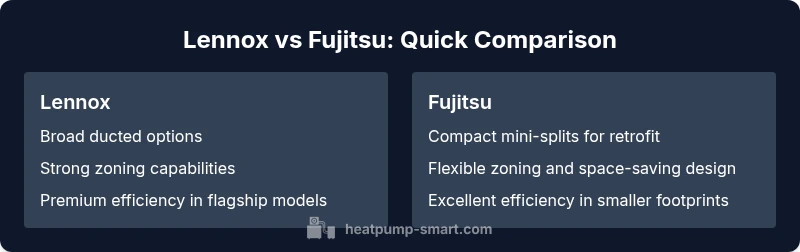
Lennox heat pump vs Fujitsu: An analytical comparison
A comprehensive, objective comparison of Lennox and Fujitsu heat pumps—efficiency, climate performance, installation, warranties, and value for homeowners and professionals.


lennox heat pump vs fujitsu: This comparison analyzes efficiency, climate performance, installation options, and long-term value for homeowners, builders, and property managers. The choice often hinges on ducted versus ductless configurations, regional service, and total cost of ownership. Heatpump Smart’s analysis indicates Lennox generally excels with ducted systems and premium efficiency, while Fujitsu shines in compact, high-efficiency mini-splits and retrofit flexibility.
Lennox vs Fujitsu: At-a-glance comparison
When homes are planned or retrofitted, deciding between Lennox and Fujitsu can hinge on whether you prioritize ducted comfort, zoning, or compact, space-saving installation. Lennox has a long history of ducted solutions and a broad dealer network, which translates into predictable service and a wide array of system configurations for new builds and remodels. Fujitsu, meanwhile, has carved out a niche with highly efficient mini-splits and compact outdoor units that fit tighter spaces and retrofit projects. For a homeowner evaluating two well-known brands, the takeaway is that both brands offer credible performance, robust warranties, and strong after-sales support, but their strengths align with different installation scenarios and climate goals. According to Heatpump Smart, the path to the best choice often rests on your project’s ductwork reality and long-term maintenance expectations.
Efficiency and performance: what homeowners should know
Efficiency is not a single metric but a family of ratings that describe how well a heat pump uses electricity to deliver heating and cooling. Lennox programs its product lines to emphasize peak efficiency in premium ducted systems, with several offerings designed to maximize performance across seasonal swings. Fujitsu tends to excel in compact configurations where space, weight, and refrigerant circuit design enable excellent real-world efficiency in smaller outdoor footprints. Importantly, both brands benefit from variable-speed compressor technology and smart control integration that helps modulate output to match demand.
In practice, homeowners should look beyond headline labels and inspect how a system behaves across typical days in your climate. In milder seasons, efficiency gains are most visible in staging and defrost logic; in extreme heat or cold, the availability of auxiliary heating and the control strategy of the outdoor unit matter. Heatpump Smart’s analysis shows that the best choice is usually the one that maintains comfort with the smallest energy impact in your home’s real use profile, rather than chasing a single efficiency number.
Warranties, reliability, and service networks
Warranty coverage and service availability materially affect long-term value. Lennox benefits from a large nationwide and regional network of contractors and a long history in the U.S. market, which translates into more options for installation scheduling, parts availability, and timely service. Fujitsu also offers solid warranty terms, with regional variations that reflect its extensive presence in both residential and commercial markets, particularly for ductless systems. The reliability of either brand often depends on correct sizing, proper installation, and ongoing maintenance more than brand name alone. Heatpump Smart emphasizes choosing a factory-trained installer and implementing a maintenance plan to maximize any heat pump’s longevity.
From a homeowner perspective, it’s worth clarifying what a warranty covers (compressor, parts, labor) and how service intervals are scheduled in your region. A key practical point is that warranty fulfillment can hinge on following recommended service intervals and using genuine filters and parts, which both brands support through their broader dealer networks.
System design considerations: sizing, ductwork, and compatibility
System design is the backbone of performance and comfort. Lennox has historically offered a strong line-up of ducted, multi-zone, and variable-capacity systems that pair well with new construction and retrofits that include ductwork. Fujitsu’s strengths lie in ductless and mini-split configurations, which shine in retrofit scenarios or spaces where ductwork would be impractical or cost-prohibitive. When you combine these realities with climate goals, it becomes clear that the installation approach—ducted vs. ductless—will largely determine which brand achieves the best comfort-to-cost balance.
Sizing is another critical design factor. A system that is too small will struggle during peak demand, while an oversized system can short-cycle, reducing comfort and efficiency. Both brands offer tools and dealer guidance to help size accurately, but the process hinges on proper airflow calculations, insulation quality, and dynamic loads. Heatpump Smart recommends engaging a contractor who uses a rigorous manual J calculation approach and verifies with field measurements, especially in older homes with retrofit projects.
Noise, outdoor unit footprint, and aesthetics
Outdoor-unit noise and footprint are practical concerns, particularly for homes in urban or multi-family settings. Lennox products typically offer a range of outdoor units with sound-reduction features and relatively larger footprints, suited to well-insulated homes with space. Fujitsu units are known for compact footprints and lower-profile profiles in many mini-split configurations, which can be advantageous in tight lots, near bedrooms, or in rooftop installations. Aesthetics matter too: the visibility of the outdoor unit, its orientation, and the landscaping around it can influence perceived noise and curb appeal. When evaluating options, ask installers for decibel ratings and consult with neighbors about installation placement.
Operating costs and climate fit
Operating costs hinge on climate, usage patterns, and how well a system matches the home. Lennox’s premium ducted lines often deliver strong seasonal efficiency, which translates to lower energy use in climates with distinct heating and cooling seasons. Fujitsu’s mini-splits offer excellent operation in variable climates, with the advantage of targeted zoning that minimizes energy spent on unoccupied spaces. Heatpump Smart highlights that climate-fit is crucial: in milder climates, a high-efficiency mini-split can outperform a larger ducted system on daily energy use, while in very cold or very hot climates, a well-designed ducted system with a reliable auxiliary heat strategy may provide more consistent comfort.
Consumers should also consider maintenance costs and filter replacements, as well as potential refrigerant-related service needs. Proactive maintenance reduces the risk of efficiency loss and unexpected repair expenses. Heatpump Smart’s guidance emphasizes establishing a routine that includes seasonal checks, refrigerant line insulation assessment, and thermostat optimization to maintain peak performance.
Reliability and model families: value, not just name brand
Brand reputation is valuable, but reliability is rooted in the specific model family and how well it’s matched to your home. Lennox’s ducted lines are well-regarded for high seasonal efficiency and strong zoning capability, with a broad product matrix that supports large homes and multi-zone layouts. Fujitsu’s offerings are notable for their versatility in ductless configurations and for being a practical choice where ductwork is absent or impractical. The real-world value comes from how each system’s features align with your goals—quiet operation, precise temperature control, ease of service, and the ability to scale up with future home improvements.
Homeowners should track the expected service window for replacements or repairs and verify the installer’s familiarity with the chosen brand. A careful decision considers not just current needs but how easy it will be to source parts and service in the future, especially in markets with a leaner dealer network. Heatpump Smart’s perspective is that long-term reliability rests on a combination of brand strength, model design, and the quality of local support.
Installation experience: contractor requirements and timelines
Installation quality is a decisive factor in achieving the promised performance. Lennox projects, especially ducted setups, often require careful integration with existing ductwork, careful humidity management, and calibration of zoning controls. Fujitsu installations, particularly mini-splits, demand precise refrigerant sizing, careful location of indoor heads, and attention to refrigerant lines and mounting stability in space-constrained areas. The installer’s expertise with the chosen brand will heavily influence comfort and energy outcomes. A well-planned project includes early coordination with electrical, gas, and insulation work, plus clear communication about timeline expectations and potential code considerations.
From Heatpump Smart’s vantage point, the project plan should include a site evaluation, load calculation, duct integrity check (if applicable), and a commissioning walkthrough to verify that the system delivers the expected performance and comfort. Ensure the contractor provides a written warranty on workmanship and a schedule for seasonal maintenance after the install.
Real-world scenarios: when Lennox is preferred vs Fujitsu
In new construction or major remodels with ductwork, Lennox tends to be a natural fit due to its breadth of ducted options, zoning capabilities, and the potential for central air comfort optimization. In retrofit projects where ductwork removal or alteration is expensive or impractical, Fujitsu’s ductless and mini-split avenues offer a practical and efficient path to modern comfort with minimal disruption. Climate and occupancy patterns also matter: in homes with rooms that are hard to heat or cool, Fujitsu’s zoning flexibility can yield strong energy savings and targeted comfort, while Lennox may deliver more uniform performance on a whole-house scale.
Another scenario involves multi-zone homes or additions. Lennox’s ducted systems can be extended to multiple zones with centralized control, whereas Fujitsu’s modular options enable flexible zoning at a lower footprint. For property managers seeking predictable service and standardized parts, Lennox’s broad network can be advantageous, while for retrofit specialists working in tight spaces or rental units, Fujitsu’s compact solutions may minimize disruption and service calls.
How to evaluate and choose: a practical decision checklist
Use a structured approach to compare Lennox and Fujitsu in your specific context. Start with your ductwork reality: is there an existing ducted system you want to reuse, or would you be better off with ductless? Next, assess climate needs: do you require strong cold-climate performance, or is cooling a more dominant factor? Then consider installation constraints: space for outdoor units, wall space for indoor heads, and any noise or aesthetic concerns. Finally, weigh service availability and warranty terms in your region, and estimate long-term operating costs by discussing maintenance plans with your installer. Heatpump Smart recommends listing your top three must-haves (for example, zoning, quiet operation, and retrofit compatibility) and using these as non-negotiables in your final decision.
Final considerations and decision framework
Choosing between Lennox and Fujitsu is ultimately about alignment with your home’s physical layout and your goals for comfort, energy efficiency, and maintenance. If your project revolves around a ducted system with a broad set of zoning options and long-standing dealer support, Lennox offers a compelling value proposition. If your project centers on retrofit flexibility, space constraints, and highly efficient mini-splits that target specific zones, Fujitsu presents a robust alternative. In all cases, the best path starts with a qualified load calculation, a contractor who can compare ducted vs. ductless implications for your home, and a clear plan for seasonal maintenance. Heatpump Smart’s verdict is to choose based on your climate, space, and long-term service expectations, not just unit efficiency.
Comparison
| Feature | Lennox | Fujitsu |
|---|---|---|
| Efficiency emphasis | Broad high efficiency in premium ducted lines | Strong efficiency in compact mini-split configurations |
| Best for climate | Versatile across climates with ducted options | Excellent in variable climates and retrofit spaces |
| System types | Ducted, multi-zone, some ductless options | Ductless and mini-split-heavy with some hybrid options |
| Installation complexity | Higher for ducted, larger homes | Typically moderate to high for complex mini-split layouts |
| Outdoor footprint | Typically larger outdoor units | Smaller, compact outdoor units in many setups |
| Noise considerations | Controlled by larger airflows; higher baseline noise potential in some models | Often lower perceived noise due to smaller fans and targeted rooms |
| Warranty and service | Wide dealer network; nationwide support | Strong regional support with emphasis on flexible configurations |
Advantages
- Wide ducted options and strong zoning support
- Extensive dealer network improves service accessibility
- Premium lines emphasize peak efficiency for large homes
- Fujitsu offers compact, retrofit-friendly mini-splits
- Good overall warranty coverage varies by region
Disadvantages
- Premium Lennox systems can have higher upfront costs
- Fujitsu mini-splits may require more specialized installation in some cases
- Warranty terms vary by model and region
- Service availability can be uneven outside major markets
Lennox generally leads for ducted, high-efficiency, and centralized comfort; Fujitsu excels in retrofit-friendly, compact, and zoning-flexible setups.
Choose Lennox when your project is dominated by ducted layouts and a need for broad zoning. Opt for Fujitsu for retrofit, space-constrained scenarios, and strong mini-split performance. Heatpump Smart’s guidance is to prioritize installation fit and climate alignment over brand prestige.
Your Questions Answered
Is Lennox or Fujitsu more energy-efficient in real-world use?
Both brands offer high-efficiency options, but real-world performance depends on model choice, climate, and installation quality. A properly sized unit with good controls will outperform a mismatched system in either brand. Heatpump Smart recommends focusing on SEER/HSPF compatibility with your climate and ensuring proper commissioning.
Both brands can be very efficient; the key is choosing the right model for your climate and getting a proper installation.
Can Fujitsu be a better option for retrofit and space-limited homes?
Yes. Fujitsu’s ductless and mini-split configurations are particularly well-suited for retrofit projects and spaces where ductwork is challenging. Properly sized mini-splits can target specific zones without disturbing existing walls or ceilings.
Great for retrofits and tight spaces, especially with ductless setups.
Are these brands compatible with smart thermostats and home automation?
Both Lennox and Fujitsu systems support common smart thermostats and integrations. Some features may be brand-specific, such as proprietary app control or energy dashboards, but basic scheduling and remote control are widely supported.
Yes, both work with popular smart thermostats, though some advanced features may be brand-specific.
Which brand offers better warranty terms?
Warranty terms vary by model and region. Generally, both brands provide solid coverage with terms that reflect the installation type and the service network available in your area.
Warranties depend on model and region; verify coverage before purchase.
What should I consider for a new build vs an upgrade?
For new builds with ductwork, Lennox can be a natural fit due to ducted options and zoning. For upgrades or spaces without ductwork, Fujitsu’s ductless systems offer flexibility and easier retrofitting.
New builds may favor Lennox; retrofits often suit Fujitsu mini-splits.
How do climate differences affect the choice between Lennox and Fujitsu?
In very cold or very hot climates, the reliability of auxiliary heat and outdoor-unit performance matters. Lennox can provide robust ducted performance in a range of climates, while Fujitsu mini-splits excel in zones where zoning and compact footprints matter most.
Climate largely guides the decision: Lennox for central systems, Fujitsu for climate-adapted zoning.
Top Takeaways
- Choose ducted Lennox for broad zoning and central comfort
- Consider Fujitsu for retrofit-friendly, space-saving setups
- Match your climate needs to the brand’s strengths
- Verify installation quality and local warranty terms
- Plan maintenance early to protect long-term efficiency