bosch heat pump vs lennox: Side-by-Side Comparison
Compare Bosch and Lennox heat pumps across efficiency, cost, warranties, and service networks. This analytical guide helps homeowners, builders, and property managers choose the right unit for climate, space, and budget.


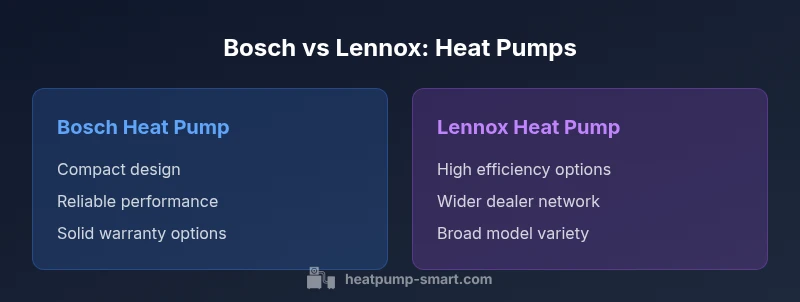
bosch heat pump vs lennox: Lennox generally offers higher efficiency models and a broader service network, while Bosch emphasizes compact design and reliable performance. Your choice hinges on climate, installer availability, and total cost of ownership over the system’s lifespan.
Bosch vs Lennox: Brand Positioning and Design Intent
Bosch and Lennox approach home heating from distinct angles that reflect their design philosophies and market focus. Bosch tends to prioritize compact, space-saving heat pumps with dependable, steady performance—an appealing proposition for retrofit projects or installations in tight mechanical rooms. Lennox, by contrast, leans into a broader model lineup and a stronger emphasis on premium efficiency, comfort features, and an expansive dealer network. According to Heatpump Smart analysis, both brands pursue energy efficiency and reliability, but the means differ: Bosch emphasizes compactness and consistency, while Lennox leverages scale and advanced control options. For homeowners and property managers, the installation context matters most—space availability, local service coverage, and the long-run value of the equipment in your climate. A quick takeaway: Bosch serves tight spaces with reliable results; Lennox offers breadth and high-end comfort when the setting supports it. Heatpump Smart’s team recommends mapping your conditions against model selections before asking installers for a quote.
Key Performance Differences: Efficiency, Capacity, and Comfort
Performance is where the Bosch vs Lennox comparison becomes nuanced. Lennox typically provides a wider range of high-efficiency models and advanced compressor technology that can deliver strong heating and cooling comfort across many climates. Bosch focuses on reliable operation in compact footprints, with heat pumps designed to fit smaller mechanical rooms and simpler retrofits. Both brands employ inverter-driven compressors, variable-speed controls, and smart thermostats that tune performance to occupancy patterns. When evaluating options, it helps to compare energy-use projections in the context of your home’s size, insulation, and typical occupancy. Seek installer-provided charts that translate efficiency labels into expected monthly energy use rather than relying on a single rating. In extreme climates, Lennox may offer models with stronger performance at low temperatures, while Bosch excels in spaces where installation constraints limit equipment size. The takeaway: match the model to your house and climate, then validate with a professional load calculation.
Reliability, Warranty, and Service Networks
Warranty terms and service coverage influence long-term satisfaction as much as on-paper efficiency. Lennox models often come with strong warranty options on premium lines and the benefit of a broad dealer network that can simplify maintenance in many regions. Bosch also offers solid warranties and emphasizes dependable components, especially for compact units that must endure tight spaces and frequent cycling. Beyond the warranty, the presence of a robust service network matters: timely maintenance reduces downtime and protects performance year after year. For property managers juggling multiple units, prioritize brands with readily available parts and trained technicians in your area. Ask installers for a maintenance plan that includes system checks, refrigerant diagnostics, and filter changes. A strong warranty plus accessible service yields the best total-cost-of-ownership outcome, regardless of brand.
Cost of Ownership: Purchase, Installation, and Operating Costs
Total cost of ownership depends on system size, installation complexity, and regional labor markets. Lennox models sometimes carry higher upfront prices, driven by premium materials, advanced controls, and a broader dealer footprint, but may deliver greater energy savings over time in suitable climates. Bosch options can be attractive for retrofit projects due to compact design and potentially lower installation labor, which can translate to lower upfront costs. Neither brand guarantees a fixed payback period; the value emerges when the unit is correctly sized for your home and paired with appropriate insulation and usage patterns. When you receive quotes, ask for apples-to-apples comparisons that include upfront costs, estimated annual energy use, and expected maintenance expenses. Be mindful of rebates and incentives that vary by locale—these can materially affect the net cost. In short, a well-matched, properly installed unit from either brand will outperform a poorly matched system.
Installation Considerations: Sizing, Compatibility, and Refrigerants
Installation quality is critical to realizing a heat pump’s potential. Begin with a precise load calculation to determine the appropriate capacity, avoiding oversizing or undersizing. Lennox and Bosch installations benefit from technicians familiar with each brand’s control systems and components, but local expertise will vary. Look for technicians with current certifications and proven experience with the selected brand, plus easy access to genuine parts. Evaluate compatibility with existing ductwork, zoning, and any heat-recovery features you plan to use. Refrigerant compatibility is another practical concern—confirm that the chosen model aligns with regional codes and your current system’s refrigerant type. Finally, consider a long-term service plan that includes regular inspections, refrigerant checks, and diagnostics. A thoughtful, climate-appropriate installation plan maximizes either Bosch or Lennox’s value, minimizing comfort gaps and energy waste.
Comparison
| Feature | Bosch Heat Pump | Lennox Heat Pump |
|---|---|---|
| Efficiency range | Compact design with reliable efficiency | Broad range of high-efficiency models |
| Model variety | Smaller lineup focused on space-saving options | Extensive lineup across configurations and sizes |
| Warranty coverage | Region/model-dependent warranties | Varies by model/region with strong options |
| Dealer network | Smaller national footprint, selective markets | Wider dealer network and service coverage |
| Installation considerations | Space-efficient installs; may require specific mounting | Flexible integration with many home layouts |
| Noise and comfort features | Reliable operation with steady noise levels | Advanced comfort controls and quiet operation in many models |
| Price/value context | Potentially lower upfront costs in retrofit projects | Higher upfront price, but potential for greater energy savings |
Advantages
- Helps homeowners compare two reputable brands side by side
- Highlights key differentiators like efficiency and service networks
- Clear guidance on when each brand is preferable
- Supports informed decision with objective criteria
Disadvantages
- No single winner; outcomes depend on climate and installer
- Brand-specific bias may exist in some markets (availability varies)
- Warranty terms vary by model and region
- Quotes can vary widely by installer; compare apples to apples
Lennox edges Bosch on efficiency and installer availability; Bosch remains a strong option for compact designs and predictable performance.
If you prioritize peak efficiency and broad service coverage, Lennox is typically the stronger choice. If space constraints and consistent performance in tight spaces drive your decision, Bosch deserves serious consideration.
Your Questions Answered
Which brand typically offers higher efficiency heat pumps, Bosch or Lennox?
Lennox generally provides more high-efficiency options, though Bosch delivers reliable performance in compact designs. Your climate and system sizing ultimately determine the best fit.
Lennox usually offers higher efficiency options, while Bosch emphasizes reliable, compact performance. Climate and sizing matter most.
Are Bosch heat pumps compatible with Lennox systems?
Bosch and Lennox units are designed to operate with their own components and controls. In most cases, mixing brands in a single system is not standard and requires careful professional evaluation.
Typically, you don’t mix Bosch and Lennox components in one system; consult an installer for any mixed-brand setup.
Which is cheaper to install, Bosch or Lennox?
Installation costs vary by model, home, and region. Bosch options can be less expensive to install in retrofit projects due to their compact size, while Lennox may incur higher upfront costs but offer broader efficiency options.
Costs depend on size and site; Bosch may be cheaper upfront in some retrofits, Lennox often costs more but may save more over time.
What factors should homeowners consider when choosing between Bosch and Lennox?
Consider climate, home size, insulation, dealer availability, energy costs, and warranty coverage. Evaluate quotes based on size-appropriate performance and projected operating costs.
Climate, home size, insulation, and local dealers are key. Compare expected operating costs and warranty terms.
Do Bosch heat pumps generally have better warranties than Lennox?
Warranty terms vary by model and region for both brands. Always review the specific unit’s warranty and what it covers in your locale.
Warranty varies by model and region; check the exact coverage for your unit.
Top Takeaways
- Assess climate and space to narrow brand fit
- Compare model variety and efficiency options side by side
- Evaluate local dealer network for service reliability
- Ask for a transparent cost breakdown with incentives