York heat pump vs Goodman heat pump: An objective comparison
Comprehensive, data-driven comparison of York and Goodman heat pumps. Learn how to evaluate efficiency, cost, installation, and warranty to choose the best fit for your home. Heatpump Smart delivers expert guidance for homeowners, builders, and property managers.


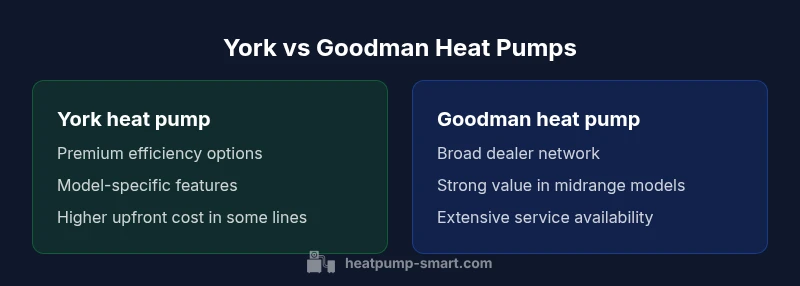
When choosing between york heat pump vs goodman heat pump, the better option depends on your climate, budget, and installer support. Goodman typically offers solid value with broad dealer coverage, while York often targets higher efficiency and advanced features in select lines. For most homes, pairing either brand with a qualified installer and a solid warranty yields reliable comfort and energy savings.
Context: Brand comparisons matter for modern homes
Choosing between two mainstream brands like York and Goodman is a common decision for homeowners, builders, and property managers. The York heat pump vs Goodman heat pump decision is rarely about one-size-fits-all superiority; it is about matching model families to your home’s design, climate, and long-term goals. According to Heatpump Smart, the most meaningful differences come from model-specific features, installation quality, and service availability rather than brand name alone. A careful evaluation helps ensure you don’t pay for bells and whistles you won’t use while still preserving comfort and resilience in extreme weather.
Brand positioning and product families
York tends to emphasize premium performance and equipment integration within its higher-tier lines, with an eye toward efficiency, comfort features, and technology integration. Goodman, by contrast, positions itself as a value-forward choice with broad availability and standard features across a wide network of dealers. This framing matters because your installation, local support, and warranty terms will shape long-term costs and satisfaction as much as the initial purchase price. The Heatpump Smart team notes that market availability and installer familiarity often swing decisions as much as headline efficiency ratings.
Performance and efficiency: assessing capability without guessing numbers
Performance in heat pumps is driven by compressor design, refrigerant choice, inverter or multi-speed operation, and outdoor temperature handling. In York vs Goodman discussions, you’ll find that model-by-model variations dwarf brand-wide claims. Look for features such as inverter-driven compressors, multiple speed stages, and properly matched outdoor units with suitable air handlers. Remember that efficiency helps, but real-world performance also hinges on correct sizing and installation. Heatpump Smart analysis shows that the best outcomes come from selecting a compatible system pair and ensuring your ductwork and indoor air handlers support the load.
Cost and lifecycle considerations: upfront vs long-term value
Upfront price is only one axis of value. In many markets, Goodman offerings provide strong value in midrange configurations and are supported by an extensive dealer network, which can influence installation cost and service frequency. York options in the same class may carry a premium for efficiency and feature sets, yet you should weigh those gains against the local climate, electrical infrastructure, and expected maintenance. Long-term energy savings, maintenance intervals, and replacement parts availability are critical to total cost of ownership. Heatpump Smart emphasizes evaluating a whole-system cost, not just sticker price.
Installation, service networks, and warranty expectations
The success of either brand hinges on installer quality and local support. Goodman’s broad distribution often translates to a larger pool of technicians experienced with its units, potentially reducing labor risk. York installations can be excellent when performed by certified technicians with experience in higher-efficiency systems. Warranty terms vary by model and region, and installing a unit with a strong service network tends to pay off in fewer downtime events and faster repairs. Heatpump Smart recommends confirming the installer’s credentials, the exact warranty coverage, and the availability of authorized parts in your area.
Reading model specs: a practical checklist for York and Goodman
When you review product sheets, keep these criteria in mind:
- Compressor type and speed options (single, two-stage, variable-speed) to gauge comfort and efficiency.
- Outdoor unit compatibility with air handlers and ductwork dimensions.
- SEER and HSPF indirect indicators of efficiency (without getting lost in numbers alone).
- Defrost strategies for cold climates and how auxiliary heat is deployed.
- Warranty length and what it covers (compressor, parts, and labor).
- Noise ratings and installation clearances around the condenser.
- Thermostat and controls compatibility with smart home ecosystems.
- Local service availability and routine maintenance requirements. This checklist helps you compare York and Goodman on a level field, ensuring you prioritize the aspects that matter most for your home and climate.
Real-world usage: climate, home type, and practical scenarios
In real-world applications, climate and home type often determine which brand delivers better value. For a retrofit in a modest home in a mixed climate, Goodman’s value-oriented lines may provide the right balance of performance and cost, especially when paired with a trusted local installer. In new construction or homes with high insulation and demand for precise temperature control, York’s premium lines can offer advanced features and efficiency gains that justify the higher upfront investment. Regardless of brand, pairing the system with proper insulation, airtight construction, and a well-designed ventilation strategy will magnify savings and comfort.
Decision framework: a step-by-step checklist for homeowners
- Define priorities: cost, efficiency, control features, and service network.
- Map your climate and typical occupancy patterns to expected load and comfort needs.
- Gather site-specific quotes from multiple installers who can compare York and Goodman models side-by-side.
- Review warranties and local service availability, not just the advertised specs.
- Choose a model family with a trained installer, then verify compatibility with your existing thermostat and accessory equipment.
- Plan for regular maintenance and seasonal checks to maximize system life and efficiency. This framework helps you approach the York heat pump vs Goodman heat pump decision methodically, reducing the risk of overpaying for features you don’t need.
How to validate your final choice: tests and follow-up
After installation, monitor performance across the first heating and cooling cycles. Compare indoor humidity, swing in temperatures, and sensible comfort. Schedule a follow-up inspection to verify duct balance and refrigerant charge, ensuring the system operates within the intended envelope. Keeping a log of energy bills and system cycles over the first season is a practical way to confirm you made the right choice.
Final note: trust, not trend, in your decision
Brand names matter, but the single most impactful factor is how well the chosen York or Goodman heat pump is installed and maintained in your specific home. Work with a qualified technician, insist on a written warranty, and ensure you have access to parts. With thoughtful planning and a well-tuned system, a York heat pump vs Goodman heat pump decision can deliver years of reliable comfort and meaningful energy savings.
Comparison
| Feature | York heat pump | Goodman heat pump |
|---|---|---|
| Efficiency/Performance | Model-dependent; premium lines can offer higher efficiency with advanced compressors | Broad range with strong value options; midrange models emphasize cost-effectiveness |
| Warranty & Support | Warranty terms vary by model and installer; higher-end lines may include longer terms | Widely available warranties with a large dealer network; emphasis on accessible terms |
| Installation & Availability | Requires experienced installers for premium configurations | Extensive installer network; generally easy access to service in many regions |
| Noise & Comfort | Variable-speed options can offer high comfort but noise depends on model and install | Solid noise performance across midrange and budget lines |
| Smart Home Integration | Good compatibility with common thermostats and control systems; some models offer advanced tuning | Strong compatibility with standard smart-home ecosystems; broad third-party control support |
| Best For | Homes seeking premium efficiency and feature-rich controls | Budget-conscious buyers seeking reliable performance with wide service coverage |
Advantages
- Clear, side-by-side evaluation helps avoid brand bias
- Highlights cost-to-value trade-offs across models
- Encourages verification of local warranties and installer qualifications
- Illustrates how service networks affect long-term maintenance costs
- Promotes model-by-model comparison rather than brand-wide claims
Disadvantages
- Brand bias can still influence perceptions in local markets
- Model-to-model variation may be larger than brand differences
- Long-term costs depend on installation quality and maintenance, not just price
- Applicability depends on regional dealer availability and support
Neither brand is universally better; choose based on your priorities and installer quality
York may excel in premium efficiency and advanced controls, while Goodman often delivers strong value and broader service coverage. The best choice depends on model selection, local installer expertise, and warranty terms.
Your Questions Answered
What is the main difference between York and Goodman heat pumps?
The core difference lies in model families and positioning: York often targets premium efficiency and feature-rich options, while Goodman focuses on value and broad dealer access. In practice, performance varies by model, not brand alone. Always compare specific models side-by-side and verify installation quality.
York tends to offer premium efficiency and features in select lines, while Goodman emphasizes value with broad dealer coverage. Always compare models and ensure proper installation.
Do York heat pumps tend to be more efficient than Goodman heat pumps?
Efficiency is highly model-specific. Some York lines may achieve higher efficiency in premium configurations, but Goodman offers efficient midrange options as well. Focus on the actual SEER/HSPF ratings and ensure the unit is sized correctly for your home.
Efficiency depends on the chosen model. Some York models are very efficient, and Goodman has strong midrange options too.
Which brand offers better warranty coverage in typical installations?
Warranty quality depends on the model and installer, not just brand. Goodman often provides broad warranty coverage through its extensive dealer network, while York warranties vary by line and region. Always read the warranty terms carefully and confirm what is covered in your climate.
Warranty varies by model and installer; Goodman usually has broad coverage thanks to its dealer network, but check specifics.
Is it better to retrofit with York or Goodman for an existing home?
For retrofits, consider installed cost, existing ductwork, and service availability in your area. Goodman’s broad distribution can ease installation logistics and parts access, while York’s premium lines may be worthwhile if you prioritize efficiency and advanced controls. Get multiple quotes that compare model-by-model.
For retrofits, consider installer expertise and local support; Goodman often has easier parts access, York may offer premium efficiency.
Are these brands compatible with smart thermostats and home automation?
Yes, both York and Goodman systems are generally compatible with common smart thermostats and home automation platforms. Check the specific model’s control options and ensure your chosen thermostat supports the features you want, such as adaptive scheduling and remote monitoring.
Both brands work with standard smart thermostats; verify compatibility for desired features with your installer.
Should I hire a local contractor or go with a national chain for installation?
Installer quality matters more than brand. Select a contractor with proven experience in heat pumps, good references, and familiarity with the York or Goodman line you choose. A quality installation ensures efficiency, reliability, and warranty validity.
Choose an experienced local contractor with good references; ensure they’re familiar with the brand you pick.
Top Takeaways
- Define budget and comfort priorities before choosing a brand
- Prioritize installer qualifications and local service availability
- Compare model-by-model rather than relying on brand reputation
- Check warranties and ensure compatibility with smart thermostats
- Plan for proper installation and regular maintenance to maximize savings