California Heat Pump Rebates in 2026: A Practical Guide
Understand how California heat pump rebates work, who qualifies, and how to stack incentives with federal credits in 2026. Learn a practical planning approach with Heatpump Smart, plus tips to maximize your savings.


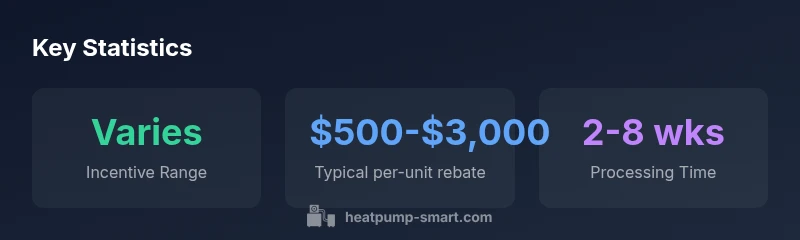
According to Heatpump Smart, California heat pump rebate programs vary by utility and project type, with incentives ranging from a few hundred dollars up to several thousand dollars per unit. The Heatpump Smart team notes that combining state, utility, and federal incentives can boost savings. Verify eligibility and deadlines with your utility before purchasing.
How California rebates work in 2026
The California heat pump rebate landscape is a patchwork of programs funded by state agencies and local utilities. These incentives reward energy-efficient upgrades that replace older heating equipment with heat pumps, improving comfort while reducing energy use. Because programs are administered by different entities—state agencies, investor-owned utilities, and energy providers—the amount, eligibility, and deadlines vary by location and program type. The result is an incentive mosaic rather than a single statewide program. For homeowners, builders, and property managers, the key is to map out all eligible streams early and coordinate with a qualified contractor. Heatpump Smart analysis shows that most participants reduce upfront costs when they combine multiple eligible incentives, such as utility rebates and federal tax credits. As with any incentive program, eligibility can hinge on system specifications, home size, and existing insulation, so a pre-installation assessment is essential to maximize the california heat pump rebate potential.
Eligible equipment and qualifying programs
Eligible equipment typically includes air-source heat pumps for space heating and cooling, and heat pump water heaters (HPWH). Some programs require minimum efficiency targets and compliance with regional standards. In addition to equipment type, programs often consider home characteristics, installation quality, and verified performance data. Contractors are usually required to participate in program pre-approval or provide documentation showing energy savings potential. Because rules differ by utility and region, it’s essential to review both state guidance and your local utility’s program details. Heatpump Smart recommends verifying which incentives apply to your specific equipment and project scope before purchasing.
How to verify eligibility and apply
To maximize your california heat pump rebate, start by identifying all eligible programs offered by your utility and the state. Gather documentation such as contractor quotes, equipment specifications, and proof of installation readiness. A pre-installation assessment or energy audit can help confirm eligibility and optimize energy savings. Your contractor should assist with the required forms and applications, while homeowners should keep copies of all approvals, invoices, and correspondence. After installation, submit final paperwork and wait for funds to arrive; processing times vary but are often several weeks. Maintaining clear records helps with future renewals or audits.
Regional variations and utility specifics
California’s vast geography means rebate offerings differ by region. Northern California programs may mirror those in the Bay Area, while Southern California options differ across investor-owned utilities like PG&E, SCE, and SDG&E. Local programs may offer additional incentives for weatherization, insulation, or smart thermostat integration. Because programs frequently update, homeowners should check the CPUC database and their utility’s energy efficiency portal for current eligibility criteria, caps, per-unit limits, and stacking rules. Heatpump Smart stresses that the strongest savings emerge from a coordinated plan across multiple programs rather than chasing a single grant.
A practical planning approach for homeowners
Plan a staged approach: (1) perform a pre-install energy assessment, (2) select a qualifying heat pump system with contractor input, (3) identify all eligible incentives, (4) submit pre-approval requests, (5) complete installation, (6) file final rebate paperwork and any applicable tax credits. Keeping a calendar of deadlines and documentation helps ensure you don’t miss opportunities. Create a single project notebook with product specs, contractor licenses, permit numbers, and receipts. This proactive process reduces delays and improves your overall energy savings, which is the real payoff of pursuing a california heat pump rebate.
Maximizing total savings: practical tips and considerations
- Start early to lock in incentives and understand stacking rules.
- Choose equipment with high efficiency and reliable performance to maximize rebates and long-term energy savings.
- Work with an experienced contractor who can handle required documentation and pre-approval steps.
- Combine utility rebates with federal tax credits where eligible, while respecting program caps.
- Keep thorough records of all permits, receipts, and confirmations in case of audits or later rebates.
- Consider timing your upgrade with other efficiency improvements, such as insulation, to further reduce energy use and qualify for additional incentives.
Comparison of rebate programs and incentives
| Program Type | Eligibility | Incentive Range |
|---|---|---|
| State/Utility Programs | Residential customers meeting program criteria | $500-$3,000 |
| Federal Tax Credit (ITC) | Tax credit via IRS Form 5695 | 30% of system cost (subject to IRS rules) |
Your Questions Answered
What California programs qualify for rebates on heat pumps?
Multiple programs are offered by utilities and state agencies. Eligibility varies by location and equipment; check with your local utility and the CPUC database for current offerings.
California offers several utility and state programs; eligibility depends on location and equipment, so check with your utility.
Can rebates stack with federal tax credits?
In many cases, utility rebates can be combined with the federal Investment Tax Credit (ITC). Verify current stacking rules for your specific programs and file accordingly.
Utility rebates can often stack with federal ITC; confirm the rules for your programs.
Do heat pump water heaters qualify for California rebates?
Many programs cover heat pump water heaters (HPWH) when they meet program requirements. Always check your utility’s list of eligible equipment.
HPWHs are commonly eligible where programs apply; confirm with your utility.
How long does it take to receive rebates after installation?
Processing times vary by program and region, typically ranging from a few weeks to a couple of months after submission of all required documents.
Processing usually takes weeks to a couple of months depending on the program.
Are there income or location-based restrictions for rebates?
Some programs consider location, utility service area, or property type; most common restrictions are program eligibility and proof of installation rather than income level.
Most rebates depend on location and eligibility rather than income, but check specific program rules.
“The ability to combine incentives can significantly reduce upfront costs while improving home comfort and efficiency.”
Top Takeaways
- Check multiple California programs before purchasing
- Stack incentives where allowed to maximize savings
- Start early—rebates have deadlines and documentation
- Work with a knowledgeable contractor to manage paperwork
- Keep copies of all receipts and approvals for audits