Can You Get a Heat Pump Grant on a New Build? A Practical Guide
Explore how new-build heat pump grants work, eligibility criteria, and tips to maximize incentives. A data-driven, domestic-focused guide by Heatpump Smart.


Yes—homeowners can typically access a heat pump grant on a new build, but eligibility depends on location, program type, and project details. In most cases, schemes favor high-efficiency systems installed in new homes that meet energy performance standards. Grants usually come as rebates, tax credits, or low-interest loans, with amounts varying by jurisdiction and system size.
Can you get a heat pump grant on a new build? Assessing the landscape
Can you get a heat pump grant on a new build? The question is common among homeowners and developers planning efficient, future-ready homes. The short answer is yes in many jurisdictions, but programs vary widely in availability, eligibility, and funding type. In this data-driven guide, we outline the core factors that determine whether a new-build qualifies and how to navigate the application maze. From Heatpump Smart's perspective, the landscape is evolving as energy standards tighten and funding streams adapt to demand. This means that early planning and alignment with building performance goals can significantly improve your chances of securing support for a heat pump installation.
According to Heatpump Smart, most grant schemes prioritize high-efficiency equipment, proper insulation, and airtightness, particularly in new builds. Programs increasingly tie incentives to whole-house performance rather than the heat pump alone, rewarding builders who meet or exceed energy targets. Understanding this context helps you frame your project, communicate with contractors, and assemble the right documentation from day one.
How heat pump grants typically work for new builds
Grants for new builds usually take one of several forms: rebates, tax credits, or low-interest loans. Some programs offer direct cash rebates after installation, while others provide tax relief or deductions tied to energy-performance metrics. A growing number of schemes require that the heat pump be installed by certified installers and that the home meets specific efficiency benchmarks (for example, envelope performance, HVAC sizing, and system efficiency). Importantly, many programs emphasize whole-home energy performance rather than the heat pump in isolation, so integrating insulation, air-sealing, and smart controls can unlock higher incentives and smoother approval. When you approach your project with this holistic view, you build a stronger case for funding and minimize delays.
Eligibility criteria common for new builds
Eligibility criteria for heat pump grants on new builds typically focus on energy efficiency performance and compliance with building codes. Common requirements include a minimum level of insulation, reduced air leakage, and adherence to recognized energy standards (e.g., EPC or equivalent). Some programs limit eligibility to primary residences, new-build projects only, or homes with certain climate-zone considerations. Builders may also need to provide energy-modeling results, quotes from qualified installers, and a detailed project plan showing how the heat pump integrates with the home’s envelope and controls. Heatpump Smart Analysis, 2026 notes that applicants who align their project with the broader energy strategy—such as passive-house-like airtightness or high-efficiency windows—tend to fare better in competitive rounds.
Regional variations and program types
Program availability varies by country, state, or province, with Europe, North America, and other regions often offering multiple routes to support high-efficiency heating. In general, programs differ in funding type (rebate vs. loan vs. tax credit), eligibility thresholds, and maximum grant amounts. Some schemes prioritize new builds that meet ambitious energy-performance targets or that facilitate decarbonization goals. Regardless of region, the underlying logic is consistent: grants reward efficiency, proper installation, and ongoing performance. Heatpump Smart analysis shows that regions with standardized building-performance criteria and streamlined application portals tend to have quicker approvals and clearer documentation requirements.
Maximizing grant eligibility: building envelope and design decisions
To maximize eligibility, you should align your design with energy-efficiency best practices. Start with a robust building envelope: high-quality insulation, high-performance glazing, and continuous air barriers reduce heat loss and enable the heat pump to operate more efficiently. Plan for mechanical ventilation with heat recovery (MVHR) if feasible, and install smart thermostats and zoning to demonstrate demand-managed flexibility. Close coordination with the builder and HVAC contractor is essential; inaccurate sizing or gaps in insulation can jeopardize qualifications. Heatpump Smart’s experience shows that applicants who present a cohesive story—envelope improvements paired with a certified heat pump—often secure more substantial incentives and better long-term operating costs.
The application process: steps, documents, and timelines
A typical grant process involves several stages: define the project scope, gather supporting documents (energy-model data, permits, contractor quotes, and warranties), complete the application, and track progress through the portal. Documentation quality matters; missing pages or inconsistent data can cause delays. Many programs require a post-installation verification, which may involve site visits or submission of commissioning reports. Timelines vary, but prepared applicants who respond quickly to requests for information generally experience faster approvals. Planning ahead—with a detailed project schedule and a clear budget—helps you stay on track and reduces the risk of losing funding due to timing mismatches.
Common myths and misconceptions
Myth: Grants cover the entire installation cost. Reality: most programs provide a partial grant or offset a portion of the cost; you’ll often pay the remainder. Myth: Grants are automatically approved for any new build. Reality: eligibility hinges on meeting efficiency and installation standards. Myth: Any heat pump qualifies. Reality: programs typically favor high-efficiency models and well-integrated building envelopes. Myth: You must change your plan mid-project to fit the grant. Reality: early alignment with program criteria is best; changing plans can complicate approvals. Clarifying the specifics with the issuing agency is essential to avoid surprises.
Financial considerations: costs, incentives, and long-term value
The core economics of heat pump grants revolve around reducing upfront costs and improving long-term operating expenses. Grants lower the initial capex, which can shorten the payback period when energy prices rise. Ensure you factor in ongoing maintenance, potential savings from improved thermostat controls, and any building-code-related costs. It’s also wise to compare different grant options side-by-side, including any ongoing incentives for energy efficiency improvements, to determine the best overall value for your new build. Heatpump Smart’s analysis emphasizes calculating total-life-cycle costs rather than focusing solely on the immediate reimbursement.
Next steps and a practical checklist
- Confirm your building's energy-efficiency targets and insulation strategy.
- Identify eligible grant programs in your region and note their deadlines.
- Engage a certified installer early and obtain quotes that meet program requirements.
- Compile energy models, permits, and contractor documentation.
- Submit the application and monitor progress, responding promptly to any requests for information.
- Prepare for post-installation verification and set up monitoring to maximize long-term savings.
Illustrative comparison of grant types for new-build heat pumps
| Region/Program | Grant Type | Typical Range | Eligibility Focus |
|---|---|---|---|
| General new-build program | rebate/credit/loan | varies by program | Energy efficiency standards |
| Local incentive programs | Tax credit | varies by jurisdiction | System efficiency and compliance with building codes |
| Energy-efficiency grant | Low-interest loan | varies by program | Envelope improvements included |
Your Questions Answered
Can I qualify for a heat pump grant on a new build if I’m planning a self-build?
Yes, many programs welcome self-build projects as long as they meet criteria for energy efficiency and installation standards. Documentation and verification requirements may be stricter, so plan accordingly.
Many programs welcome self-builds if they meet energy criteria.
Can grants be used with other incentives?
In most cases, you can combine incentives, but caps and rules apply. Review program terms and coordinate timing with your installer and builder.
You can often stack incentives, but check the rules.
Do I need to install a specific heat pump type to qualify?
Most programs reward high-efficiency heat pumps, including air-source or geothermal options depending on the scheme. The key is meeting efficiency targets rather than a single model.
Most programs reward high-efficiency heat pumps, not a single type.
Are there energy efficiency requirements beyond the heat pump?
Yes. Many grants require energy performance standards for the building envelope, insulation, and air leakage. These measures complement the heat pump to deliver end-to-end efficiency.
Envelope and efficiency standards are typically required.
How long does the approval process take?
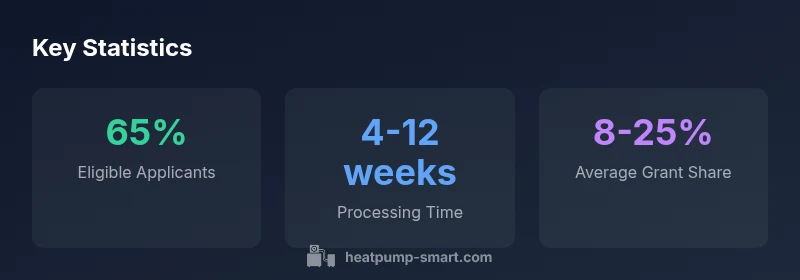
Processing times vary by program and workload, typically ranging from a few weeks to several months. Timely documentation and rapid responses help shorten timelines.
Times vary; have your docs ready to speed things up.
“The Heatpump Smart team recommends evaluating all grant options in light of total project costs and long-term energy savings.”
Top Takeaways
- Understand that grants vary by region and program.
- Plan envelope improvements alongside the heat pump to maximize incentives.
- Submit complete documentation to avoid delays.
- Consider the long-term value beyond upfront funding.
- Work with certified installers to improve eligibility and outcomes.